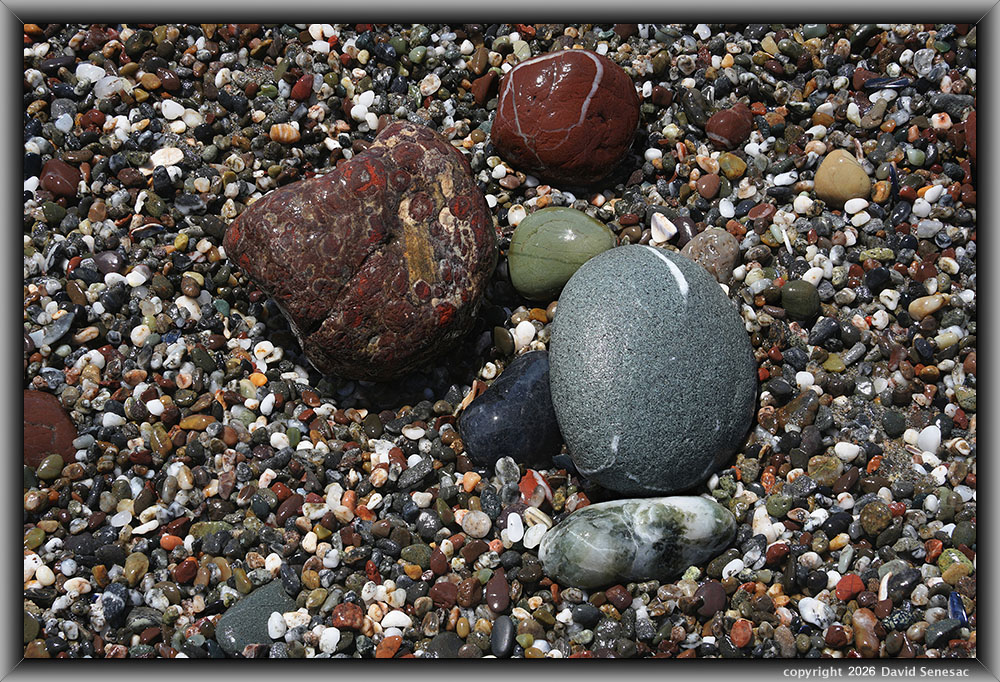
VQ09094-18h 6150x4100 pixels 1 frame 25 shot focus stack blend a6700 56mm
enlarged vertical slice view image text section
NEXT: Page 10 Ebbetts Pass 6/30
2026 Trip Chronicles: Contents
Sonoma Coast State Beach 5/20
After returning from the long day trip the week before up to Sonoma Coast State Beach, I decided to do a second trip since tides would be at their most extreme levels of the year that I expected shore waves would erode off the covering layers of sand I had found on that trip. Tuesday late afternoon had been out enjoying live music, freestyle dancing, and then, didn't retire till 1:30am. With a short night's sleep, I was then awake at 6:30am PDT on Wednesday May 20, 2026 and despite being a bit groggy, decided to go through the motions of packing up gear then getting on the road that happened at 9:23am PDT. On I280, a Caltrans tree cutting truck had flipped over near Palo Alto causing a 50 minute delay. Thus, reached my destination an hour later than expected at 12:03pm PDT that then required another 20 minutes to reach the remote mélange geology beach of interest.
Peak high tides occur at night during new moons. On May 17 at Fort Ross, a bit north of this beach, that was 6.5 feet at 11:26pm Pacific Standard Time when the Moon was 0% visible because the alignment of Earth to Moon to Sun was on the same gravitational line that has maximum pull on our ocean waters. (Note, David dislikes Daylight Savings Time because it is unnatural, unbalanced, for outdoor activities.) The Moon is nearly invisible because we only see that opposite side from the Sun direction. Conversely, peak low tides are a bit after sunrise and on May 18 that was at 6:49am PST at -1.8 feet, a tidal range of 8.3 feet. Each succeeding day, the peak tides are about 50 minutes later with ranges lower.
For California tides, SaltWaterTides dot com link
On this May 20, the high tide at 6.0 feet was at 1:09am PST and low tide at -1.4 feet 8:37am PST (9:37am PDT) that is a better time of day with sunlight than sunrise to actually do things at maximum low tides like hunt abalone or poke poll fish for monkeyface prickleback eel. With rocky shore stone photography at this temperate 38.3 degrees North latitude, the most saturated rock colors occur when sunlight is more directly above, that then more deeply enters into often translucent stone surfaces before being reflected, that then can provide additional light to glow from within. The same phenomenon as with colorful fall tree leaf landscape photography that is best mid day.
The daytime high tide on May 20 would be at 2:51pm PST (3:51pm PDT) but only to 4.5 feet because the Earth is then between the Moon and Sun while still being in a direct line. Ideally, I would have been at the beach by about 10am PST when the sun altitude is high enough to result in best stone colors. Stone photography is better during an incoming high tide versus moving towards a low tide, because the wet zone is regularly being refreshed to a natural wet look including places any persons may be stepping. Additionally, better stone photography is on mostly sunny days without heavy marine overcast or fog. And once locating a good subject, the exact orientation versus the sun can make a huge difference. So, once I locate a potential stone subject, I'll circle it while moving about at different heights to see how that affects color and saturation.
After reaching the 1700 foot long beach, well after an ideal earlier time, I could see plenty of chert mélange geology stone piles were now too low in the wave wash zone to be able to work without getting myself wet. Walking a bit south, then all the way north, I found most still workable wet stone piles were north and that some of the best piles would soon be submerged.
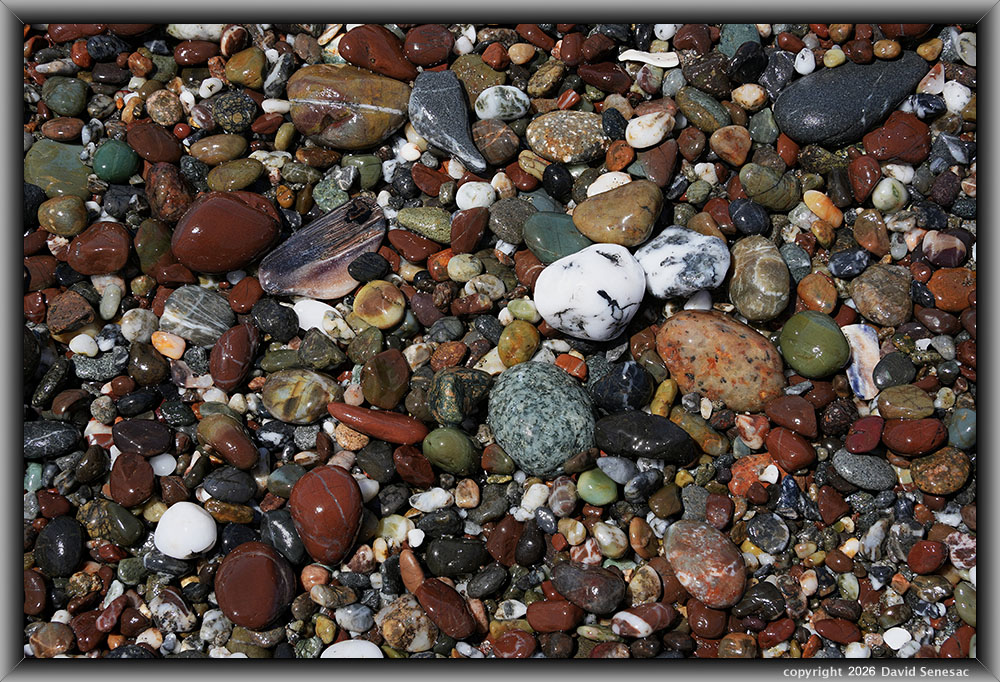
VQ08947-64h 6150x4100 pixels 1 frame 18 shot focus stack blend a6700 56mm
enlarged vertical slice view
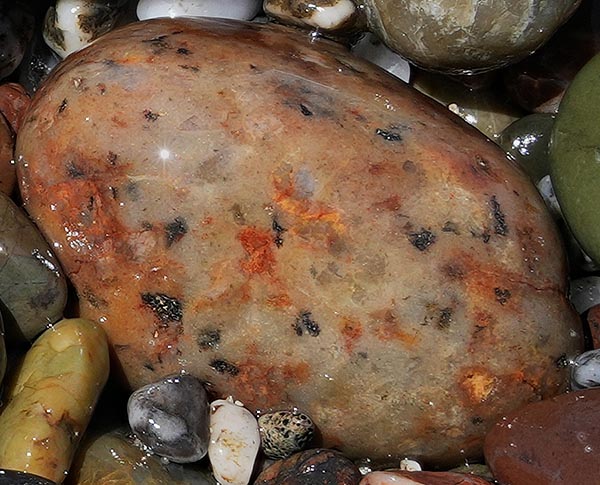
I worked the above first subject of the day at 12:48pm PDT, that was one of the piles soon to be submerged. I've worked such subjects occasionally for so many years, that has refined my visual aesthetic sense, that I can just look down at large areas of stones and consciously sense when aesthetics are strong at small rectangular areas without consciously looking for anything specific. However, more often I primarily look for larger strongly aesthetic anchor stones to frame around. The above is a case of the former. The most common non-stone elements are pieces of mussel shells, with a large flat piece at bit left of frame center. At frame top right is a wavy rectangular piece of white shell from some mollusk. At center lower right is a nicely oval rounded piece of granite. To its right is an interesting similar oval piece from some confetti like iron oxide rust within igneous rock with its close-up above right on this web page. The black flecks are probably biotite mica or amphibole in both stones. Select the enlarged vertical slice view below any of these stone image to understand how aesthetic these subject look near full detail.
I was using my Oben tripod with its panoramic head setup instead of the usual, more flexible at low height for close-up work, old Benbo tripod, because the small ballhead on my Benbo can no longer be easily tightened without a wrench as polytetrafluoroethylene, PTFE, in the ballhead mechanism to clamp tighter against ages. So, I will soon buying another small ballhead. The Prime Directive in this photography game is NEVER allowing salty seawater on one's expensive camera regardless of waterproofing. So a pocket with a dry cotton rag and dry paper towel sections is important as splashings will inevitably sometimes occur.
Incoming waves this afternoon were larger than normal that adds an added danger to the activity of being accidentally soaked while concentrating on working a camera. I was wearing usual Levi 505 jeans with my expensive waterproof Zamberlan backpacking hiking boots, gaiters, and kneepads. So I was safe, from up to shin high waves. What one really needs, haha, is a non-photography spotter person, watching incoming waves. Note I also for many years, have worn kneepads in the field and also even on trails when backpacking in the Sierra Nevada, as I am quick to get down close to ground level. Almost all work on these beaches was while kneeling on sand or stones with my tripod in various low positions.
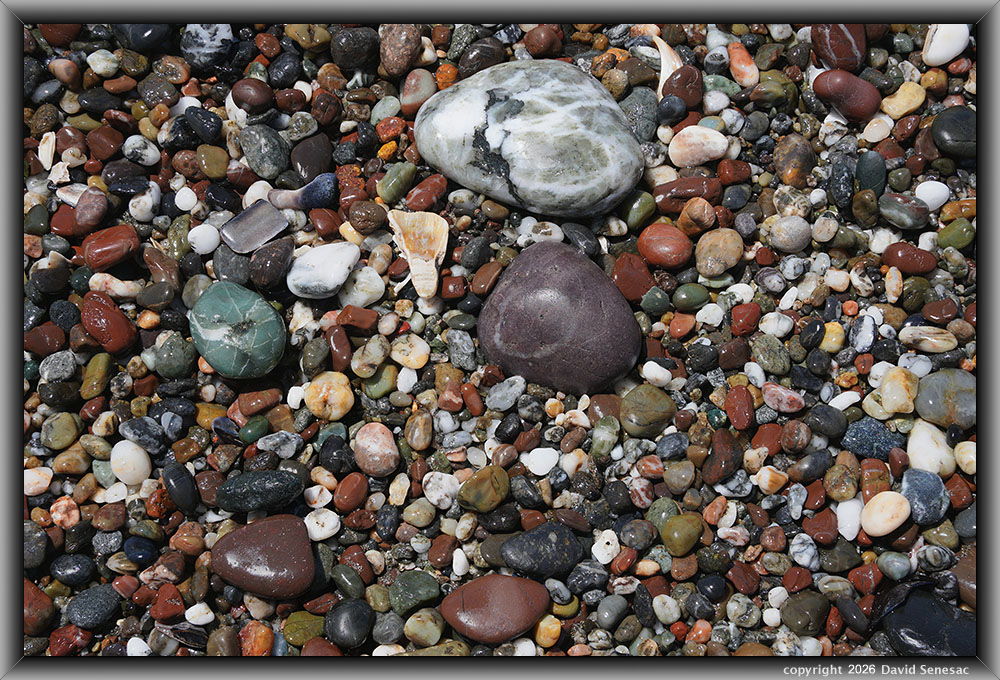
VQ09044-68h 6150x4090 pixels 1 frame 25 shot focus stack blend a6700 56mm
enlarged vertical slice view
Twenty minutes later after continuing to check out what was north on the beach, returned south some, and at 1:08pm worked this above frame using the large white stone with gray inclusions as an anchor. Many of the stone surfaces, including that of the large purple stone, were already evaporating off their last layer of wave wash seawater, so are not as shiny. As an aesthetic positive, that also reduces the amount of specular highlights. Just to its left is a piece of white, hard rubbery like, kelp holdfast that anchors kelp to rock. As to the nature of the pretty cyan hued, oval cabochon shaped stone frame center left:
Google AI: Vibrant cyan, blue, and green chert on the Sonoma Coast is part of the geologic mélange of the Franciscan Complex. These striking colors are caused by trace amounts of reduced (non-oxidized) iron trapped in the silica. The coast is littered with these ocean-scoured pebbles. Most Franciscan chert in Northern California is famously brick red due to oxidized iron. However, in subduction zones where high pressure and low temperatures occur (creating rocks like blueschist), the iron is reduced. This chemical process leaves the silica colored in various shades of vibrant aqua, cyan, and deep green.
At page top, image VQ09094-18h.jpg, a half hour later at 1:39pm, featured an exceptional, bizarre reddish purple anchor stone with inclusions, that I was regularly checking on while walking back and forth. The above grouping occurred just seconds after a wave washed over the stones and then moments after the shutter completed the exposure, I quickly grabbed my tripod with a6700 atop, and leaped higher up the sandy beach as a wave chased me. The adjacent light green stone and tear-drop shaped pastel stone frame upper right are perfect, nearly already polished stones for a rock tumbler.
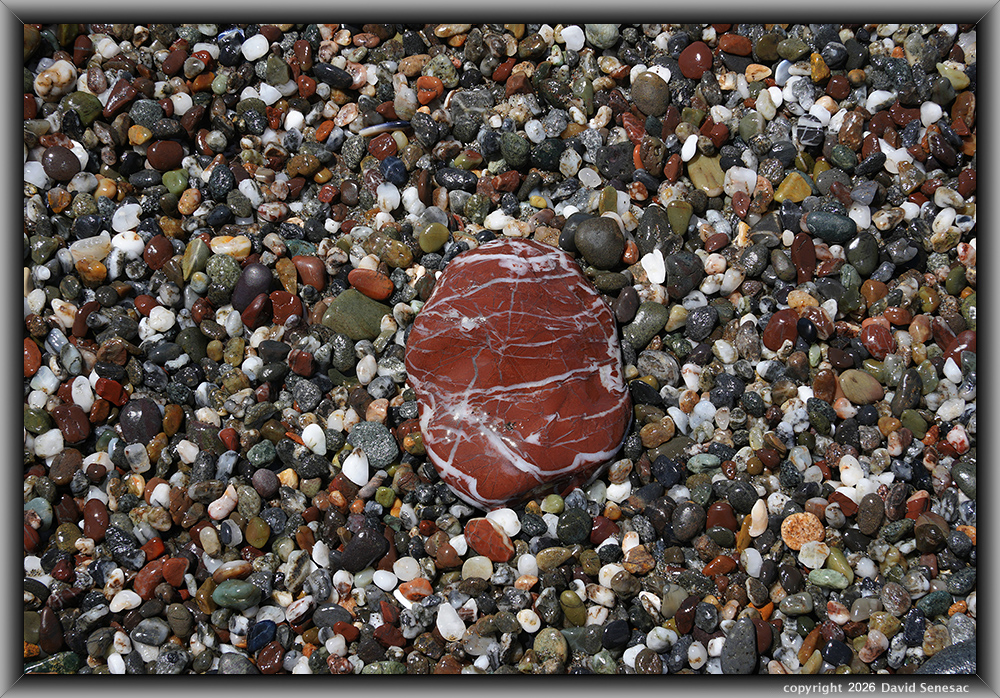
VQ09144-65h 6000x4100 pixels 1 frame 22 shot focus stack blend a6700 56mm
enlarged vertical slice view
Quickly afterward at 1:41pm, another beautiful anchor stone, I'd also been regularly eyeing, finally wave wash landed in a nice spot that I then pounced on quickly with my tripod. This is the more common Franciscan Complex chert that gem folks would term jasper. One should note, how there is often considerable time between each of these shots. There are a few lower aesthetic subjects I worked but are not herein shown. More often, I am just very picky about what I will work because I've done this over so many years, so already have a great deal of strong material, well beyond what has been posted in my chronicle pages. The more years one is a serious outdoor photographer, the fewer potential better subjects than what one already has in one's body of work, will exist. So, I spend a lot of time carefully slowly, looking looking looking moving around.
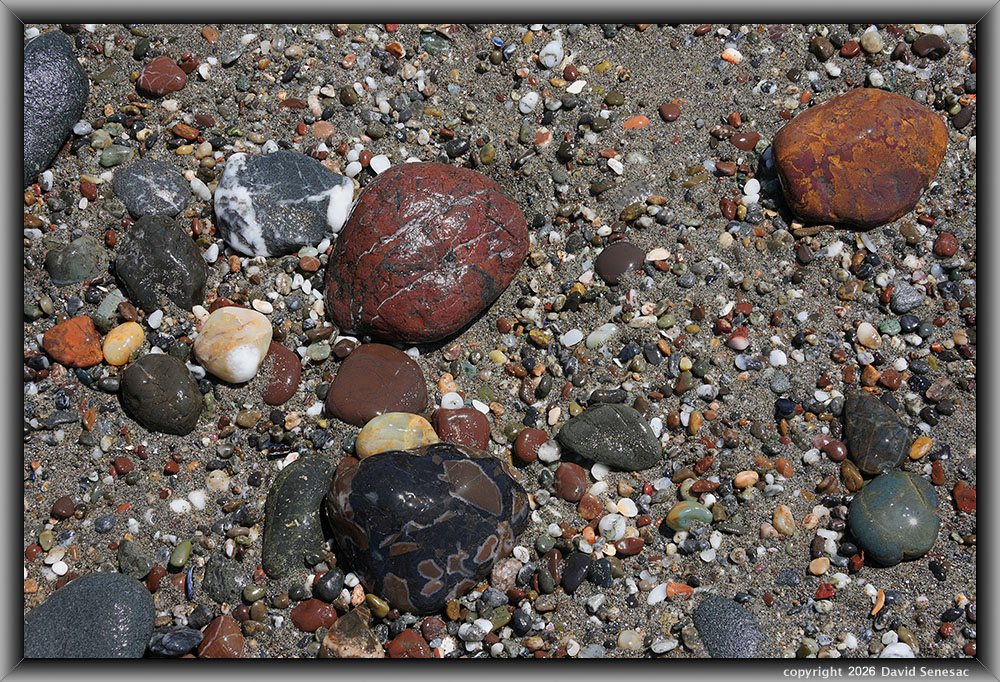
VQ09244-63h 6150x4100 pixels 1 frame 20 shot focus stack blend a6700 56mm
enlarged vertical slice view
Some of the best subjects occur within a group of isolated stones within a sand matrix. In the above image at 2:03pm, are several larger anchor level stones. Frame lower center, the large black stone with brown inclusions surrounded by white quartz, is particularly unusual.
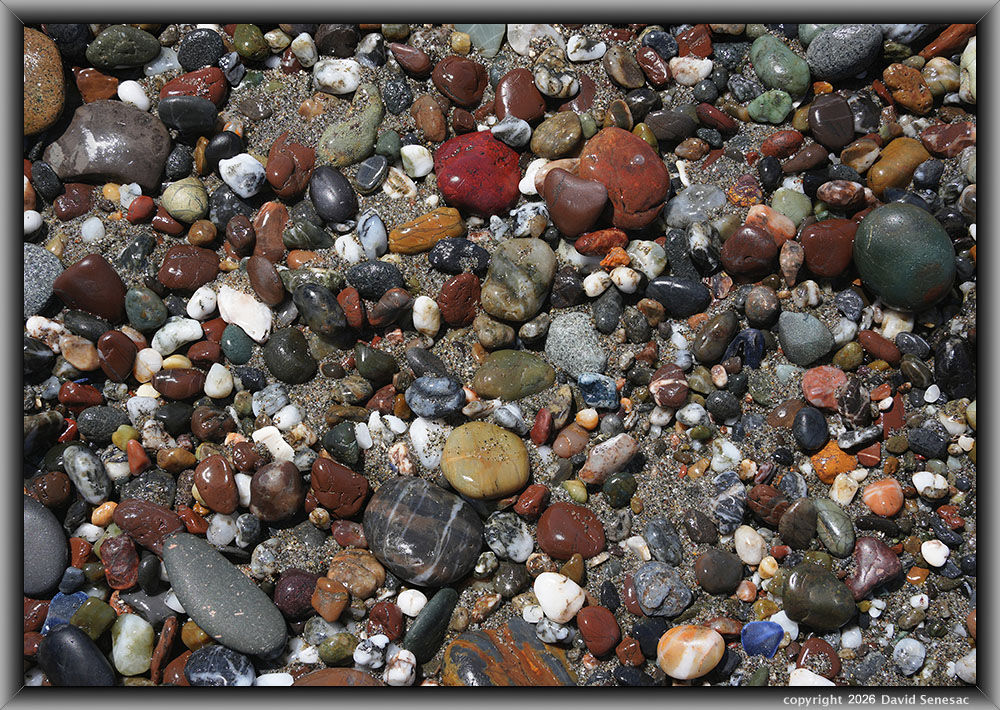
VQ09294-08h 5900x4100 pixels 1 frame 15 shot focus stack blend a6700 56mm
enlarged vertical slice view
At 2:12pm, worked this above group of stones, with at frame center, the small bright red stone, chert jasper, an eye-catching anchor. The below image of crops at 67% full pixels of this VQ09294-08h.jpg image, shows how each one of these images at full detail is much more interesting.
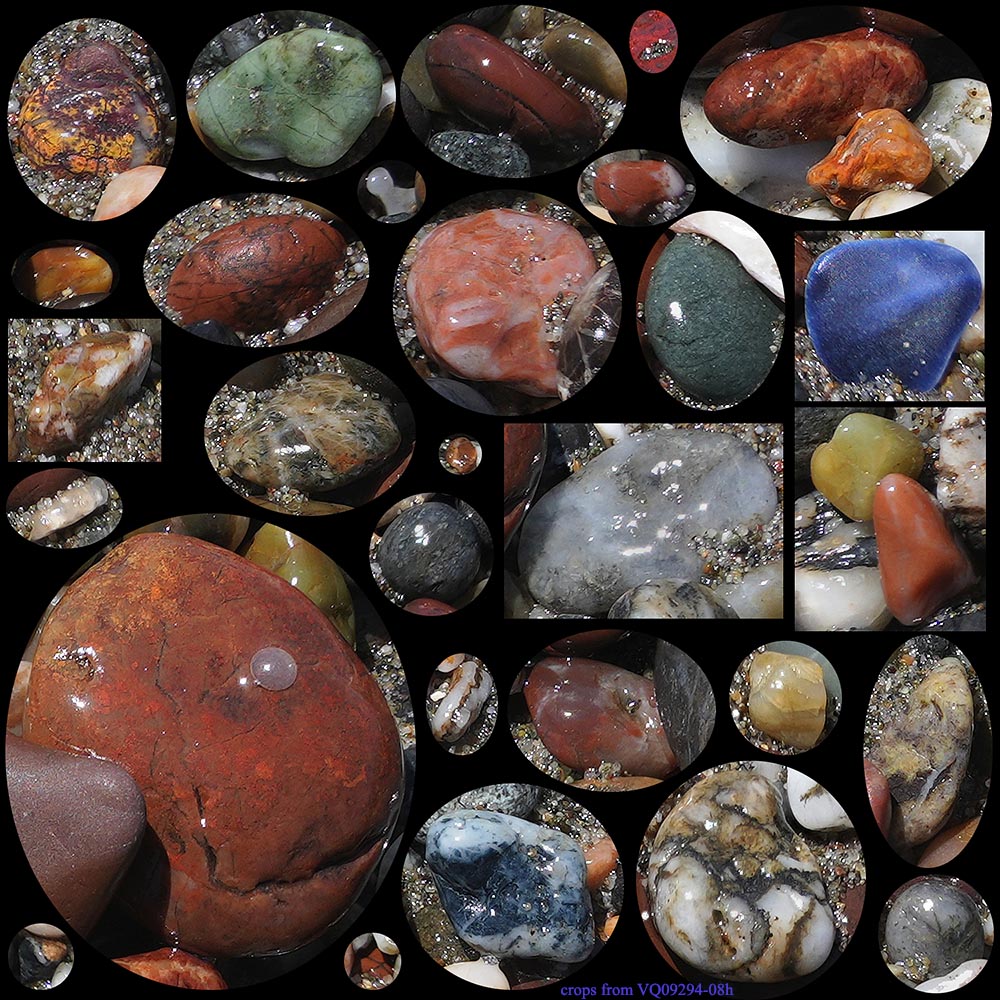
The blue stone frame upper right edge, is from part of a mussel shell. Just below left, is a translucent quartz stone with the sand below showing through, that could be termed an agate. Frame corner lower left, is a large red stone with a seafoam bubble. At frame top right, the red oval is a crop from the upper center bright red stone with sand in a small pit. To its lower left is part of a small quartz stone with a head with 2 specular highlights that make it look like eyes on a ghost's head. I also like how frame lower edge center quartz stone has such a nice blue hue.
VQ09344-67h 6150x4100 pixels 1 frame 24 shot focus stack blend a6700 56mm
enlarged vertical slice view
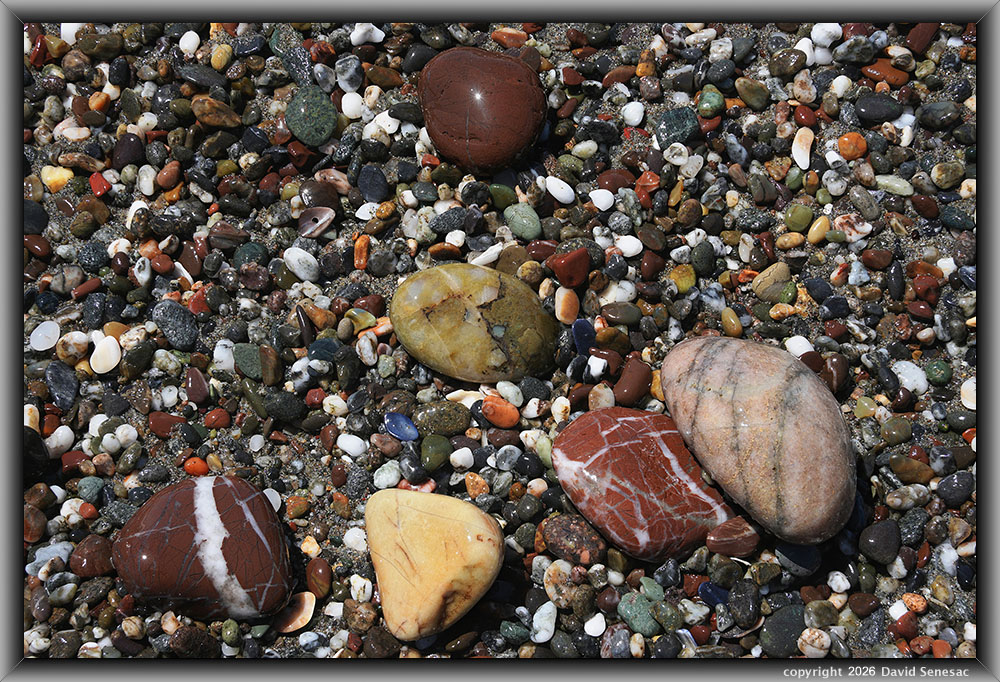
By this time, most of the lower stone piles were now under water with larger stones from below being wave wash pushed higher onto the beach. At the same time, some areas of the dry upper beach that had been buried under sand, were now uncovering a few new stone piles. This next above image at 2:15pm, has several excellent larger stones around a group of darker than usual smaller stones within a fair amount of sand. My basic framing effort was to reasonably geometrically balance the large stones aesthetically within the rectangular frame. Another group of larger stones, already ready for polishing in a rock tumbler.
VQ09444-65h 6150x4100 pixels 1 frame 25 shot focus stack blend a6700 56mm
enlarged vertical slice view
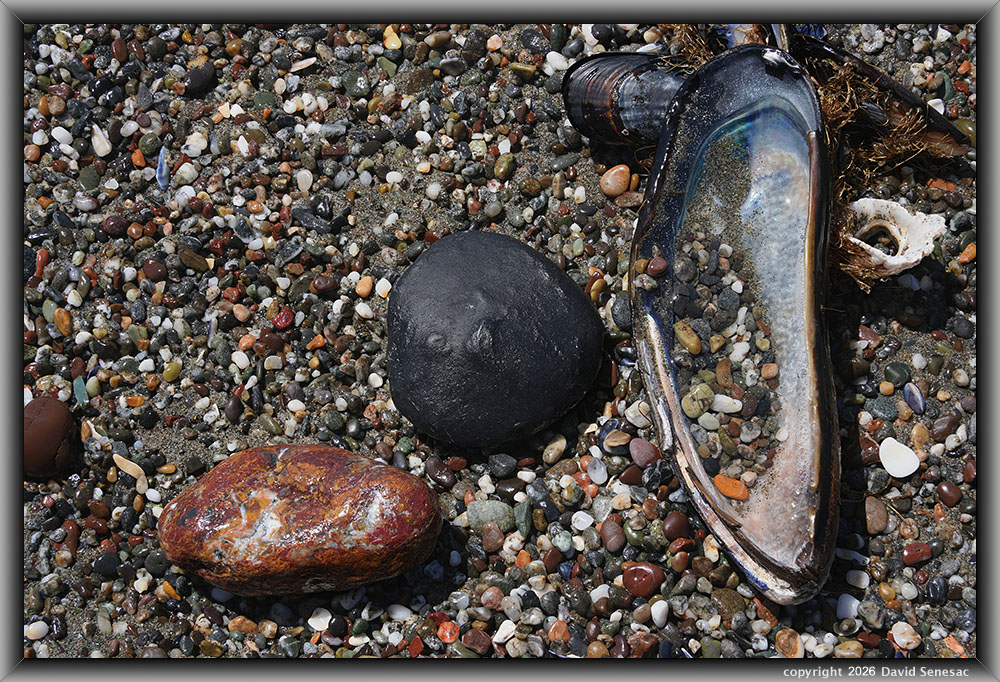
This above image at 2:31pm, shows half a seawater filled large mussel shell about 6 inches long with pebbles and sand inside. Above attached, are small closed mussels that were detached when the large mussel became detached. It was apparently anchored near a kelp holdfast, the white structure at frame right, that may have been what really came loose first. The image is strongly enhanced by the colorful frame lower left oblong chert stone. The tangle of byssal threads are used by mussels to attach to rock, other mussels, and whatever else is nearby. Byssal threads are as strong as Kevlar and can stretch. One weird feature is the ability of a mussel to instantly release all the byssal threads. This YouTube video link explains how amazing these threads are:
Youtube video link to mussel byssal threads.
VQ09494-14h 6150x4100 pixels 1 frame 22 shot focus stack blend a6700 56mm
enlarged vertical slice view
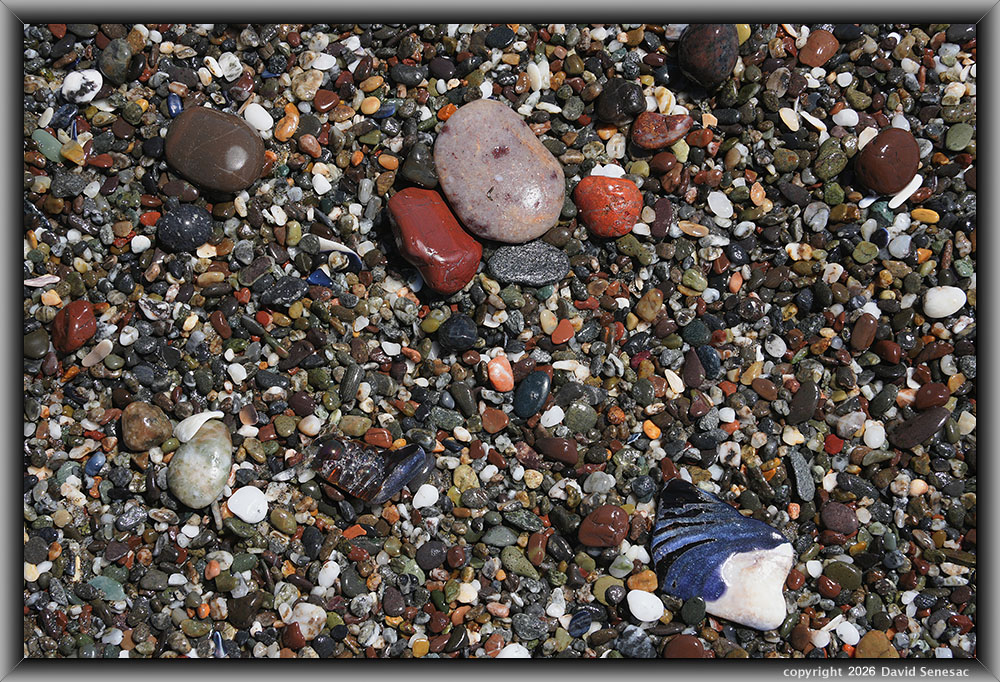
Then at 2:35pm, worked this geometrically weak rectangular frame. Note the bright vermillion red jasper. The frame has many mussel shell pieces, including one frame lower left center with many seafoam bubbles atop as a wave had just washed across the subject. Select the enlarged vertical slice view to better understand how intensely brightly saturated some of these gemstone quality stones can be.
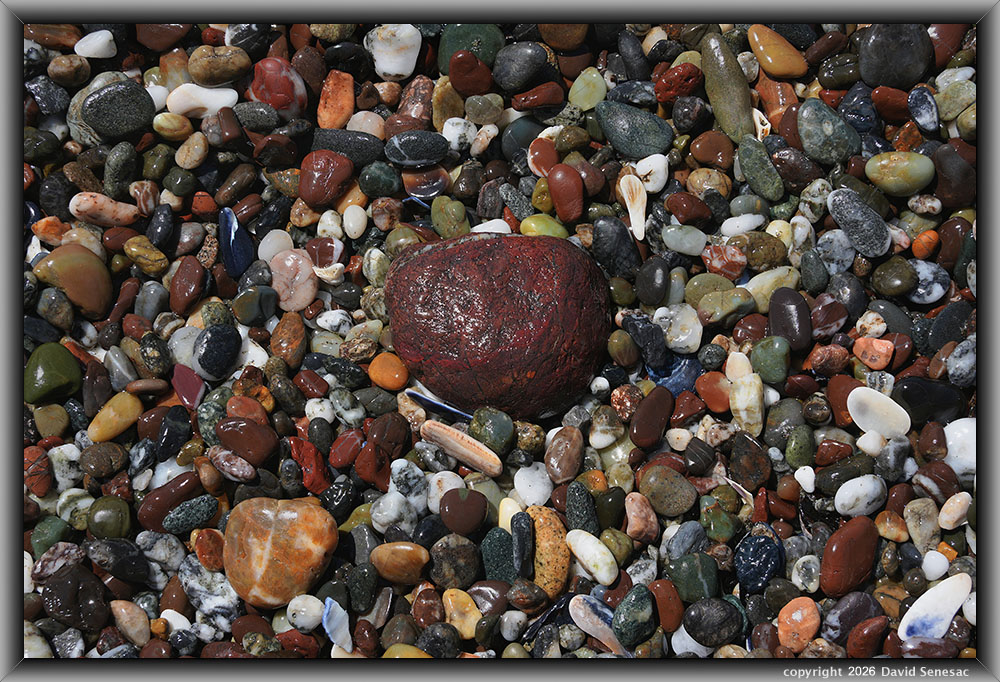
VQ09515-34h 6150x4100 pixels 1 frame 20 shot focus stack blend a6700 56mm
enlarged vertical slice view
At 2:51pm, worked the above piece of red chert but with a bumpy surface. The black elements between the red quartz, must oxidize out faster than its surface can be polished in the stony surf mix. The frame has an unusual number of aesthetic small stones.
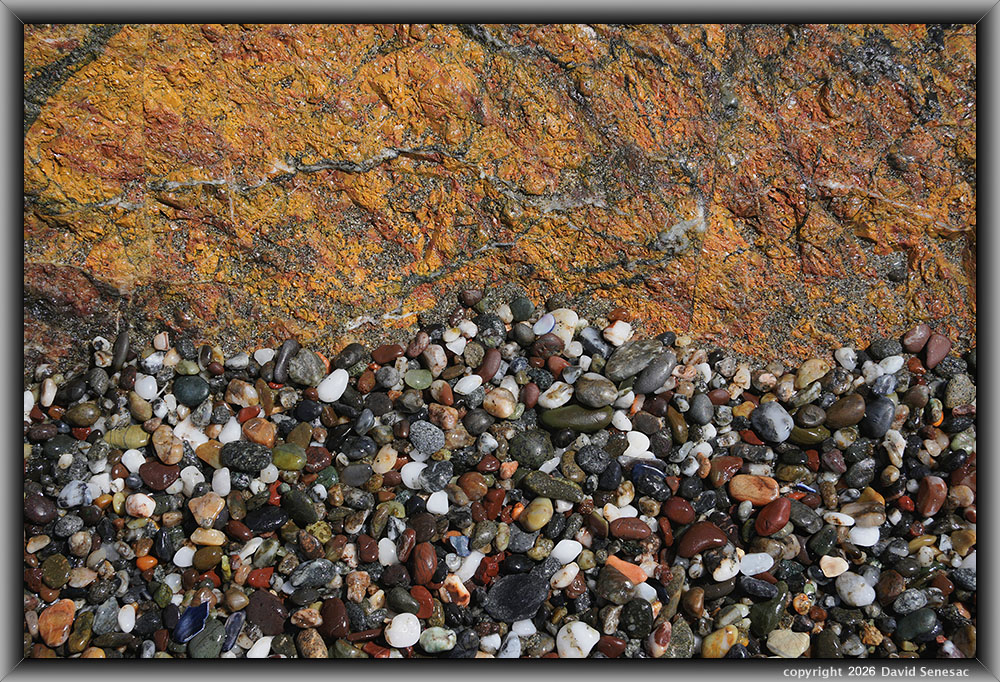
VQ09565-77h 6150x4100 pixels 1 frame 13 shot focus stack blend a6700 56mm
enlarged vertical slice view
This image at 2:55pm shows stones up against a larger light orange chert boulder. The boulder was lower in the wash zone that I struggled to set up a few times while abandoning the spot as waves washed in. The tendency on incoming high tides is to gradually push smaller stones and sand higher up the shore side faces of such immobile heavy boulders.
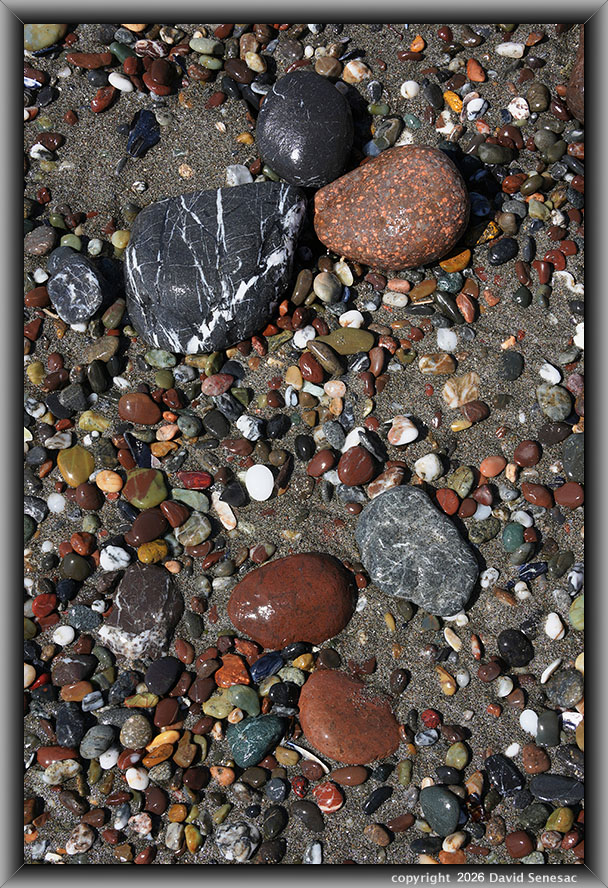
VQ09615-30v 4100x6150 pixels 1 frame 16 shot focus stack blend a6700 56mm
enlarged vertical slice view
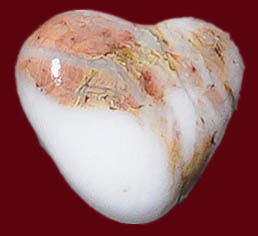
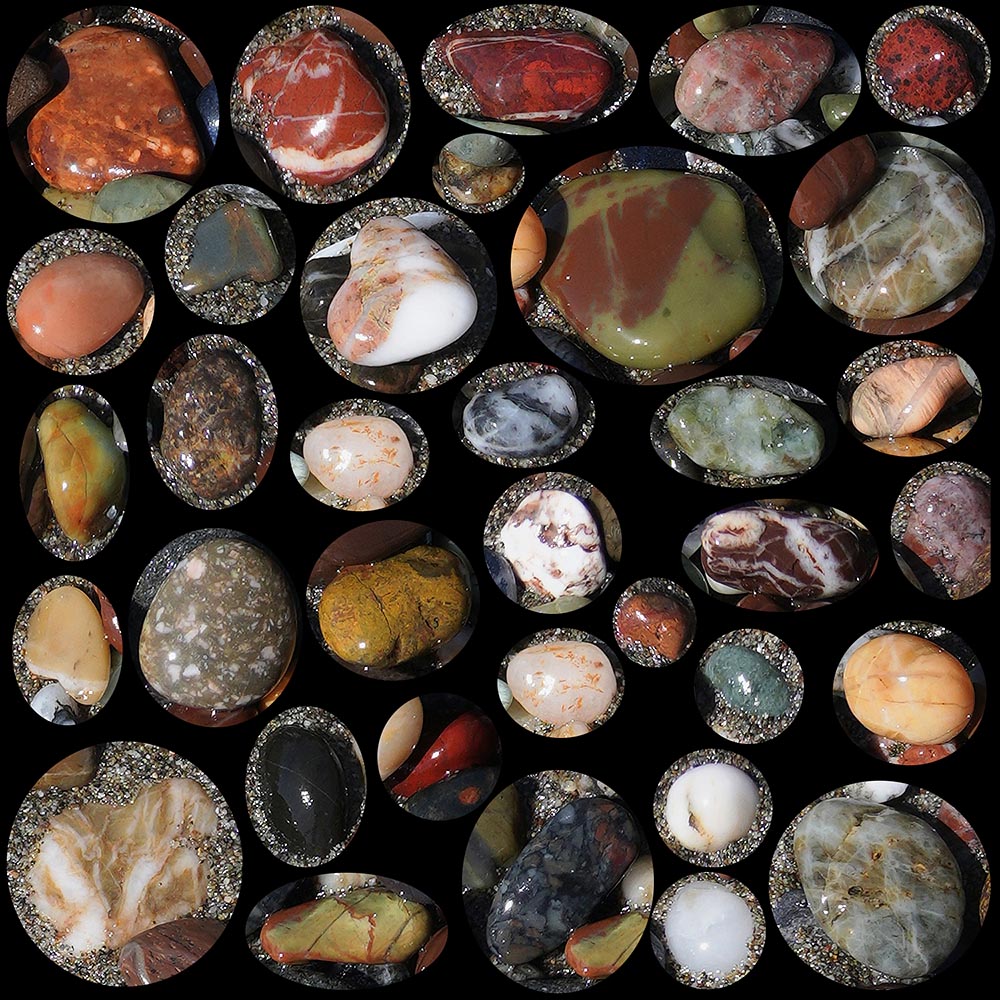
High tide had maxed out and the sun was getting noticeably lower in altitude creating more shadows between stones. I took a half hour break higher on the beach in the shade of a large boulder, eating a yogurt and blueberry muffin. Then back down at the wet zones, worked a final vertical orientation image above at 3:52pm. The below, is another group of single stone 67% pixel crops, from just this above VQ09615-30v.jpg. Frame center mid right, is the heart shaped white rock I cropped out, rotated, and added a dark red surrounding to for the small image near page top.
NEXT: Page 10 Ebbetts Pass 6/30
2026 Trip Chronicles: Contents











