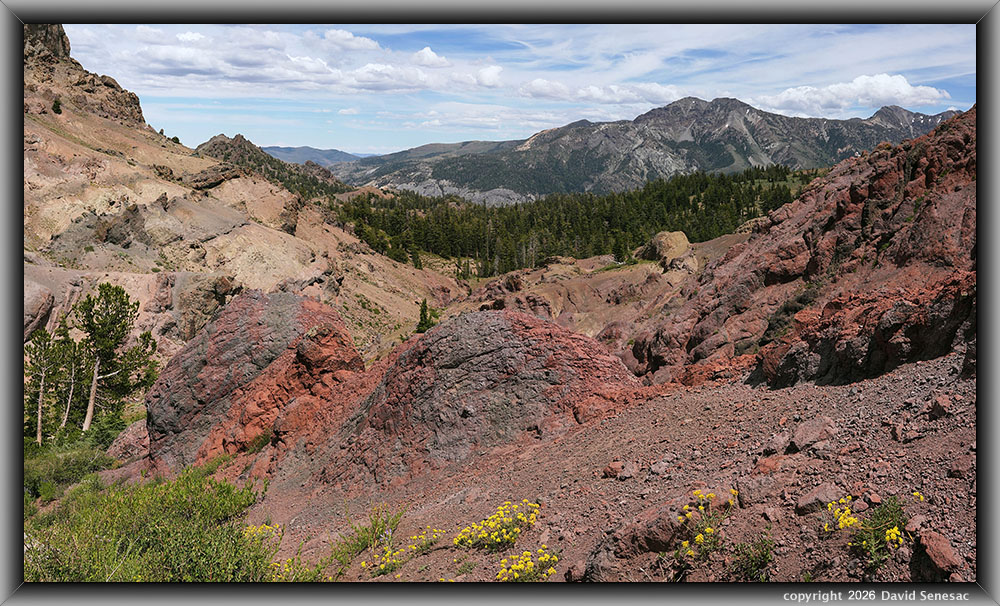
VR09955-09980-3x1v 9200x5400 pixels 3 column 1 row 3 frame 26 shot focus stack stitch blend a6700 17:40mm at 21.1mm
enlarged vertical slice view image text section
NEXT: Page 11 TBD
2026 Trip Chronicles: Contents
Ebbetts Pass 6/30
Ebbetts Pass 7/1
Ebbetts Pass 7/2
On Tuesday June 30, 2026 at 9:23am PDT, I drove out eastward against the weekday commute from my Santa Clara County residence, across the Central Valley, onto highway SR4, then up into the Sierra Nevada. By early afternoon I reached Ebbetts Pass at 8732 feet and continued a bit east. These Stanislaus National Forest areas have numbers of 4WD roads including some not on any maps where one can legally disperse camp. Although the Pacific Crest Trail, aka PCT, runs through this section, because it does not contain any lakes between the pass and Raymond Lake, very few thru hikers given a dominant lakeitis attitude, bother to plan camping within the zone. Ironic, because in early summer, it is arguably one of the most aesthetically impressive PCT trail sections north of Yosemite.
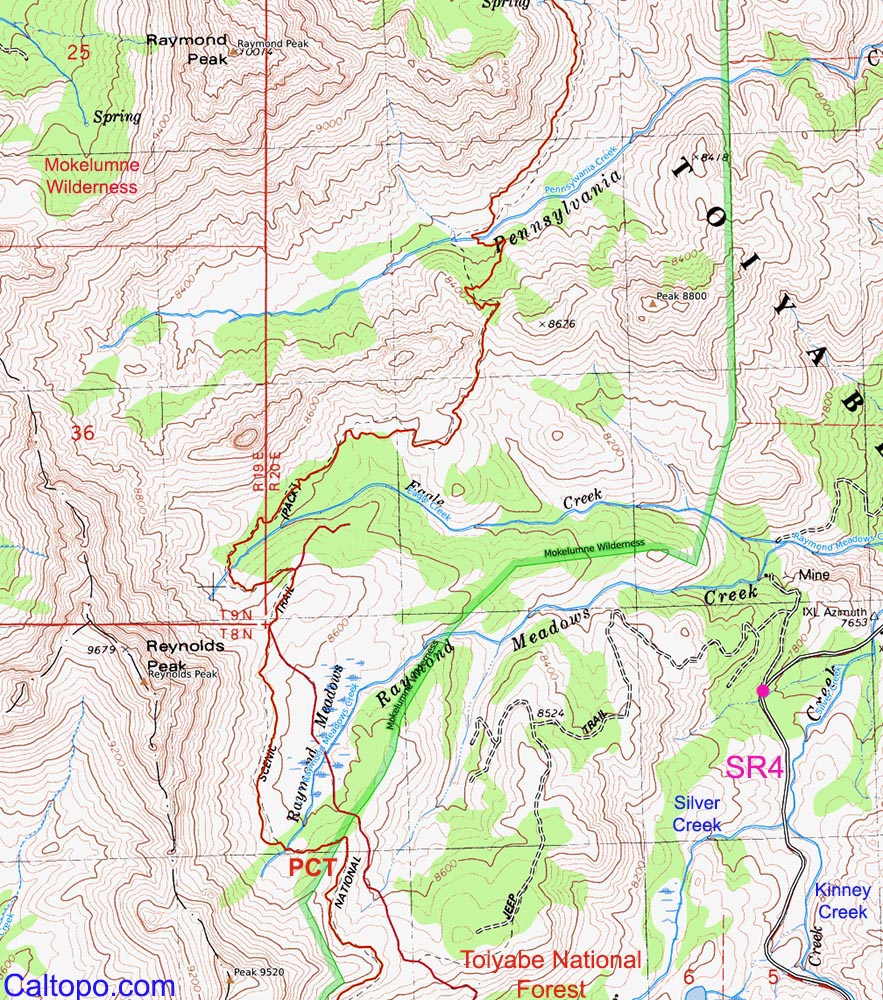
This was my first Sierra Nevada visit since my Tahoe ski season prematurely ended with the awful March warm dry spell. Instead, I had spent the previous 3 months on productive photography road trips about lower elevations in western California. My interest in this unique area is reflected in having done 9 short backpacks over 3 decades into this colorful volcanic geology zone with many aesthetic hoodoo pinnacles and rich nutrients for wildflowers. And 3 of those backpacks began as cross country night hikes.
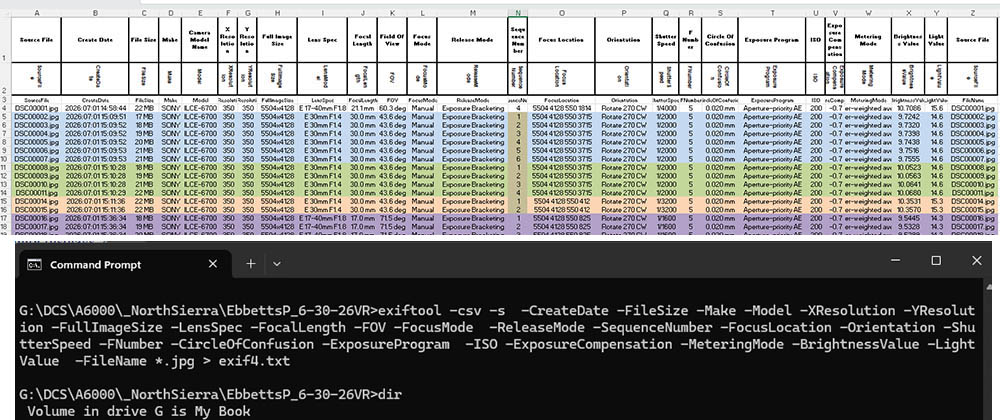
My last trip to the area was in 2012 when I was still lugging about a heavy Wisner view camera system. The majority of that work is however not yet digitized that requires ~$80 drum scanning per 4x5 inch transparency. About $10,000+ worth of scanning, just for strongest film images, that I won't have done until newer exhibition of digital camera work is successful. Thus some value in this trip to give that earlier work some public visibility. The primary purpose of text on these chronicle pages is to be able to in the future talk about the images while exhibiting on large 8k pc monitor displays. All the out of camera Sony digital images also have Excel files from full exiftool data per the below screen example print capture.
Along my drive, the drinking nozzle on a large steel vacuum bottle I had filled at home with milk, had not been screwed on tightly, that then leaked about a cup of liquid onto my passenger side floor mat. I brought the top removable section down to tiny Kinney Creek and rinsed out most of that. However, some also leaked down through the difficult to remove base mat so would later at home need to deal with its resulting foul bacterial smell for several days. As I was doing so, I noticed many small pools had trapped terrified 8 to 10 inch planted rainbow trout that had escaped downstream from SR4 roadside Kinney Reservoir and would doubtless soon become dead fish as the ephemeral stream dries up by September.
I parked in shade at a familiar dirt turn out at 7830 feet then wandered east along Kinney Creek where indeed more of these rainbow trout had taken up residence. Where Kinney Creek combines with less likely to dry up upper Silver Creek, some trout might survive. About 2:30pm, I set out cross country towards Raymond Meadows about 2 miles of route hiking distance and 700 feet higher. Although mostly sunny, a strong afternoon wind was now blowing making most landscape photography impossible and close-up wildflower work difficult at best. Before the trip, forecasts showed early mornings were likely to have light breezes that I require for focus stacking any landscapes with near foreground vegetation.
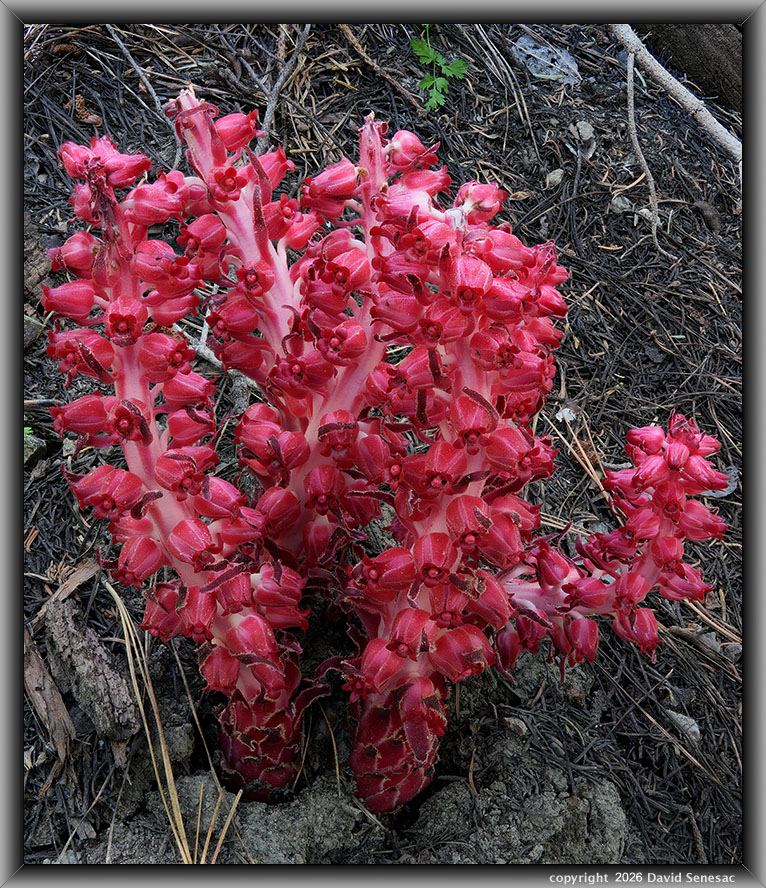
VR09665-98v 4100x4800 pixels 1 frame 34 shot focus stack blend a6700 30mm
enlarged vertical slice view
Well except for snow plants, Sarcodes sanguinea, that were common down beneath tall wind protecting red fir forest areas. I found the above specimen at an awkward to work location in a narrow gully, that then had me carefully set up my tripod position for the resulting close frame using my 30mm APS-c sharp prime lens at F8.0. In the Sony a6700 Focus Bracket mode, that automatically cranked out 34 shots, resulting in one of the sharpest frame edge to edge such images I've ever taken. Below the image, Mouse select the enlarged vertical slice view. I did see another specimen, impossible to shoot within a tangle of fir branches that was about 18 inches, the tallest I've yet encountered. That lower forest zone also had numbers of spotted corral root plants I regret not bothering to work.
The cross country route required climbing up 400 feet along an old abandoned 4WD route to 8200 feet where the granite geology then changes to Mehrten Formation volcanic termed Tvu, Undifferentiated Volcanic Rock and Intrusions, geology. I then crossed small Raymond Meadow Creek and continued along the rib north that soon enters Mokelumne Wilderness. Although I came across plenty of aesthetic landscapes, all my rambling this afternoon of about 4 miles, would just be for the sake of exploration of subjects I might better deal with the next day after strong winds subside. Happily, I had nailed the peak of greenery and wildflowers in my target zone that might have been slightly better a week before if the weather had not had thunderstorms. Near sunset, I set up nearby to quietly overnight. Nicely, there had been few mosquitoes about, except for low numbers along streams and wet meadows that reflected the unusual weather pattern this wet season.
After waking pre-dawn, a bit before 5am PDT on July 1, 2026, I was quick to gather up gear and food then set out by 5:30am on the same route towards Raymond Meadows that would become a long 13 hour day hike of about 7 miles. I left early, as it was important to reach the target zone early before any breezes began. Another mostly sunny day but with lighter breezes. Two hours later, I had reached Raymond Meadows where only a slight breeze was flowing from the southwest. I quickly set up at a colorful bare ground reddish purple outcrop that is part of 4 to 5 million year old Plioocene Epoch deposits, termed tdpeps, of a stratovolcano with andesite debris-flow deposits that were hydrothermally altered and that I would be within the rest of the day. A key reason this PCT section is special. The below links to a technical geologic discussion.
A tale of two Walker Lane pull-apart basins in the ancestral Cascades arc, central Sierra Nevada, California
And this less technical page is more a summary:
Mehrten Formation
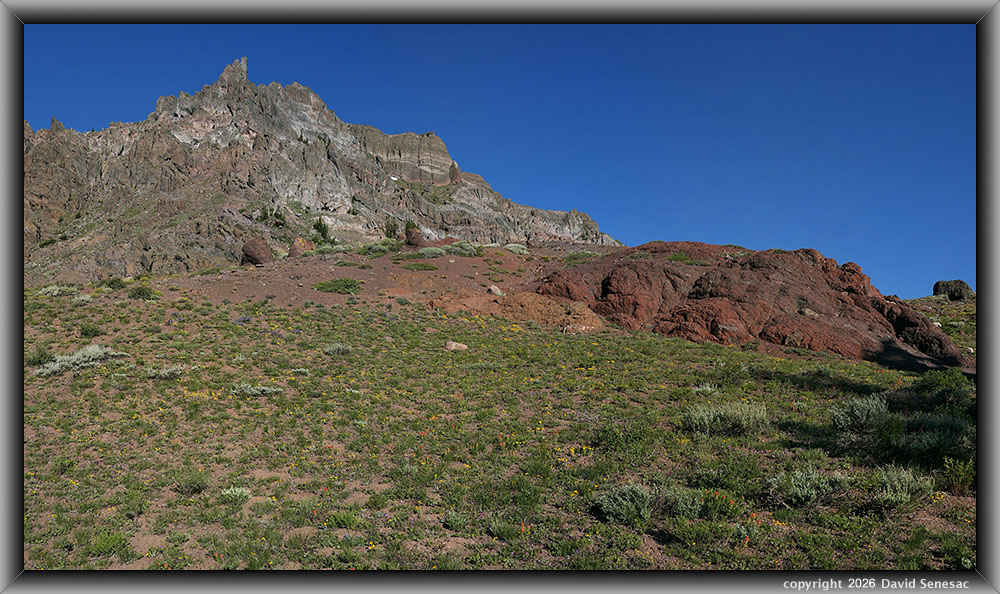
VR09713-09734-3x1v 9400x5400 pixels 3 column 1 row 3 frame 22 shot focus stack stitch blend a6700 30mm
enlarged vertical slice view
My first subject at 7:29am PDT, a 3 column stitch blend from 22 Focus Bracket shots with my Sigma 30mm prime lens, shows 9679 foot Reynolds Peak with a foreground of a list of wind pruned short wildflower species including, sulfur flower, Eriogonum umbellatum, Duddley's clarkia, Clarkia dudleyana, woolly sunflower, Eriophyllum lanatum, showy penstemon, Penstemon spectabilis, spreading phlox, Phlox diffusa, Applegate's paintbrush, Castilleja applegatei, Brewer's lupine, Lupinus breweri, pine lupine, Lupinus albicaulis, western pennyroyal aka mountain pennyroyal, Monardella odortissima, blue flax, Linum lewisii, nude buckwheat, Eriogonum nudum, Drummond's thistle, Cirsium drummondii, sagebrush, Artemisia sp, arching ceanothus, Ceanothus arcuatus, and mountain hemlock, Tsuga mertensiana.
Note, on all my chronicle page images, are some plants, I cannot identify, most often because they are too indistinctly resolved that increases with distance. Others, I was not able to research or as with grasses, I am largely ignorant with. Also, some of the botanical names, ie scientific names, are dated as taxonomy is rapidly changing names of fair numbers of genus:species names given the rise of recent genetic science that corrects previous incorrect classifications. And then there are a few plants that I, a non-botanist amateur naturalist incorrectly identified. In any case, using only common names is far less accurate and I am not afraid to publicly make such mistakes so don't be afraid to correct me, haha. Also on a given page, I only provide bolded common names and genus:species names for first occurrences.

VR09737-09764-3x1v 9600x5400 pixels 3 column 1 row 3 frame 28 shot focus stack stitch blend a6700 30mm
enlarged vertical slice view
And a second 3 column stitch blend image of the above subject a bit to the right at 7:37am with the 30mm again, shows most of the same species plus yarrow, Achillea millefolium, Sierra willow, Salix orestera, and whitebark pine, pinus albicaulis. Note the single small snow patch on the peak.
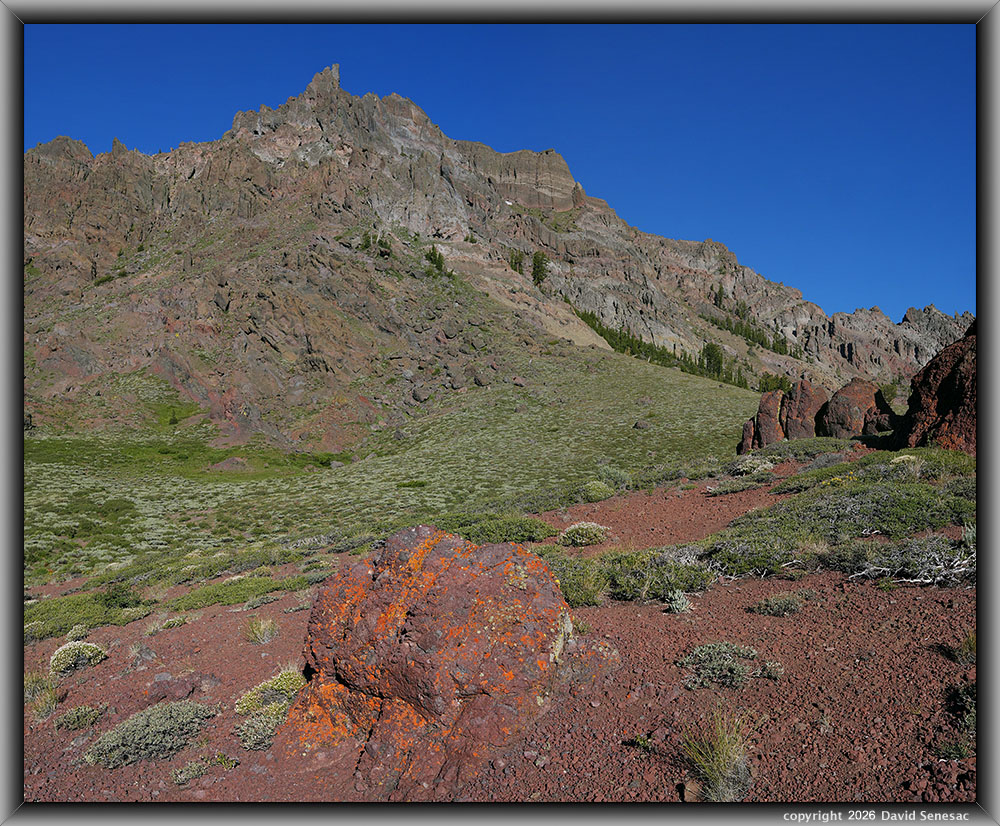
VR09765-09777-2x1v 6600x5400 pixels 2 column 1 row 2 frame 13 shot focus stack stitch blend a6700 17:40mm @22.3mm
enlarged vertical slice view
This above image shot at 7:45am with my new Sigma 17-40mm DC/ART zoom at 22.3mm, was from just above the previous two images. In this region, these uncommon reddish purple andesite outcrops, are often colonized by lichen, providing potential colorful foregrounds. Among plants discernable on my full image are sulfur flower, Lobb's buckwheat, Eriogonum lobbii, spreading phlox, Applegate's paintbrush, pine lupine, Bridge's penstemon, Penstemon rostriflorus, sagebrush, Sierra willow, and mountain hemlock. Not all species on given landscapes bloom during the same periods. Spreading phlox is an early bloomer in Sierra Nevada landscapes and most of the plants I came across on this hike were at least a couple weeks past peak with wilting petals.
The Pacific Crest Trail aka PCT, runs across the base of where the slope steepens and is slightly discernible at the frame right left of the top of an outcrop. Despite such, thru hikers and day hikers, even those carrying serious cameras, rarely venture away from trails to obviously better perspectives and elements to capture landscapes. And that is why in wilderness, one almost never sees human footprints on what appears to be perfectly manicured pebble rocks. Well, unless an obvious use path vectors off or a lake or stream is nearby.
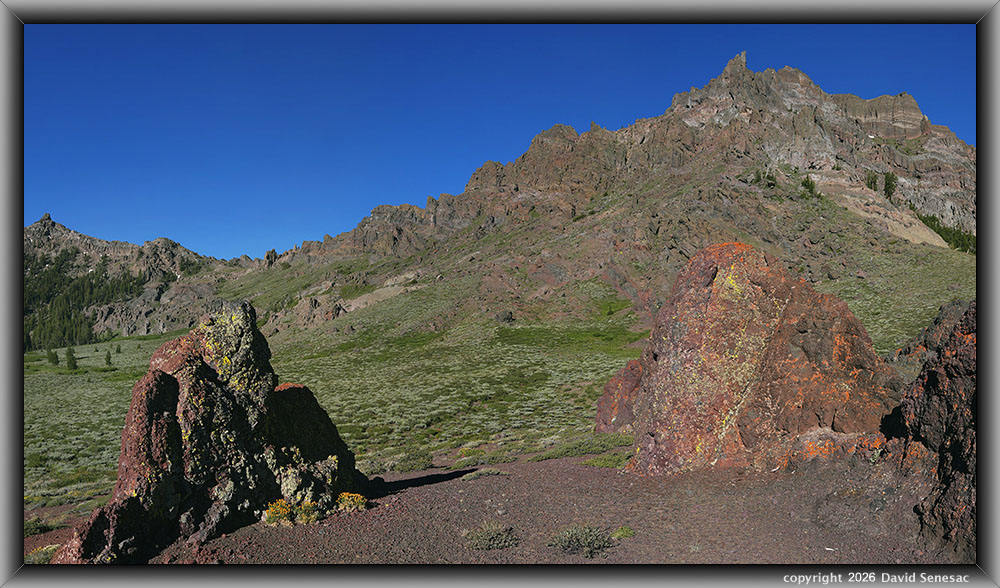
VR09784-09801-3x1v 9600x5400 pixels 2 column 1 row 2 frame 9 shot focus stack stitch blend a6700 17:40mm @22.3mm
enlarged vertical slice view
Another lichen adorned image above from the same outcrop area as the previous image with similar plants, shot at 7:49am with the 17mm:40mm zoom at 22.3mm.
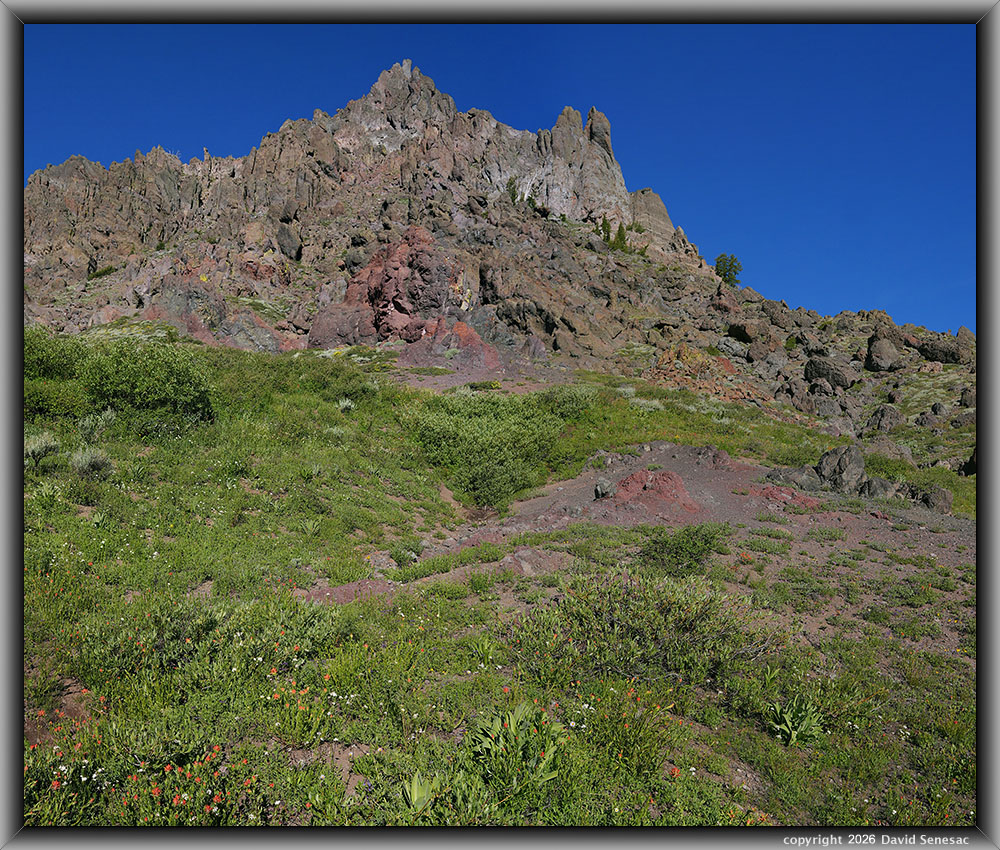
VR09809-09817-2x1v 6400x5400 pixels 2 column 1 row 2 frame 9 shot focus stack stitch blend a6700 17:40mm @19.4mm
enlarged vertical slice view
I then crossed over to the base of Reynolds Peak at 8650 feet a bit above the PCT, where vegetation is more concentrated given greater precipitation runoff. The above image at 8:05am with the 17mm:40mm zoom at 19.4mm, includes sulfur flower, spreading phlox, western pennyroyal, showy penstemon, subalpine fleabane, aka wandering daisy, Erigeron glacialis, western wallflower, Erysimum capitatum, woolly sunflower, Applegate's paintbrush, Duddley's clarkia, whorled penstemon, sticky penstemon, western wallflower, mule ears, forget-me-not, myosotis sp, sagebrush, Sierra willow, and mountain hemlock poking up into the deep blue sky at the ridge line.
VR09818-09827-2x1v 6500x5400 pixels 2 column 1 row 2 frame 10 shot focus stack stitch blend a6700 17:40mm @17.0mm
enlarged vertical slice view
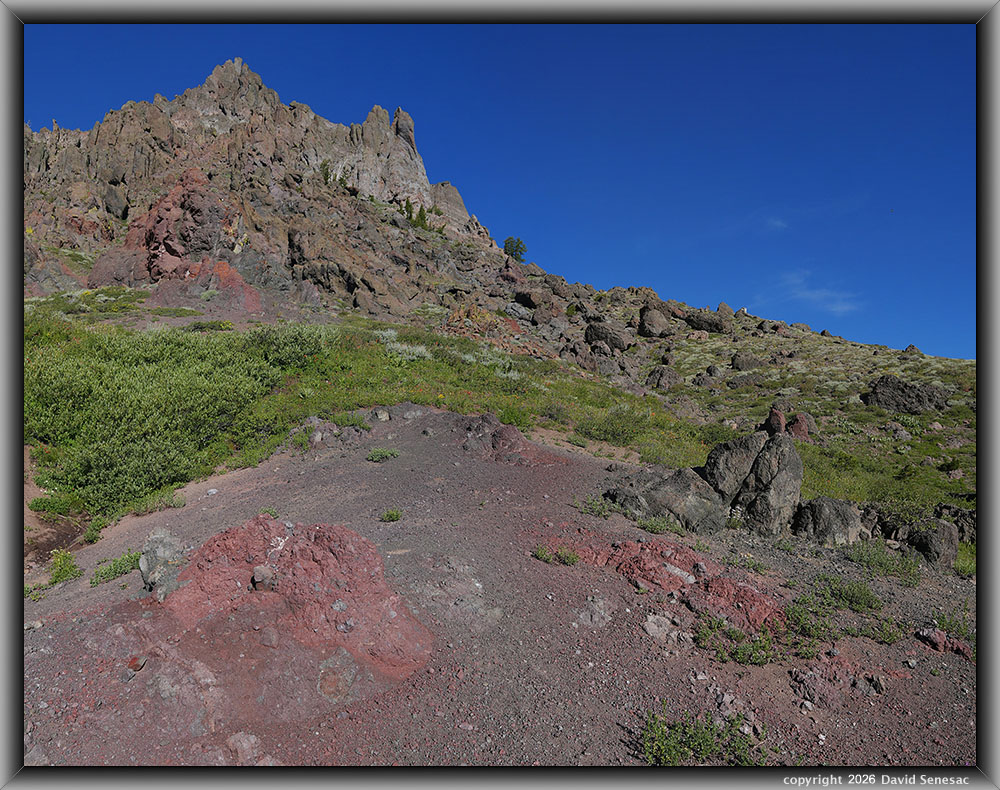
And above, another image a bit higher than the previous image at 8:08am with my 17mm:40mm zoom at 17.0mm. Note at frame left still damp soil from some thunderstorms the previous week. The image also includes a bird, maybe a hawk, flying in the sky at frame right that this downsized for web version lacks resolution to show. There were plenty more interesting aesthetic subjects on this Reynolds Peak's east facing slope I didn't have time to explore but will some day, as I needed to continue on my route to reach other subjects before stronger breezes arose. I was surprised to find a lack of flowing water in the lower meadow, as one would need to drop down the Raymond Meadows Creek canyon to where it steepens maybe 100 feet lower.
VR09891-09902-2x1v 6300x5400 pixels 2 column 1 row 2 frame 12 shot focus stack stitch blend a6700 17:40mm @27.3mm
enlarged vertical slice view
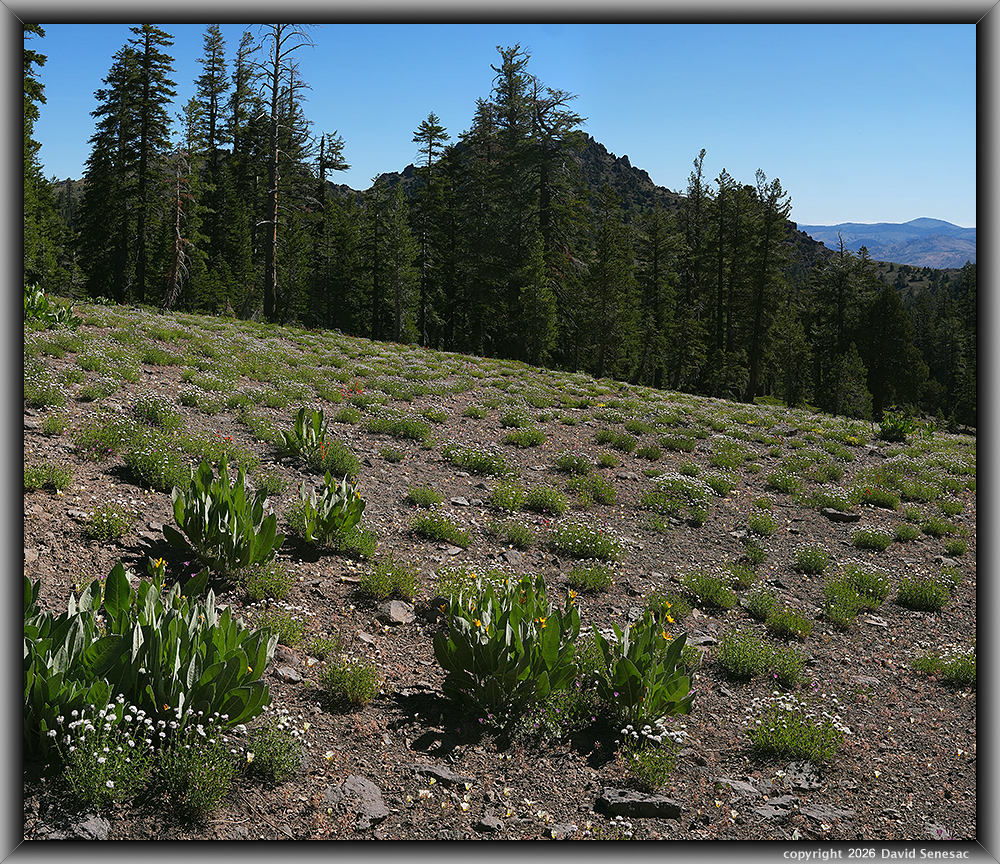
I next rambled off to the mostly forested ridge between the Raymond Meadows Creek and Eagle Creek drainages. A stronger breeze had arrived that slowed work on subjects. At 9:18am, I stopped to work using the 17mm:40mm zoom at 27.3mm, the above eastward back lit expanse of mule ears, western pennyroyal, Bridge's penstemon, Duddley's clarkia, Leichtlin's mariposa lily, Calochortus leichtlinii, Applegate's paintbrush, Sierra onion, Allium campanulatum, sagebrush, red fir, and lodgepole pine, Pinus contorta. Western pennyroyal, ie frame lower left, have an extremely strong mint odor. Many of these species petals like these white at ground level Mariposa lilies, are closed up until mid-morning, so one really cannot work some wildflower subjects any earlier than about 7:30am. The ground level lilies are difficult to see without displaying the enlarged vertical slice view.
I unsuccessfully tried to find a location to shoot the volcanic ridge with pinnacles to the north but everywhere was blocked by tall forest. Eventually, I dropped down to Eagle Creek and followed that back west to its headwaters area. All this was across strenuous awkward footing landscapes that consumed much time. I decided to spend mid-day resting in that familiar area that has the most reddish purple andesite rocks in the area. That requires passage through a narrow red rock walled ravine with a small trickling stream.
VR09903-09909-2x1vh 7600x5300 pixels 2 column 1 row 2 frame 7 shot focus stack stitch blend a6700 17:40mm @17.0mm
enlarged vertical slice view
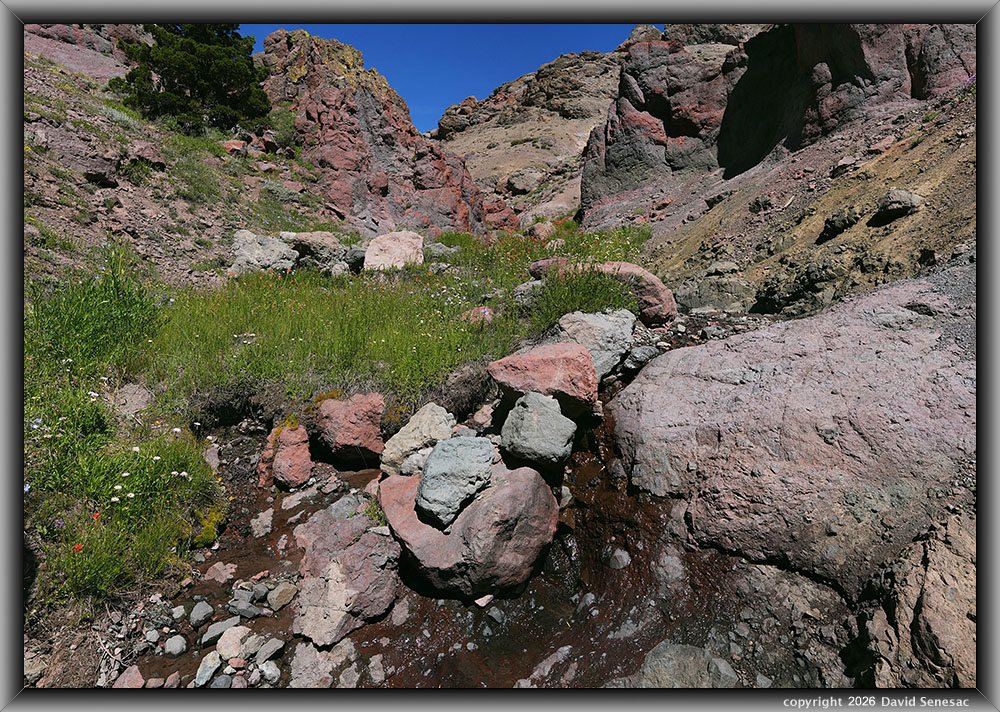
Along that ravine at 10:49am, worked the above stream section with my 17mm:40mm zoom @17.0mm, that held numbers of peaking wildflowers including mule ears, western pennyroyal, Applegate's paintbrush, blue flax, yarrow, subalpine fleabane, streambank arnica, Arnica amplexicaulis, sticky cinquefoil, Sierra penstemon, pit seed goosefoot, Chenopodium berlandieri, sagebrush, Sierra juniper, and mountain hemlock.
VR09910-14h 5500x4100 pixels 1 frame 5 shot focus stack blend a6700 17:40mm @17.0mm
enlarged vertical slice view
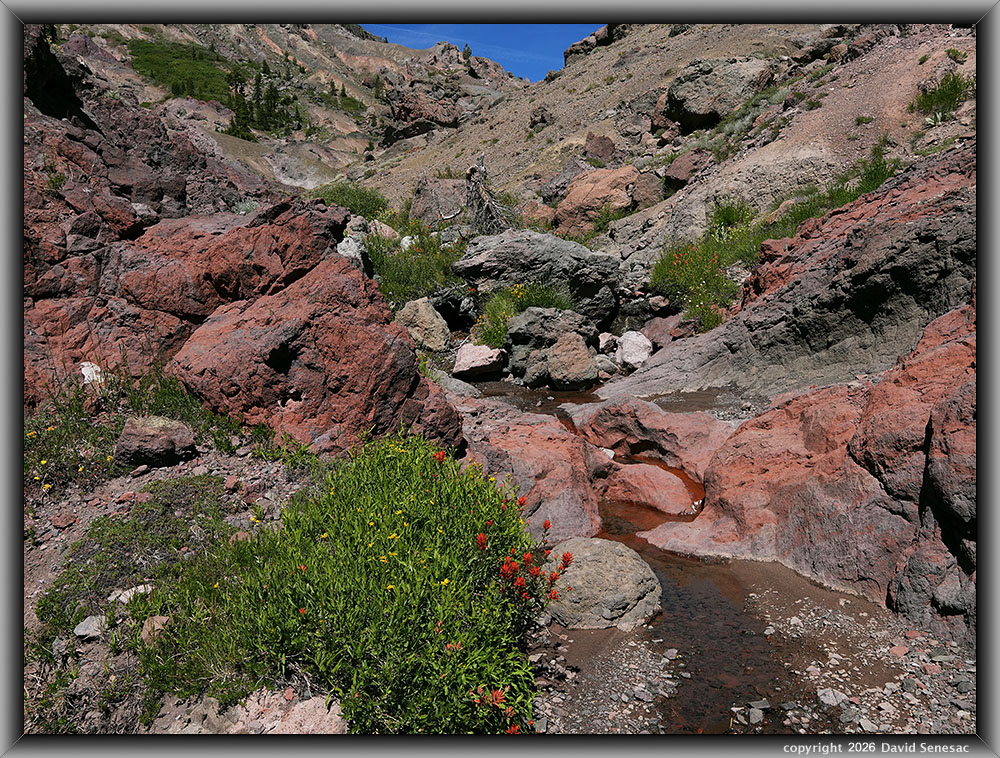
And at 10:59am with my 17mm:40mm zoom at 17mm, worked a second stream section above, with the same species. Higher up, I spent a couple hours mid-day in partial shadows beneath a small whitebark pine, consuming my lunch and napping. I was glad there were almost no mosquitoes left in the area while the temperature was about a comfortable 60F.
After ending my rest with the sun now far enough west for better front lighting eastward, I climbed up the Reynold's Peak slope high enough for views eastward. Clouds were now building. There at 2:36pm, worked image VR09955-09980-3x1v.jpg at page top, east southeastward with my 17mm:40mm zoom at 17mm, with 10772 foot Silver Peak and 10824 foot Highland Peak in the background. In the foreground in front of some colorful andesite outcrops are sulfur flowers. Also in the frame are western pennyroyal, showy penstemon, Applegate's paintbrush, silver lupine, pinemat manzanita, Arctostaphylos nevadensis, whitebark pine, Sierra juniper, red fir, and jeffrey pine. I had climbed up into these areas years before with my 4x5 view camera.
VR09981-09986-2x1v 6900x5400 pixels 2 column 1 row 2 frame 6 shot focus stack stitch blend a6700 17:40mm @17.0mm
enlarged vertical slice view
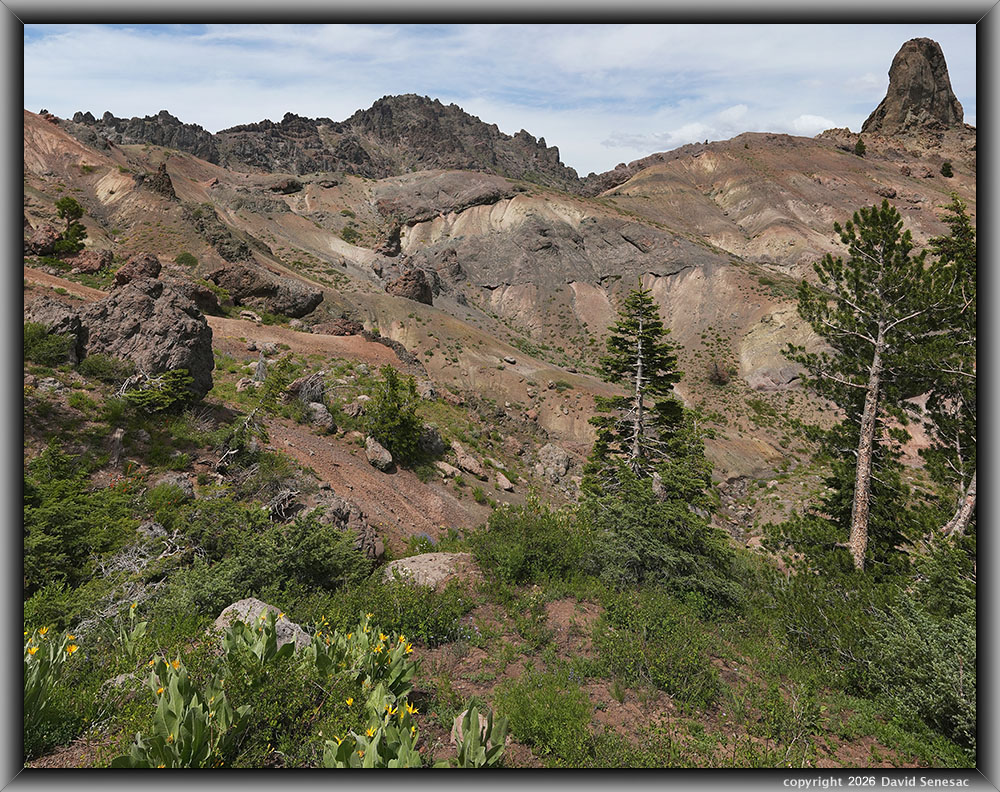
Next, at 2:42pm worked with my 17mm:40mm zoom at 17mm, the above subject northeastward towards 10014 foot Raymond Peak poking mid left. Beyond my near ridge line is the Pennsylvania Creek drainage. This slope had many of the same species including mule ears, western pennyroyal, Applegate's paintbrush, silver lupine, sticky cinquefoil, blue flax, sagebrush, snowberry, Symphoricarpos albus, red fir, Sierra juniper aka western juniper, Juniperus grandis, whitebark pine, and mountain hemlock. At frame right is a spectacular pinnacle looking like a whale snout, rising 250 feet above the ridge.
VR00002-00015-3x1v 9500x5200 pixels 3 column 1 row 3 frame 12 shot focus stack stitch blend a6700 30mm
enlarged vertical slice view
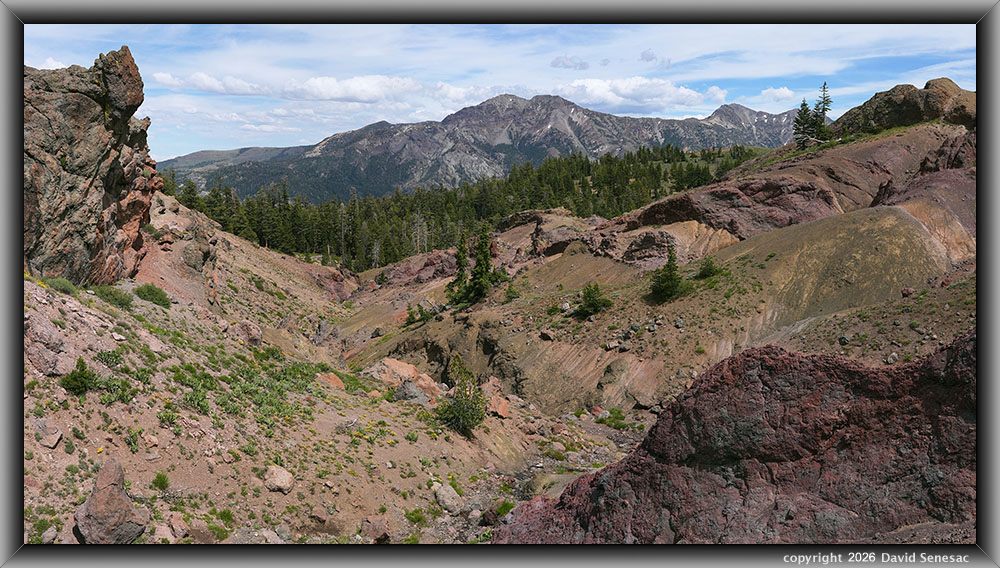
On my way back down the small stream ravine, at 3:09pm stopped per image above for another view eastward with similar elements. Note, walking on the steeper andesite pebble slopes is treacherous as the loose irregular pebbles roll like ball bearings.
VR00016-20v 4100x5500 pixels 1 frame 5 shot focus stack blend a6700 17:40mm @17.0mm
enlarged vertical slice view
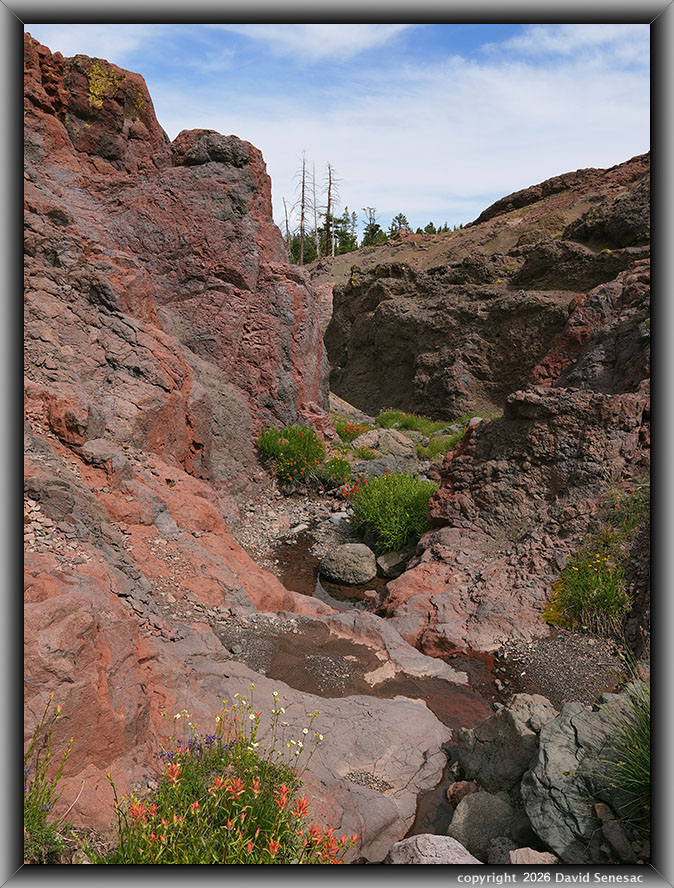
Down inside the ravine at 3:36pm, worked the above particularly colorful water carved rock stream ravine segment with Applegate's paintbrush, sticky cinquefoil, whorled penstemon, and streambank arnica wildflowers. After reaching the PCT below, I went south on the trail a bit, to where a large popular camp is located beneath tall shading red fir trees near small Eagle Creek. It is the only location in this section with flowing water near the trail. In its meadow, I worked a couple mediocre images while several PCT hikers passed by including one older guy that said he was on day 104 and he looked it.
VR00052-68v 4100x4700 pixels 1 frame 17 shot focus stack blend a6700 30mm
enlarged vertical slice view
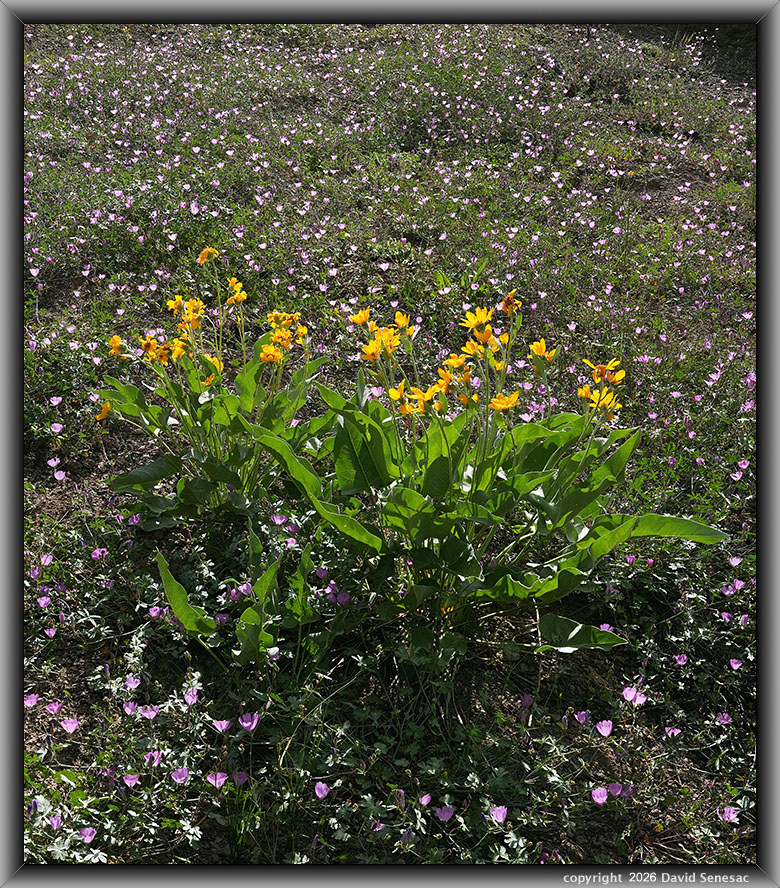
Back on the PCT northbound, I stopped at 4:33pm for this intimate back lit subject with my 17:40mm zoom at 28.6mm, of arrowhead balsamwood, Balsamorhiza sagittata, within dense Duddley's clarkia, Clarkia dudleyana. A difficult image to post process due to a slight breeze causing mis-registrations. The related to more common mule ears species, arrowhead balsamwood has different shaped large leaves and often more flowers per plant. The peaking clarkia flowers often formed dense patches within sun exposed open forested areas of this zone.
VR00069-00074-2x1v 5900x4900 pixels 1 frame 6 shot focus stack stitch blend a6700 17:40mm @17.0mm
enlarged vertical slice view
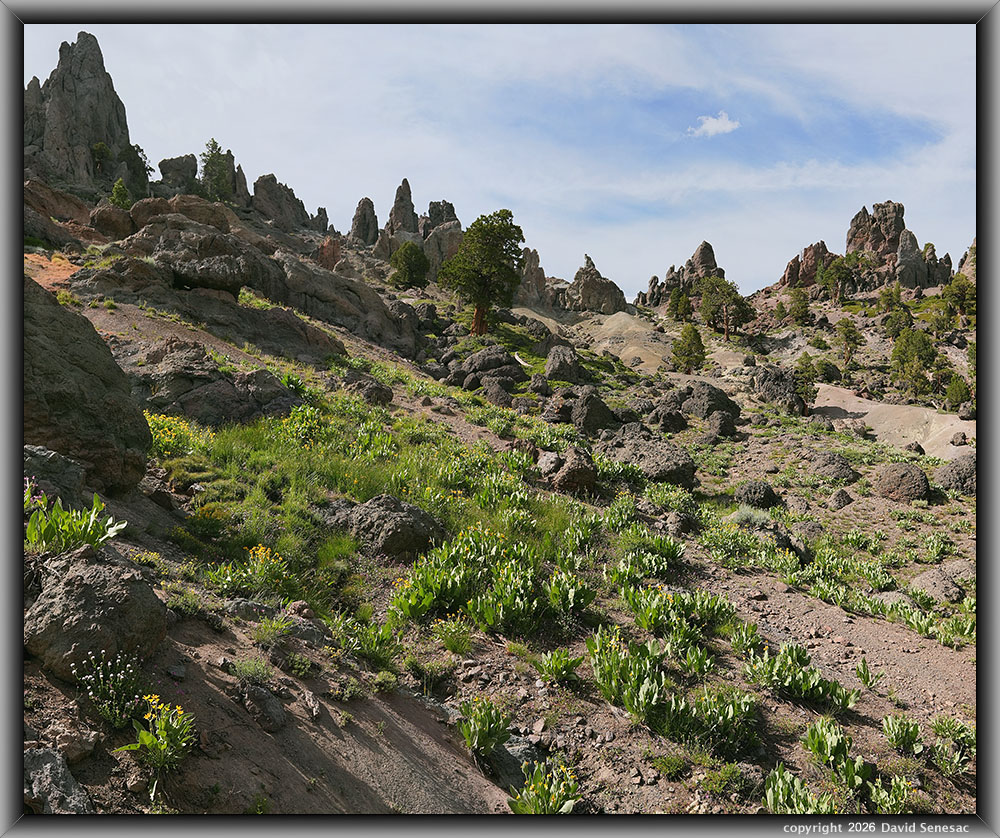
The above image shot at 4:38pm shows a south facing pinnacled section of the andesite ridge between Eagle and Pennsylvania Creeks with spectacular Sierra juniper trees plus mule ears, arrowhead balsamwood, western pennyroyal, Duddley's clarkia, sulfur flower, nude buckwheat, sagebrush, and pinemat manzanita. At frame upper left, are orange hued dodder, aka witches hair, Cuscuta californica. It is a leafless, rootless, parasitic vine that twines around host plants and uses tiny, root-like structures to siphon water and nutrients. The bumpy surfaced boulders and pinnacles are eroded remains of volcanic mudflows wth embedded conglomerate volcaniclastics that tends to form hoodoos at ridge lines. And yes, in the past with my 4x5 film view camera, I've climbed up to explore the pinnacles at the ridge line. Raymond Peak in the next drainage north, is covered with these hoodoo features.
VR00093-01v 4100x5400 pixels 1 frame 9 shot focus stack blend a6700 17:40mm @17.0mm
enlarged vertical slice view
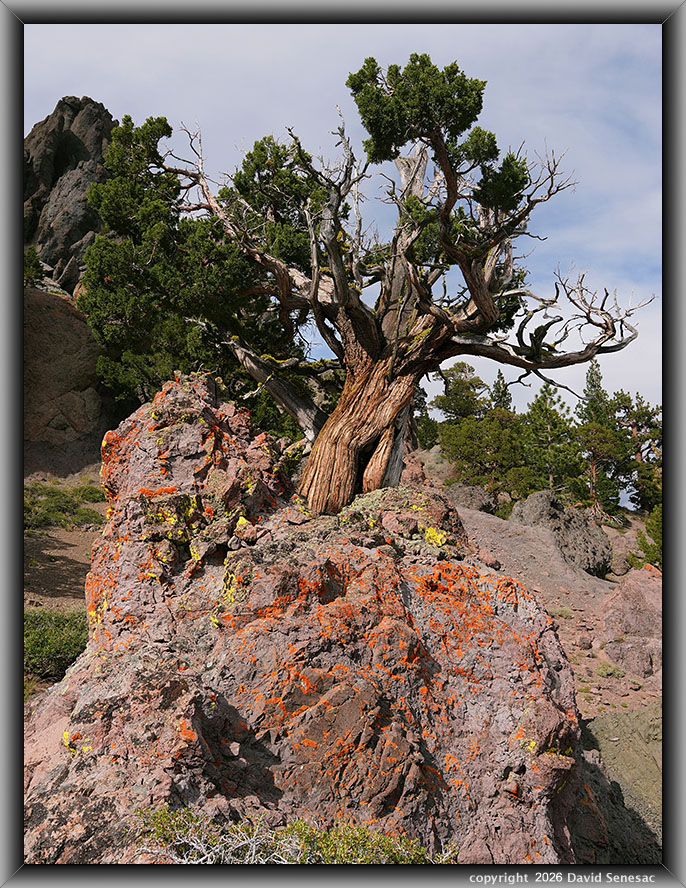
At a late 5:12pm, worked my last subject with my 17mm:40mm zoom lens at 17.0mm. This was a familiar Sierra juniper rising out of colorful andesite rock with lichen I'd found years before. Jeffrey pine, Pinus jeffreyi, are in the background at frame right. Without wasting time, I rambled the 2 miles of awkward cross country back to my vehicle. Then drove west on SR4 back to Ebbetts Pass where I drove out on the 4WD road to a lonely location still in some westward shining sun. I greatly dislike getting into my Aya Nemo 15F degree sleeping bag feeling grubby nor want it to become soiled. Thus gave myself a full body wash by pouring out water from a car sun warmed 96 ounce plastic bottle. The bottle has holes poked in the lid. On road trips, I carry a 5-gallon water jug so I don't always need to jump into usually quite cold Sierra lakes or streams.
VR00102-51h 4100x5400 pixels 1 frame 50 shot focus stack blend a6700 56mm
enlarged vertical slice view
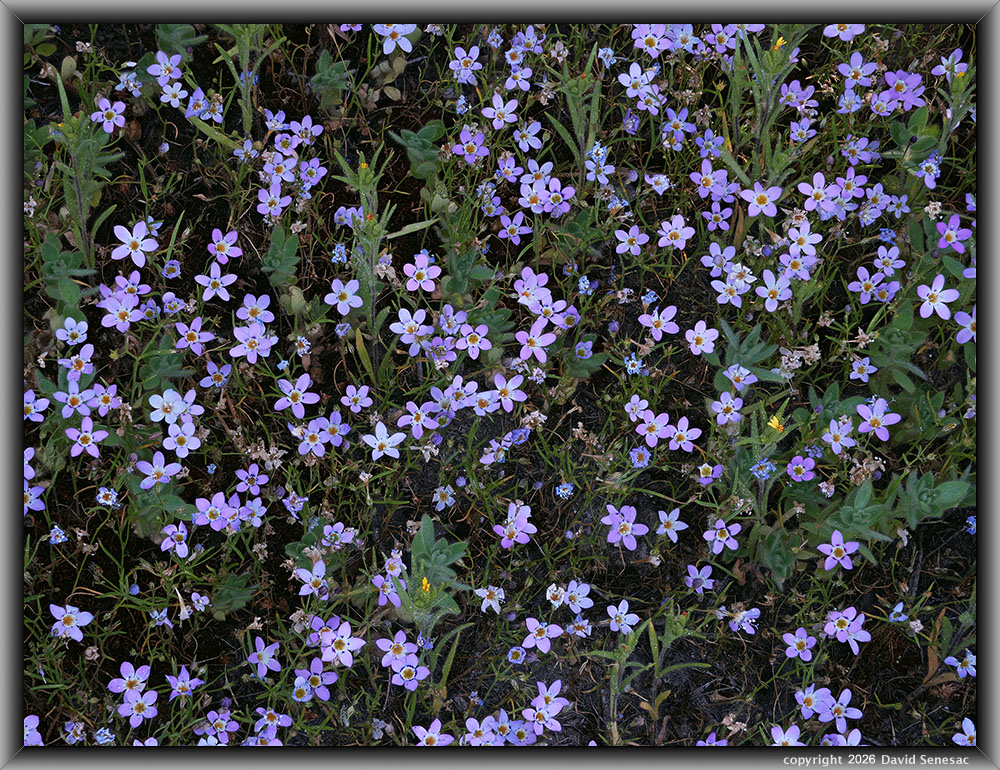
Although I had plans to work some landscapes in the morning after waking, I decided to just drive back west on SR4 since I felt I had already captured a fair number of strong subject while not wanting to possibly stress my slightly sore feet any more, on this first trip of the summer. Along the way stopped roadside for a close-up of a dense patch of Bridge's gilia, Navarretia leptalea with my 56mm prime that required 50 shots, my a6700 shot setting limit. The species is another for which the botanical name has recently changed given genetic research. The small yellow flowers may be mountain tarweed, Madia glomerata.
By mid-day, I was back home in the San Jose area. Although a quite productive trip for just a single day of real work, there were plenty of landscape subjects that I either didn't have time for, or for which the breezes were too strong to bother with. My 77 year old body held up well for a first trip of the summer and now a few days later, I feel stronger for that effort.
NEXT: Page 11 TBD
2026 Trip Chronicles: Contents

















