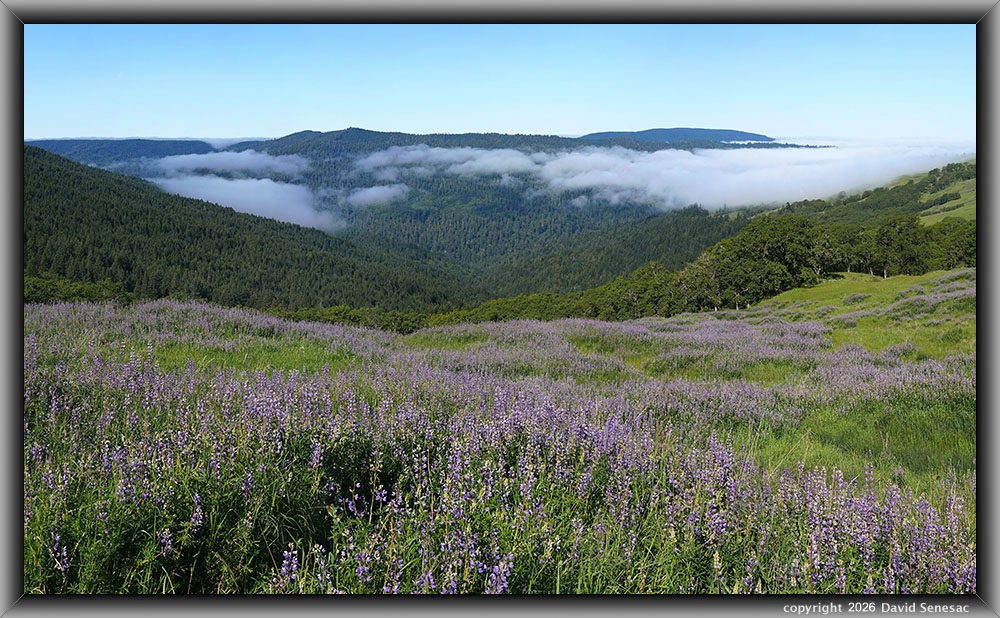
VO07484-07532-4x1v 10000x6000 pixels 4 frame 4 column 1 row 40 shot focus stack stitch blend a6700 30mm
enlarged vertical slice view image text section
NEXT: Page 8 Humboldt Redwoods State Park 5/8 2of2
2026 Trip Chronicles: Contents
North Coast Redwoods 5/5
North Coast Redwoods 5/6
North Coast Redwoods 5/7 1of2
Sue-meg State Park 5/7
On Monday May 4, weather forecast changes with wind for Sonoma coast areas had me looking at other road trip ideas. By late afternoon decided on driving all the way north nearly 400 miles to Redwood National Park. Forecasts showed I would have at least 2 optimal days of marine overcast or fog with light breeze days, necessary for my a6700 focus bracket work. However, I would need to go immediately for that weather window! I hadn't done any planning, nor was any gear ready for that trip, but had plenty of maps and other information from my last trip there in 2015. With gasoline prices surging, that would be about $160. So at dawn on Tuesday May 5, 2026, while the SF Bay Area commute was active, began assembling gear at my front door. Didn't have time to do a usual thorough logistics job, so expected I would make some mistakes that indeed happened.
Filled my 13 gallon gas tank at $5.49/gallon. By noon between commutes, was on the road north on I280, then through San Francisco, across the Golden Gate Bridge on US101, and through continuous suburban cities until about 2pm. From there, the long drive was more rural within Coast Range woodland and pine forests. By late afternoon, I reached Eureka where at a Walmart supermarket bought perishable foods plus crushed ice for my high end cooler plus refueled at $6.29/gallon. And at day's end drove off to a rare obscure near ocean, dirt road to freely disperse camp overnight. Overnight was much drizzly fog with sounds of the crashing surf not far away. Of note, just north of Trinidad, there are California Rest Stops with facilities on both sides of the highway where one can freely overnight sleep inside vehicles.

Awake at dawn on Wednesday May 6, 2026, I rearranged gear then in thick fog and overcast, continued north on US101 to the Damnation Trailhead along Del Norte Redwoods State Park. Three older California state parks are part of the large Redwoods National Park with most of the park free to access. The first third mile hiking down the Damnation Trail would tell me the condition of rhododendron blooms in the region. I saw a few blooms, though much less than during good years in late May. OK, so would not be working any redwood areas for those subjects.
Redwood National Park home webpage
Although I attempt to identify many plant species by Latin names on my website pages, I am an amateur doing so, thus make occasional mistakes. Also in this technology era, given new DNA analysis tools, many former Latin species names are changing. Worse are common names, botany guide authors seem to obviously hate using other guide's names for, and instead often invent new ones. So this person will never be serious over correct use of plant names. Within many of my images, are plants including those flowering, I was not able to identify. I only show Latin names for the first such subject on any webpage. If anyone notices incorrect names, feel free to email contact me at david@davidsenesac.com, thank you.
Back in my car, I drove back south to an unfamiliar Lagoon Creek parking lot with a Coastal Trail trailhead. Sea shore landscapes are often mediocre without at least some sunshine. Although I was too early in spring for rhododendron, most of the other coast wildflowers were at their peak, especially coastal manroot, Marah oregana, that densely covered much of the impenetrable coastal vegetation. Although, I had both rain gear and gaters, impatiently, unwisely didn't bother to put them on. Some trail areas were overgrown with dewy vegetation that quickly began soaking my old pair of Levi 505s.

VO06710-06732-2x1v 6400x6100 pixels 2 frame 2 column 1 row 23 shot focus stack stitch blend a6700 17-40mm @ 17.0mm
enlarged vertical slice view
After about a mile stopped at 8:28am PDT, to photograph this above overlook of Hidden Beach that in the future, given better sunny afternoon conditions, would return. In the foreground are manroot plus cow parsnip, Heracleum maximum, and one douglas iris, Iris douglasiana, bloom. In the distance are Sitka spruce, Picea sitchensis, that are able to tolerate the heavy marine salt atmosphere while coastal redwoods do not, so tend to be further inland. Coastal shore areas given the vast unblocked ocean expanses, even on otherwise calm days, almost always have at least minor breezes.
The Klamath River enters the ocean in a nearby estuary through a large section of the Yurok Reservation lands with their considerable well-recommended tourist infrastructure including a casino along US101. And that included a much cheaper gasoline station at just $5.89/gallon that I refueled at. I drove south off US101 onto the Newton B. Drury Scenic Parkway, that routes along Prairie Creek within Prairie Creek Redwoods State Park, now part of the national park. Arguably our most scenic redwood park. I stopped at the familiar Corkscrew Tree trailhead, that is one of several roadside pullouts with trailheads.
Prairie Creek Redwoods State Park home page

VO06840-49v 4100x6150 pixels 1 frame 10 shot focus stack blend a6700 30mm
enlarged vertical slice view
For the next hour plus walked about the Karl Knap Trail that routes just east of Prairie Creek through a lush dense forest within tall coast redwoods. A a6700 subject at 10:41am, was the above image of a bigleaf maple, Acer macrophyllum, root collar that entered the ground at three locations with open air space between each. The root collar aka root flare, was adorned with an array of moss, ferns, and plants that colonize temperate rain forest tree branches. Western sword ferns, Polystichum munitum, grow on its trunk along with redwood sorrel, Oxalis oregana. On the ground are Kellogg's umbrellawort, Tauschia kelloggii. In the background are coast redwoods.
Google AI: Bigleaf maples, in Redwood National Park act as "biodiversity magnets," hosting the largest, most complex epiphyte communities of any tree in the Pacific Northwest. These trees, particularly in moist, old-growth, and riparian areas, accumulate massive amounts of bryophytes, lichens, and ferns on their trunks and branches.
The Moss Complex Dominant Species: The epiphytic mat is primarily composed of Neckera menziesii (which often dominates mature trunks), Hylocomium splendens (Electrified Cat's Tail), Leucolepis menziesii, Isothecium stoloniferum, and Selaginella oregana (a club-moss that often hangs from branches). Licorice Fern: Polypodium glycyrrhiza (Licorice fern) is commonly found growing within these moss mats. Weight & Load: These epiphyte loads can be intense, with an average load of approximately 78 lbs (35.5 kg) on a single tree, with some old-growth trees carrying hundreds of pounds.
Ecology of the SystemNutrient Cycling: The high calcium content of the bigleaf maple bark supports these extensive moss colonies. Canopy Soil: Over centuries, decaying mosses and ferns accumulate and create a rich, thick layer of "canopy soil" in the tree's bark furrows and branch crotches. Canopy Roots: The maple trees have evolved to tap this resource by sending out specialized "canopy roots" from their branches directly into these moss mats to absorb nutrients and water high above the ground. Microhabitats: These moss mats are communities that support other organisms, including insects, invertebrates, and even Wandering Salamanders.

AL-PXL-6439 2918x2411 pixels 1 frame Pixel 10 Pro 2.0mm
enlarged vertical slice view
Despite its much lower resolution, I began using hand-held my Pixel 10 Pro camera instead of the a6700 due to its superior 14 stop DGA mode dynamic range. The above subject at 10:56am, shows at frame center right, the Corkscrew Tree redwood below a bigleaf maple branch. Also, western sword fern, redwood sorrel, coast redwood, and lady fern, Athyrium filix-femina. Note how the trail passes below a trunk supporting branch anchored at the ground. These large, bright green chlorophyll rich, bigleaf maple leaves turn a bright yellow about late October.

AL-PXL-5268 3264x2458 pixels 1 frame Pixel 10 Pro 6.9mm
enlarged vertical slice view
At 11:13am worked the above redwood trunk rootwad beside the trail. Also Western sword fern, lady fern, deer fern, redwood sorrel, red alder, and evergreen huckleberry, Vaccinium ovatum.

AL-PXL-1439 3256x2440 pixels 1 frame Pixel 10 Pro 6.9m
enlarged vertical slice view
Then a half hour later after driving a bit further south, at 11:44am worked this above large bigleaf maple with a background of its canopy leaves that dominantly grow on the sunny side of a forest opening with shaded western sword ferns below and coast redwoods frame right edge. At noon, I drove off to the park's popular Elk Meadows Campground that was full. However, found at 2pm any no show campsites become available. So parked and spent another 90 minutes hiking near central park trails.

AL-PXL-2307 3072x4080 pixels 1 frame Pixel 10 Pro 2.0mm
enlarged vertical slice view
At 12:39pm, took another Pixel image from a Prairie Creek trail bridge showing how wonderfully bright green these areas appear at mid day in diffuse overcast cloud light. Leaves of cascara buckthorn, Frangula purshiana, display at upper frame right. Also sword fern lady fern, redwood sorrel, and red alder. Salmon do spawn in the creek and yes did see one 6 inch salmon smolt.

AL-PXL-0119 3264x2458 pixels 1 frame Pixel 10 Pro 2.0mm
enlarged vertical slice view
1:42pm along the Cathedral Trees Trail, worked the above sideways trunks bigleaf maple(s) with western sword ferns, giant horsetail, Equisetum telmateia, thimbleberry, Rubus parviflorus, and cascara buckthorn. This maple also has many licorice fern, Polypodium glycyrrhiza, growing atop the mossy branches. Their rhizomes have a distinct, intense sweet licorice or anise-like flavor and fragrance, particularly when chewed. The taste and aroma are caused by a high concentration of glycyrrhizin, a natural compound that makes them taste sweet without being a sugar and is rated 600 times sweeter than sucrose.
I drove back to the campground where, indeed, a couple reserved campsites had cancelled. So for $33, had site #67 for the one night. After setting up, I drove US101 back south seven miles to the Redwood Creek Beach where I hoped to be able to work wildflowers on sand, however the breeze was too strong. Then drove up Bald Hills Road just to the Lady Bird Johnsone Grove at the 1.3k elevation, where rhododendron bloom roadside. Didn't see a single bloom, indicating indeed I was a few weeks too early.

VO06885-25h 4100x6150 pixels 1 frame 41 shot focus stack blend a6700 56mm
enlarged vertical slice view
Back at the park center, took the James Irvine Trail for about a mile. I did stop at 4:21pm to work one Pacific trillium, aka western trillium, trillium ovatum, subject. These trillium are common in the park, however they peak between March and early April, with just a few blooms left at their peak white petal stage.
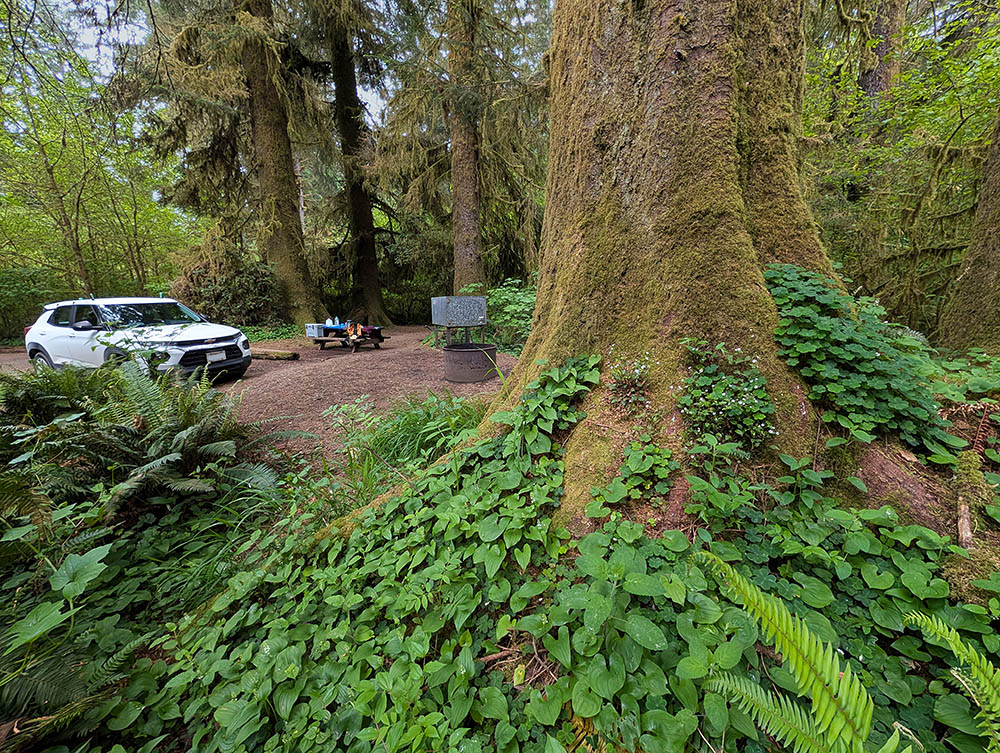
By 6pm I returned to my campsite. Enjoyed cooking a can of chicken soup on my MSR backpacking stove and then exploring the campground areas. Only the south section of the campground was open. Arguably within its lush temperate rain forest environment, one of the finest forest campgrounds anywhere. At 6:28pm with my Pixel using the ultra wide lens that has a 123 degree angle of view, captured this image of my camp, gear, and vehicle. I was soon in my car for a long night of sleep. At this point, I'd captured enough of the redwood forest that my next work would be along the Bald Hills Road that was having a strong lupine bloom.
Was again awake early dawn on Thursday May 7, 2026, as I watched through my rear car window a few people walking by in dim light to the restroom, 120 steps from my site. With much excitement ahead, it didn't take long for me to admit, I was not going to sleep say another half hour. So was up, and moving gear around for this day's photography. Each day, I switch gear around inside the 2023 Trailblazer LS in order to free up back bed sleeping space behind my passenger side seat. That done, turned my one-night campsite sign around to AVAILABLE. For a half hour over 27 miles, would be on the paved Bald Hills Road with the destination at a 2000 foot elevation ridge top.
I'd visited the area in 2015 but didn't photograph because it tends to be breezy. But windy dot com forecast for this day had been showing mostly sunny and breezes below 5 knots, that was a key reason I pulled the trigger on the road trip. Landscapes along the road beyond the LBJ Grove, are rather boring without distant views, down inside a dense second growth Douglas fir forest. Although paved, logging trucks and remote ranchers, use the road enough that it tends to be rutted and bumpy. As I reached the open grassland prairies, I was glad to find the air above the vast marine fog and overcast cloud deck was indeed calm, with skies mostly sunny, and nice grassland expanses of lupines.
I drove beyond the couple miles or so with lupine where I saw plenty of other wildflower species roadside along the northwest side of Schoolhouse Peak. With spring wildflower landscapes, aesthetics are almost always better during mid day hours when sunlight better illuminates downward into translucent plant elements. Conversely, close-up plant aesthetics are almost always better early while out of sunlight when diffusely illuminated by either skylight or clouds.

VO06988-29v 4100x5900 pixels 1 frame 42 shot focus stack blend a6700 56mm
enlarged vertical slice view
The top of the ridgeline in this grassland zone also contained areas of Oregon white oak that unlike redwood areas, also had plenty of poison oak, I take significant efforts to avoid. After climbing up steeply maybe 100 feet while gymnastically dodging poison oak plants, at 7:49am began working this above close-up subject of Douglas iris, Iris douglasiana plus a few Western buttercup, Ranunculus occidentalis. Note a wild strawberry plant leaf frame upper right that were abundant in some of these areas. In California, wildflower guides invariably use the common name California buttercup that reflects on my earlier comment on how common names are abused. This iris species regionally has a few color forms including deep purples. All these close-ups were with my 56mm lens, usually at F8.0 and not F5.0 that I use more on landscapes.
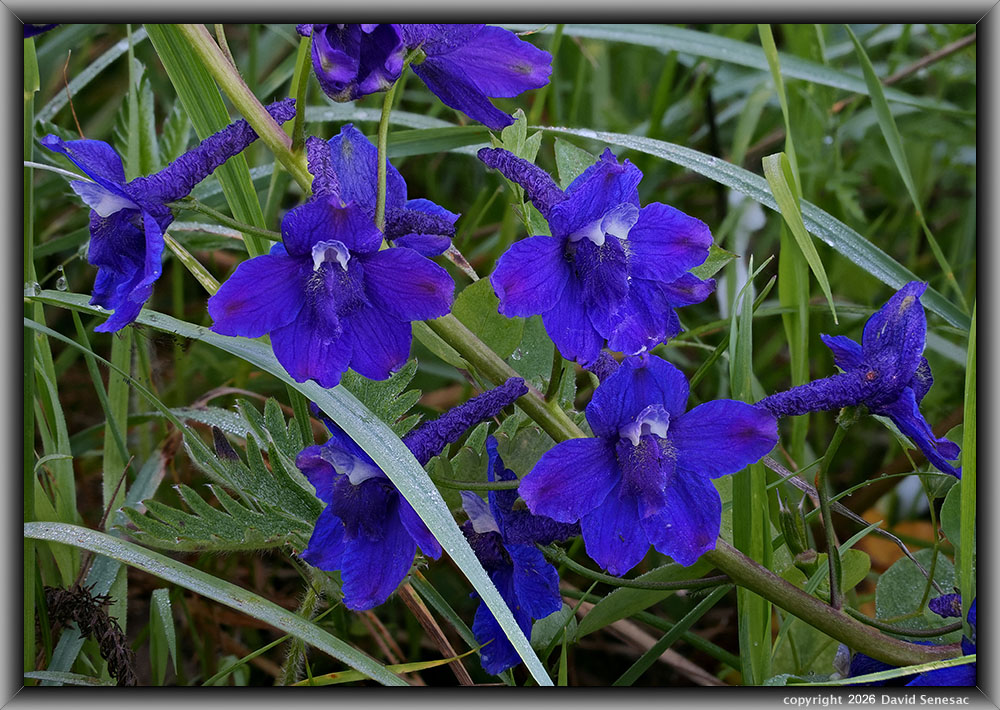
VO07030-79h 4000x5400 pixels 1 frame 50 shot focus stack blend a6700 56mm
enlarged vertical slice view
This next subject above at 7:49am, an unidentified possibly hybrid, larkspur, Delphinium spp, species, was common in oak forest areas. A slight breeze was active enough that I could not work subjects except the above that was tangled up low down in grasses. I love the long, extremely rough surface, nectar spurs that looks like an ideal shape and texture for witches pointy hats.

VO07080-25v 5600x3900 pixels 1 frame 46 shot focus stack blend a6700 56mm
enlarged vertical slice view
Another surprise species in the area were giant white wakerobin, Trillium albidum. A reason there are debris on the large trillium leaves is because it was below an oak. Also at frame lower right is a fragrant bedstraw, Galium triflorum, plant with two tiny white flowers.

VO07185-16h 6150x4100 pixels 1 frame 32 shot focus stack blend a6700 56mm
enlarged vertical slice view
I was keen to capture a good image showing why the Oregon white oak, Quercus garryana, are so named. The above subject at 8:06am was surrounded by a protective barrier of much poison oak, Toxicodendron diversilobum that in this case, was easily avoided because it was next to the paved road. Also, woodland strawberries, Fragaria vesca, fragrant fringecup, Tellima grandiflora, giant white wakerobin, and fragrant bedstraw. None of the strawberries in the area with the white blooms, yet had red fruits. The ephemeral stream channels off the slope were still trickling down water.

VO07350-07374-3x1v 9000x6000 pixels 3 frame 3 column 1 row 25 shot focus stack stitch blend a6700 30mm
enlarged vertical slice view
There was plenty more of interest in the oak forest, however the sun had risen high enough at this point that the river-bank lupine, Lupinus rivularis, landscapes would photograph well while the breeze was still low. Thus, drove back north a bit, parked and wandered down to these tall plants that were sometimes over head height. This above subject at 9:26am was well down below the road. Elk also grazed these area that made for deep channels I often chose to follow as shown on the above image frame lower right. Notice how the far ridgeline has a bluer hue than closer ridgelines due to Rayleigh Scattering. As sunlight passes through the atmosphere, air molecules and tiny particles scatter light. Shorter, blue wavelengths of light scatter more easily than longer, red wavelengths, provding our wonderfully blue skies.
At 9:3am, at page top at a knee on the slope is a 4 column stitch blend with my 30mm lens of 10000 by 6000 pixels looking down into the Copper Creek basin tributary to Redwood Creek and its canyon below. It was also a flattened vegetation knee location elk had laid down for the night where they could see anything approaching from below. Below the oak forest are conifers, dominated by dense coast redwoods plus Douglas fir. Most nights the cool moist marine air pushes inland, often with fog, then during morning hours, the sun gradually evaporates the thin overcast cloud deck and fog. By afternoons, the clouds are often limited to shore areas. On a next future visit, I hope to explore the lower grassland zones where white oak and redwoods mix.
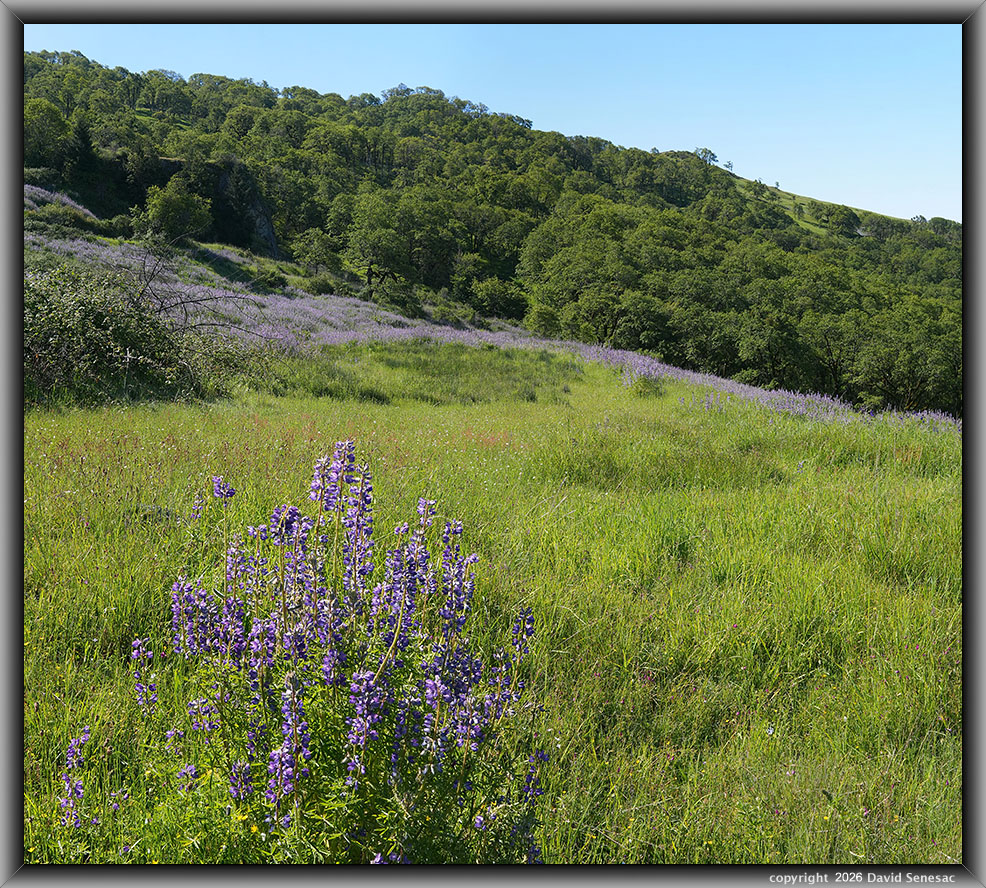
VO07533-07561-2x1v 6700x6000 pixels 2 frame 2 column 1 row 29 shot focus stack stitch blend a6700 30mm
enlarged vertical slice view
A few areas of the grassland were devoid of both lupine and tall grasses allowing shorter wildflower species. As I worked this subject at 9:47am, a breeze was already making any further work difficult. At frame mid left edge are California blackberry, Rubus ursinus, bushes that were commonly planted by early settlers throughout the state as a food source, along with other alien blackberry species. In the short grasses, are California buttercup, narrow leaved flax, Linum bienne, and leafy pea, Lathyrus polyphyllus. In the Oregon white oak background is the hillside I worked close-ups of flowers with the road passing through left to right.
For the next hour worked areas atop the ridge line with other species. However I have declined post processing the image sets due to mis-registration of the growing breezes. By 11am, was on the road, back to the Redwood Creek Beach to hopefully work beach wildflowers. It was still overcast at the coast with enough breeze that work would be difficult. Unlike mountainous areas with complex terrain that often have intermittent wind, ocean shores are unblocked, so breezes tend to be continuous. I brought along a 32 inch diameter collapsible circular diffuser and a 32 inch diameter collapsible circular silver reflector that are more often used to block slight breezes as much as is possible.

VO07745-56h 6150x4100 pixels 1 frame 12 shot focus stack blend a6700 56mm
enlarged vertical slice view
Above at 12:15pm is my first successfully captured subject of beach evening primrose, Camissonia cheiranthifolia, and beach morning glory, Calystegia soldanella. The black and white, pepper like, wind smoothed sand matrix common along miles of the northern coast, is an ideal photographic background for beautifully isolating objects on these beaches. View the enlarged vertical slice view to see what that looks like in high detail.

VO07850-68h 6150x4100 pixels 1 frame 19 shot focus stack blend a6700 56mm
enlarged vertical slice view
My next subject above, at 12:34pm were these beach strawberry, beach strawberry, Fragaria chiloensis, plants against the sand. The majority of these wild strawberry plants on the beach were not in the fruiting phase, just showing their white flowers. A silky beach pea flower is also at frame lower left. I had to make use of both my 32 inch collapsible disks to block a considerable breeze that required some time before enough of a lull occurred. I love the surface texture of the delicious looking strawberry in the enlarged vertical slice view.

VO07966-00v 3700x5000 pixels 1 frame 35 shot focus stack blend a6700 56mm
enlarged vertical slice view
Likewise at 12:49pm, had wind trouble working the above silky beach pea, Lathyrus littoralis. The bright saturated petal colors bleach quickly in the intense beach sand sun. Another species, that given its delicate fine hairs, is more impressive at higher magnification.
VO08066-94h 6150x4100 pixels 1 frame 29 shot focus stack blend a6700 56mm
enlarged vertical slice view
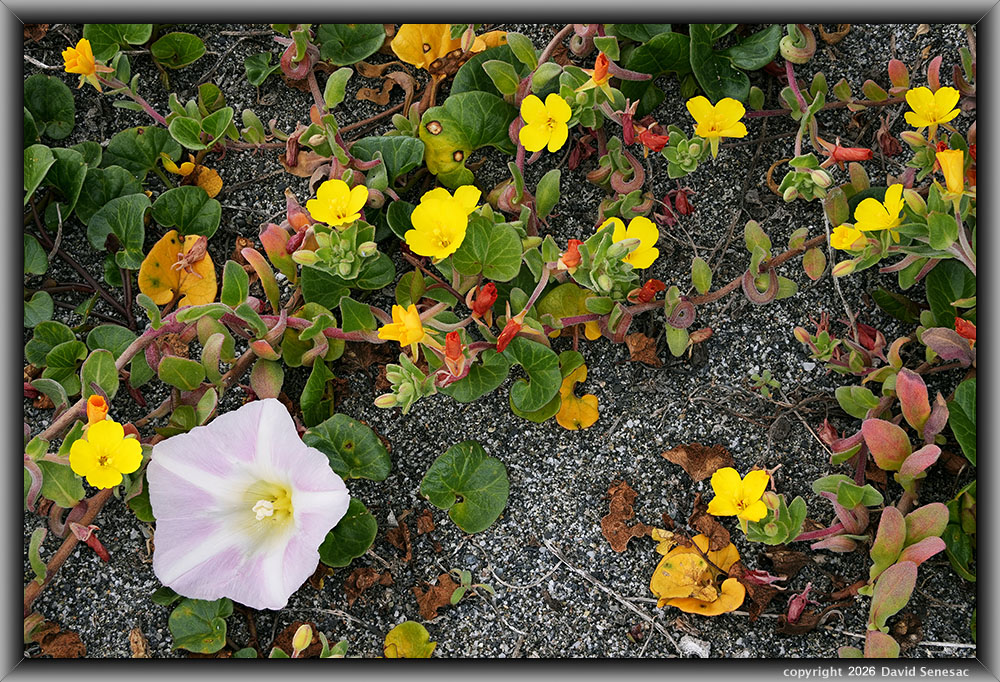
My final beach subject at 12:57pm was this dense patch of beach evening primrose, with one beach morning glory flower. Like some other yellow pea species, the petals begin an orangish red. Without the breeze, I would have been able to work many more subjects.
I drove off south a minor distance to what in the past was named Patrick's Point State Park but which has been recently changed to a native-American name, Sue-Meg State Park, that I was not aware of. That caused a delay driving into the park as the road signs had been changed as I drove by. Thus looked carefully on maps to verify the road with the new name was the park entrance. Like Prairie Creek State Park, only limited areas of their full camping sites were open at this slower time of year and that was full. Well except when I arrived at 2:00pm a no show called up right then that opened a couple sites. Thus set up camp at the pleasant Agate Beach Campground.
VO08198-15h 6150x4100 pixels 1 frame 18 shot focus stack blend a6700 56mm
enlarged vertical slice view
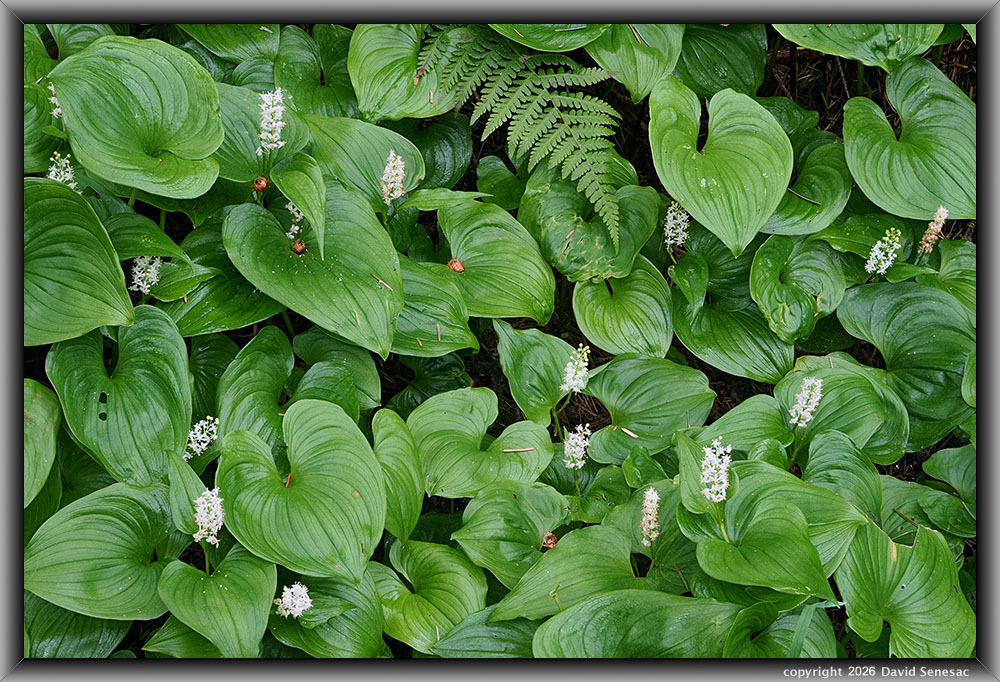
An hour later decided to hike down from the campground's high bluff forest to the beach. Without having researched the park features, I found Agate Beach was apparently misnamed long ago by its local tourist industry settlers apparently interested in making their beach sound more interesting because the geology won't include agates but rather is the same black and white, salt and pepper, sedimentary geology sand as that for miles north. These areas are of the late-Pleistocene Gold Bluffs Formation from uplifted, ancient beach and river deposits, a mix of sand, gravel, and mud but few agates, haha. I didn't spend much time on the beach that was breezy regardless but along the paved path, did work this group of false lily of the valley, Maianthemum dilatatum, plants with a fern.

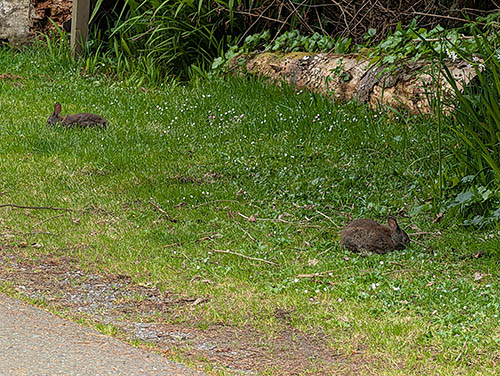
Back atop the bluff, I explored 3 other parking lot trailheads, that I decided were not going to be worth working the following morning. At sunrise would drive directly south and take a look at conditions at Clam Beach County Park. Late afternoon, per image a bit above, a couple cute Western brush rabbit, Sylvilagus bachmani did come out next to my camp site to dine on grass. Another quiet night sleeping in the back bed of my Trailblazer LS.
NEXT: Page 8 Humboldt Redwoods State Park 5/8 2of2
2026 Trip Chronicles: Contents


















