
US06470-06624-4x2v 12300x7500 pixels 8 frame 4 column 2 row 132 shot focus stack stitch blend a6700 30mm
enlarged vertical slice view image text section
2024 Trip Chronicles: Contents
Treasure Lakes Backpack 8/10 2of2
Treasure Lakes Backpack 8/11 2of2
Treasure Lakes Backpack 8/12 2of2

Continuing my cross-country route from the text on page 11 on Saturday, August 10, 2024, the above image shows the southwest shore area of Long Lake with two of the noted avalanche meadows and their streams. I set up camp at the red dot. The third meadow is out of sight behind trees just right of my camp.

My west shore of Long Lake camp was one of the most ideal, near-pristine sites I've had anywhere. Shade from tall whitebark pines nearly all day that also provided an excellent windbreak. Fresh, clean small seep water sources nearby in turf meadows where it was easy to walk about barefoot and enjoy pour-pan over-body washings. Flat, woody detritus for several tent spots, several boulders with ideal backrest angles. The whole west side of Long Lake appears to have not been used for siting camps over several years, so nicely remote and private. Thus, excellent isolation from the heavily travelled and camped-about main trail along the east side of Long Lake. Better fishing on this west side of the lake as trout are less wary.

During my 2 days, I never saw anyone near my area, as circumnavigating the lake is awkward with several significant up-and-downs, 3 sizeable streams to cross, and some blocking rock walls. And important for photographers: versus the trail side, far better views of spectacular Chocolate Peak and the Inconsolable Range. In fact, Chocolate Peak was visible from my tent per image below. On the negative, it requires cross-country effort to reach, and any camp spots are on a bench well above the lake waters.
Online Caltopo, SF Bishop Creek map:
After setting up my camp and fetching water, about 10am set up my fishing gear for the first time of the trip, putting a silver Kastmaster on the 4-pound test monofilament, then rambled down a steep obstacle course to the metamorphic rocky lake shore that has many short cliffs. On my third cast, I caught a mature 8-inch brook trout, then soon after a 7-inch rainbow. Within 90 minutes, I had brought in 4 fish to the shore that I released and had hooked into another 5 that shook off. I planned to eat a freeze-dried meal at noon but made plans to fish early Sunday morning, then have a fish dinner at noon. After lunch, I relaxed, then at 3pm began exploring the area for close-up wildflower and landscape foreground subjects.
I found a good foreground just above the lake shore on a nicely lichen-adorned metasedimentary bedrock bluff per image at page top where I waited a couple of hours for afternoon light to improve before working with my 30mm lens on this 8-frame, 4-column, 2-row stitch blend consisting of 132 shots. The afternoon had become breezy again, with frequent strong downdrafts one can see on the wavy lake surfaces. At frame center is 11682-foot Chocolate Peak with its unusual metasedimentary geology that includes white limestone. At frame right is the top of 13525 foot Cloudripper. Do you see the two people hiking along the lake at frame left?
This was the last image later in post-processing that I unsuccessfully tried using Adobe CSR6 to stitch and blend. Frustrated that yet another set of stitching images could not be processed, I was ready to download and learn to use another stitching software application, but luckily found a link to where Kolar had set up its newer tool, Autopano Giga 4.4, for its users with an open-for-use subscription key code. Note: Kolar went out of business in September of 2018, so I was not able to move my Kolar Autopano Pro application from my old HP Windows Vista desktop, whose motherboard died, to my Dell laptop. Thus, this year, I had been stitching with CSR6 that I found years before had a list of unacceptable issues. But with this set of stitching frames, I had to use CSR6 and Autopano Giga to successfully stitch this difficult subject due to issues with combining adjacent lake areas where it cannot establish anchor points. Usually, Autopano Giga solves odd issues, but this is an example where it alone could not.

US06674-06679-6x1v 18100x6000 pixels 6 frame 6 columns 1 row 6 shot stitch blend a6700 85mm
enlarged vertical slice view
With shadows from towering Hurd Peak just west reaching my lake edge by only 5:32pm, I installed my Sony 85mm prime lens for subjects without foregrounds and shot this above 6-frame stitch blend, getting the top sections of Chocolate Peak up against the blue sky.
Because all elements for the subject are at lens infinity distances, I didn't need to use Focus Bracket functions and rather just used simpler, single shots. For any work with infinity distances, I tend to use Manual focus versus autofocus, as I can more consistently reach a sharper focus, something I am very skilled at. And note for my work, I almost always use the EVF and not the LCD. The only time I do use the LCD is with some close-up subjects.

US06713-06718-5x1v 15200x6000 pixels 5 frame 5 columns 1 row 5 shot stitch blend a6700 30mm
enlarged vertical slice view
I rambled up the Hurd Peak slope to about 10950 feet where I found an old use path to a superb viewpoint. Note how, unlike from the lake edge, from this viewpoint, for a 5-column stitch blend, the top of Chocolate Peak is below the Inconsolable Range.

US06800-06801-2x1h 8600x3300 pixels 2 frame 2 columns 1 row 2 shot stitch blend a6700 56mm
enlarged vertical slice view
I took a few more mediocre shots of various distant features and then climbed down to an open meadow spot where, at 7:59pm, I shot a sequence of clouds down canyon to the north, catching relatively good late red light. Note, this was also a 2-frame horizontal stitch blend.
My plan for Sunday, August 11, 2024 was to get up early and, while the sun is blocked by the Inconsolable Range, fish right below my camp where I fished Saturday. Then, after the sun reached lower areas, I would return to camp for my photo gear, then hike around the north end of Long Lake to the east end of Bull Lake.
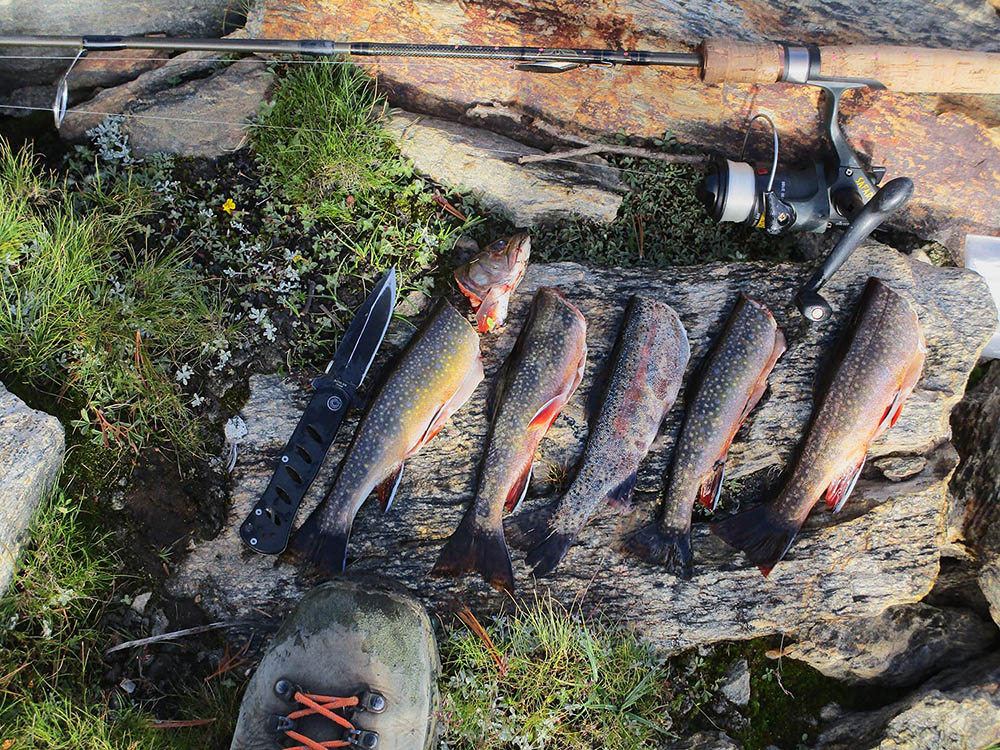
Indeed, fishing was good again, and within 90 minutes, using the same medium-weight silver Kastmaster, I had 4 eastern brook trout and one rainbow, all pan-sized, 7 to 9 inches, that fought well. So cleaned them at the lake shore, putting them into a Ziploc bag I stored partially in meadow stream water to keep them cool. In order for fish to fit within my backcountry 9-inch diameter frying pan, I always cut heads off and, for larger fish, tails. And may slice bodies in half if necessary.

US06833-06840-5x1v 14200x5400 pixels 5 frame 5 columns 1 row 8 shot stitch blend a6700 30mm
enlarged vertical slice view
From my camp, I chose a route along the rim of the bench above the shore. The outlet stream is crossed on a large log jam that also provides cover for some larger trout, the largest of which was about 13 inches. On the north side, the trail climbs up about 50 feet above lagoons before reaching the main trail. In order to reach Bull Lake without wasting significant elevation, one must hike a use path directly to Bull Lake via its outlet meadow and not the map trails. Unfortunately, it was not only another breezy day, I've been plagued with this summer, but clouds obscured the above stitch blend that I climbed an outcrop for well above the lake. Eventually, I gave up on waiting for the clouds to move, so I was content with just this one modest panorama of the lake with Hurd Peak and Thompson Ridge in the distance.

US06865-95 5100x4100 pixels 1 frame 31 shot focus stack blend a6700 56mm
enlarged vertical slice view
Back near camp at 11:31am, I worked with my 56mm lens, the above close-up of alpine gentian, Gentiana newberryi, on turf moss amid whitebark pine needles that I had located Saturday. The subject required 11 shots. The bud at the upper left edge is a hiker's gentian. Select the enlarged vertical slide view to see what focus stacking can do; frame edge to edge with a sharp lens at F5.0 with APS-C.
This kind of close-up, versus a manual process selecting each focus point as I performed for years with the a6000, is much more efficient and is over in seconds using the a6700 Focus Bracket function. I focused on the granite in the lower left. That short shot sequence is also more likely to fit within short breeze lulls before any breeze starts up again.

US07046-81 6150x4100 pixels 1 frame 36 shot focus stack blend a6700 56mm
enlarged vertical slice view
Next, worked these more common mid-summer in Sierra Nevada meadows, hiker's gentian, Gentianopsis simplex. Note the alpine gentian at the bottom-left edge of the frame. The plant leaves on the right against the rock and mid-left are dwarf bilberry, the leaves of which turn reddish purple by September.

Back at camp, I filled my 9-inch frying pan with the fish, then began pan frying/baking them in our usual process that requires using minor amounts of oil, while aluminum foil helps keep heat in for more even heating. I will turn the fish over once.

And here is the result. At this point, I use a pair of small diagonal pliers to grab fish backbones, then a fork to separate the flesh from the bone. Will also remove the fins/tail fin. Usually, we will also add some Minute rice, but not this day.

US07096-41 6150x4100 pixels 1 frame 46 shot focus stack blend a6700 56mm
enlarged vertical slice view
After a couple of relaxing hours in the afternoon, during which I enjoyed a water pour from a pan and water dunking on my meadow, at 3:33pm worked on another close-up of a metamorphic schist rock showing its fine-grained minerals within a siliceous matrix.

US07142-07169-3x1v 10700x6000 pixels 3 frame 3 columns 1 row 8 shot focus stack stitch blend a6700 30mm
enlarged vertical slice view
For later in the afternoon, I planned to climb up higher onto Hurd Peak slopes than I had done Saturday, which required an indirect route. That brought me up above 11050 feet, where at 4:26pm worked this modest image southeastward with a talus foreground including the south end of Long Lake, Ruwau Lake, Spearhead Lake, 13280+ foot Picture Puzzle, 13265+ foot Aperture Peak, 13893 foot Mt Agassiz, 11990 foot Bishop Pass, and much whitebark pine. Some Applegate's paintbrush, western asters, and gone-to-seed shooting star, amid grasses in the foreground. Though I'm not often a peak bagger, I did climb Mt Agassiz in 1981, my highest such effort. My usual planned hiking targets are not highest peak tops but rather best viewpoints, which are often not obvious but can involve difficult efforts to reach.

US07199-07201-2x1v 7000x4900 pixels 2 frame 2 columns 1 row 2 shot stitch blend a6700 30mm
enlarged vertical slice view
Pointing my lens northeastward at 4:46pm, I shot this 2-frame 30mm vertical orientation lens landscape with the north end of Long Lake at frame lower right, Bull Lake, and part of Chocolate Peak and the Inconsolable Range behind. Hurd Peak shadows at frame lower right were quickly encroaching on the lower frame trees. So 5pm mid August is about as late in the afternoon one might work on any west side of Long Lake landscapes.

US07217-07222-6x1v 17600x6000 pixels 6 frame 6 columns 1 row 6 shot stitch blend a6700 85mm
enlarged vertical slice view
After shadows engulfed my position at 5:07pm, I installed the 85mm lens for the above 6-shot, 6-frame stitch panorama of the Bishop Pass zone, with Picture Puzzle, Aperture Peak, Mt Agassiz, Bishop Pass, whitebark pine.

And a 100% pixels crop from the image US07217-07222-6x1v above of Bishop Pass showing how sharp the Sony 85mm lens is. Have helped mark the trail with magenta dots.

US07246 5900x3500 pixels 1 frame 1 shot a6700 85mm
enlarged vertical slice view
Back at camp at a late 7:32pm, captured the rugged avalanche chutes of 13528 foot Cloudripper in good gold-orange phase sunlight. The peak has a similar look to the late light on nearby Mt Winchell from Dusy Basin.

And a look at what parts of the above image look like with a 100% pixel crop.

US07255 6150x4100 pixels 1 frame 1 shot a6700 56mm
enlarged vertical slice view
For my last image of the trip, at 7:56pm, I shot red light on clouds down the canyon to the north.
Well, Monday, August 12, 2024 was windy, just like previous days, plus some clouds like Sunday. So just packed up gear and set out towards the trailhead. That effort went smoothly, and by 9am had reached the South Lake trailhead parking lot. I then drove down to Von's in Bishop for a quick pit stop of gas, food, and drink, before heading north on US395 towards SR108 and Sonora Pass. Easily driving against the opposite direction of Monday afternoon commute traffic, by 4pm was back home.
2024 Trip Chronicles: Contents
David Senesac


