
UR05625-05628-3x1h 15300x4100 pixels 3 frame 3 column 1 row 4 shot stitch blend a6700 56mm
enlarged vertical slice view image text section
NEXT: Page 11 Treasure Lakes Backpack 8/7 1of2
2024 Trip Chronicles: Contents
George Lake Backpack 8/5
George Lake Backpack 8/6
After our Green Creek backpack, I had a week to prepare before starting the first of two back-to-back backpack trips into Bishop Creek areas. My original plan was to drive the 300+ miles on Sunday, August 4; however, I changed that to Monday, 8/5, the starting day of my recreation dot gov wilderness permit for three days to George Lake, and instead enjoyed a late afternoon nearby outdoor music concert. My second permit to Treasure Lakes was set to begin on Thursday, August 8, and extend 5 days till Monday, August 12. I expected to only spend one night on the George Lake backpack, with 8/7 an insurance day I would otherwise reorganize gear and recover strength.
So began the long drive on Monday morning, August 5, 2024, against the commute that went smoothly, reaching Bishop early afternoon on a hot day. Due to the strenuous effort to reach a remote location with a spectacular view (at page top), I packed gear not into my Osprey Aether 70 backpack but rather my Osprey Skarab 32 photography gear daypack that is normally bunji'd to the back of the Aether 70, with a total carrying weight of about 60 pounds. Into the Skarab 32 would fit my Remo Aya 15-degree goose-down sleeping bag, an old OR Gortex bivy sack I had not used in several years, a Tyvek ground sheet, and a much reduced amount of photo gear. That included only my 30mm, 56mm, and 85mm lenses, just 3 NP-FZ100 batteries, no cooking gear, minimal clothing, and minimal food. That came out to be about 35 pounds of carrying weight, including my 3.3-pound Zamberlan boots and 3.5 pounds of clothing and pocket items, including 1.4-pound Levi 505 pants. So my pack weight was about 29 pounds or half my usual carrying weight for this 5 foot 5.5 inch 138 pound 75 year old male.
At Bishop, I went into Von's supermarket and bought a $7 tuna sandwich and a strawberry yogurt that I would be carrying to George Lake, complemented by a minor amount of Quaker Simple Granola. The rest of my gear for the second trip was carefully left in bags I would assemble after the return. Thus, I drove to the Lake Sabrina trailhead at 9070 feet adjacent to the campground and, at 4:01pm PDT, set out in upper 70F degree temperatures. The first half mile climbs 100 feet to 9150 along the down-and-up paved road before reaching the actual foot trail above the east end of the reservoir dam. Sabrina is another small natural lake that was greatly enlarged with a dam.
Link to CalTopo topographic map of area:
caltopo George Lake map

The next 1.1 miles to the George Lake/Blue Lake trail junction had some ups and downs, climbing to 9420 feet with maybe 400 feet of vertical gain. At the junction, somewhat weary and sweating, I dropped my pack and went another couple hundred yards to the George Lake creek for additional water and a cool head soaking since the next water source was a steep 600 feet above.
George Lake is at 10717 feet, or 1300 feet above the junction, with much of that a steep 1000 feet. The narrow footpath trail has not been maintained in recent years, so the granular granite sand geology has washed over level trail surfaces, creating awkward downward-sloping surfaces. In some sections, the trail is across very steep slopes, so it is a bit dangerous. Per my usual style, despite the lower weight, I stopped frequently to sit or lean back on every available thigh-high log or boulder. Midway, 600 feet above, the trail crosses a small seep stream where I added water. I was glad that I was not lugging my usual weight, as the steep trail would have been miserable. By sunset, in weariness, I reached the rim of the upper basin at 10450 feet, with another 150 feet, 6/10 mile to my planned camp zone. In the dim light, I lost the trail through a marshy meadow, taking a use path, so I missed where I expected to stop. Instead, I regained the trail further ahead, where the trail rises more steeply, 150 vertical feet over 4/10 mile before reaching the northwest end of George Lake.
At George, I quickly rambled well above campsites by the lake shore and found a level granite sand spot between boulders per Canon ELPH190 image above. A total day's effort of 3.2 miles with 1800 feet of vertical. After filling up my water bottle directly from the lake, I made camp and settled into the bivy sack that I immediately had torn mosquito-netting zipper issues with. I should have looked at and repaired the old bivy before the trip. After consuming the tunafish sandwich, I spent a moderately unpleasant night trying to sleep while the netting on the bivy continually and annoyingly fell against my face while a few mosquitoes whined just outside. Without a usual soft sleeping pad, sleeping directly on the coarse sand was unpleasant, causing frequent rotation from side to back to side. Fortunately, I did manage enough sleep. I never used any DEET during the trip as there were few mosquitoes left by this time of mid-summer. Given the huge marsh above the lake, this is a basin to avoid in early summer during peak mosquitoes.

With dawn rising on Tuesday August 6, 2024, I was up and packing my gear for photography. I stashed my ground sheet, sleeping bag, and bivy sack at the camp spot, reducing weight for the coming 1000 foot 1.6 mile climb to the view spot. Before starting that effort, I would first enjoy some morning photography of George Lake itself. The George Lake basin has a northwest-to-southeast orientation, with the rim of Table Mountain 600 or so feet steeply above. Thus, moved to the south end of the lake for front-lit morning sunlight. There were no other groups in the basin.

UR05432-05445-4x1v 11600x6100 pixels 4 frame 4 columns 1 row 14 shot focus stack stitch blend a6700 56mm
enlarged vertical slice view
The above at 8:01am was my third subject of the morning, a sunny day with a sumping night breeze off shadowed slopes making better reflection lake subjects unlikely most mornings. I climbed up a bit above the lake for this modest 4-column 56mm lens stitch blend of just 13 shots. George Lake, with Mt Emerson at frame center beside rusty Piute Crags with the top of Mt Humphreys poking out above.
When focus stacking landscapes with clear blue sky, one should always use just a single, at-least near-infinity shot for a whole sky for each frame and not the combined result of all Zerene Stacker or Photoshop CSR6 shots because such additive combinations will add up any noise in each shot. With clouds, one won't have that option. With the addition of stitching frames with clouds, a strategy is to, after shooting all frames, set Drive mode to single shot with focus on Manual infinity. Then quickly shoot all frames in sequence. To do so, one must carefully match such last shots to tripod head positions used in earlier shots lest one lose frame edge registrations.

UR05446-05461-2x1h 10100x4100 pixels 2 frame 2 columns 1 row 16 shot focus stack stitch blend a6700 30mm
enlarged vertical slice view
My fourth subject at 8:15am, was back down at the meadow, where I repeated my second subject, given the less wavy lake waters. If the lake had a better reflection, I would have used 4 vertical 30mm frames instead of 2 horizontal. George Lake with a slight breeze plus eastern brook trout fish rings, Mt Thoreau, Mt Emerson, Piute Crags, Lemmon's painbrush, Castelleja lemmonii, mostly gone to seed little elephant's head, Pedicularis attollens, plus a few ranger buttons, Sphenosciadium capitellatum, great red paintbrush, Castelleja miniata, with Sierra willow, Salix orestera along the shore.

UR05462-05480-4x1v 12800x6100 pixels 4 frame 4 columns 1 row 19 shot focus stack stitch blend a6700 30mm
enlarged vertical slice view
I rambled back to the outlet end of George Lake to a quiet, nameless pond that was receiving lake water seeping through the porous granite sand. There at 8:28am worked this nicely calm reflection 4 column stitch blend, northwestward with Mt Thoreau in the distance. Whitebark pine, Pinus albicaulis, with Sierra willow and grasses below, reflect in its shallow, algae-coated waters.
Note sunshine illuminating the pond bottom. Such reflection shots require careful post-processing with Zerene Stacker. All water images using focus stacking require selective shot processing that otherwise results in wavy, blurred, out-of-focus combinations of all shots. Also, because the surface reflection of distant elements is sharp in different shots than shots of the closer pond bottom or surface floating grasses, one must select different shots for different water sections without making an unnatural result at transition areas. Two such shots cannot be combined in ZS, so the dominant shot of either ought to be used. Note: if one selects the reflecting infinity distance canyon talus slopes or trees, near-water grasses at the surface would be out of focus, and vice versa. Note: one can later combine two shots in Photoshop using layers, though that is rarely necessary.

UR05481-05495-4x1v 9400x4000 pixels 4 frame 4 columns 1 row 15 shot focus stack stitch blend a6700 30mm
enlarged vertical slice view
With up-canyon breezes appearing, for my last subject down by the lake, I climbed up into some large talus near the pond to put both the pond and lake in the same frame. The lake had numbers of pan-sized eastern brook trout. Given the large marsh and all-year flows into the lake for spawning, it would be best if the lake was treated with rotenone and replanted with either rainbow or golden trout.

It was now 8:50am, time to start hiking cross-country to my prime objective up to the headwall ridgeline separating the south and middle fork drainages of Bishop Creek. See the above Google Earth image. I didn't need to be up there until about 4pm, so I was in no hurry and would take a midday break somewhere below the ridgeline. Behind the lake is a long marshy meadow with multiple deeper channels. The north side was choked by medium to large talus with marsh right up to boulders, while the south side had a mix of smaller talus and forest. Dense Sierra willow made travel awkward in many areas. Walking along the northeast side of the marsh was impossible, and hiking above it would require moving through 4 medium to large talus slopes. The south side of the marsh had minor talus, so I was able to walk most of the way either atop a shallow stream on granite sand or just beside it.
At the southeast end of the marsh, a bedrock outcrop surrounded by tall Sierra willow blocked further movement, with large talus just beyond. I crossed the stream to the north side and traversed on steep granite sand slopes between whitebark pines until I had gone beyond the large talus. Beyond the talus, I crossed over to areas south of the stream where there are numbers of possible routes up the north-facing slopes to the ridgeline. Now, in hindsight, I would reach the target ridge via the Tyee Lakes trailhead while vectoring off the trail after the trail passes the highest lake. This above route from George Lake was an unpleasant obstacle course.

UR05496-05529-2x1h 9400x4000 pixels 2 frame 2 columns 1 row 34 shot focus stack stitch blend a6700 56mm
enlarged vertical slice view
At about 11.0k, there were some meadow areas with dense, peaking wildflowers that I expected to encounter before the trip because the north-facing slope was certain to have later summer snowmelt and seeps. On such slopes, areas at the base usually have the best flowery meadow areas. The above shallow pond I worked at 10:01am, was one of 3 subjects I worked. Behind the pond are Lemmon's paintbrush, little elephant's head, western aster, Aster ascendens, alpine gentian, Gentiana newberryi, silver lupine, Lupinus argentius, and Sierra willow. As I noted above, this kind of water reflection subject requires considerable post-processing work separating the reflection from the pond bottom.

UR05557-05572-3x1v 9500x6100 pixels 3 frame 3 columns 1 row 16 shot focus stack stitch blend a6700 30mm
enlarged vertical slice view
An hour later, near 11.0k or a couple hundred feet below the ridgeline, I stopped in a high meadow below snow patches with some shading pines to relax for a few hours and eat the strawberry yogurt. There, I worked, looking down the canyon beyond nearby whitebark pines, towards George Lake, with in the distance Mt Thoreau, Mt Emerson, Piute Crags, and Mt Humphreys. The valley below Mt Thoreau contains the Wonder Lakes, none of which are visible, while the North Fork of Bishop Creek is in the out-of-view canyon in front of Mt Emerson that leads to Piute Pass.
About 3pm, I began exploring upper ridgeline areas as I headed towards the location I'd figured out to have an exceptional view towards the South Fork of Bishop Creek headwaters areas. Unfortunately, as is common during afternoons in Sierra Crest areas, even during fair weather, clouds had been building up above that made capturing the distant landscape in good light without unaesthetic shadows difficult. Although clouds were moving from the west-northwest at speed, such clouds continually re-form over the crest, so some landscapes remained shadowed despite waiting and waiting for much of an hour.
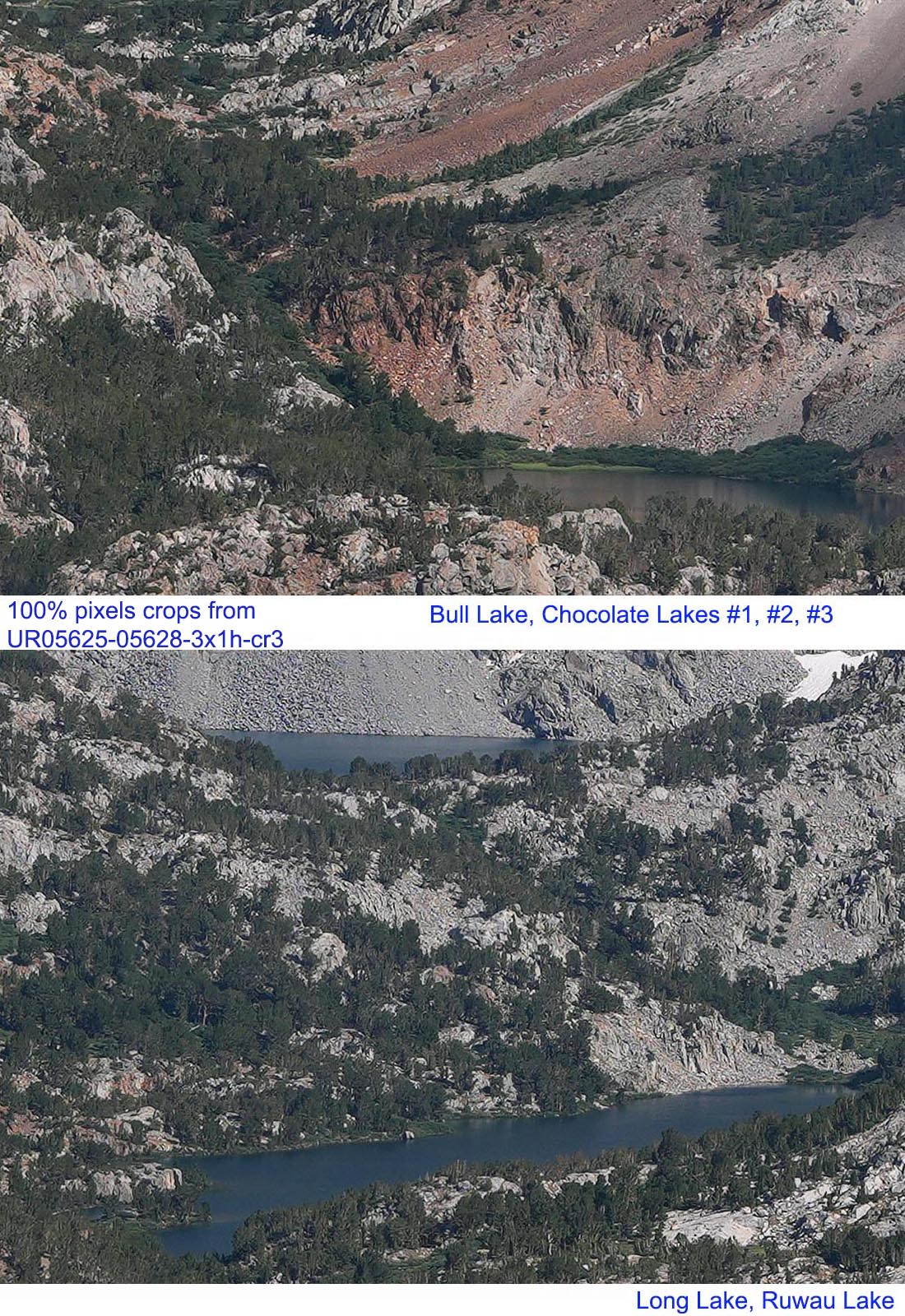
The 4pm image at page top with dimmed, shadowed areas is the best I could salvage. There was a stronger variable breeze at the ridgeline even during lulls; I also had to block my tripod/camera by standing in front of the wind direction. Within this 3-column, 56mm lens horizontal stitch are Cloudripper, Gendarme Peak, Picture Puzzle, Aperture Peak, Mt Agassiz, Chocolate Peak, Hurd Peak, Mt Goode, Chocolate Lakes #1, #2, #3, Bull Lake, Long Lake, Ruwau Lake, Treasure Lakes #1, #2, #3, #4, #5, #6, #7, thirteen lakes total. The following are 100% pixels crops showing the 13 lakes in the image at the top. During a future summer, will need to visit this remote location again. But will likely do so a few weeks earlier via the Tyee Lake trail while snow is still more prominent from a base camp atop Table Mountain.

UR05631-05637-4x1v 15500x6100 pixels 4 frame 4 columns 1 row 7 shot stitch blend a6700 30mm
enlarged vertical slice view
At 4:30pm I removed the Sigma 56mm prime lens in the horizontal orientation and installed my Sony 85mm prime lens in the vertical orientation. That provided this second landscape above.
I needed to hike all the way back to the trailhead before dark; that was 4.5 miles and 2500 feet lower. Well, actually, I'm quite experienced in trail night hiking with a flashlight; however, I prefer to avoid such overly long distances. Even with a strong flashlight, night hiking off-trail can be quite tedious and dangerous. Below is a view of the Class 2 blocky glaciated granite headwall route where I descended from the north-facing ridgeline down to where I had stayed during midday, with these small remnant snowfields providing water for the green meadow and flowers. The headwall is Class 1 a bit further west, but that leads to expanses of whitebark pine at the top one then needs to navigate through, whereas this more direct route leads to open granite sands. From the bottom at 11.0k, this is the ravine to the east, not the larger ravine further west that tends to have more blocking willow areas.


UR05640-05657-2x1v 7200x6100 pixels 2 frame 2 columns 1 row 18 shot stitch blend a6700 30mm
enlarged vertical slice view
Thus descended back to my earlier day camp where I did spend a few minutes shooting the above with silver lupine and common monkeyflower wildflowers plus a few little elephant's heads. Also at the lower right edge are arctic willow, Salix arctica, showing cottony catkins. Against the boulder frame left are leaves of red mountain heather and, in the right corner, shooting star, both of which bloomed several weeks earlier.
It was now 5:05pm as I began bounding down my cross-country route that, given terrain knowledge of areas to avoid, was a bit different, more efficient, than the route I used climbing up. Before 6pm, I had reached the pond below George Lake, where I unwisely wasted precious time taking a dunking in the water that required undressing, drying off, then redressing, including my boots and socks that had become wet after accidentally stepping in the marsh. Sunset occurred while I was dropping into the steep switchbacks at 10000. I finally reached my Forester at dim dusk at 8:15pm. Thus, my hike back was a 3-hour effort. I immediately drove off to the nearby creek bridge on the North Lake Road in order to dunk myself in the water, as I needed it to sleep pleasantly. Then drove nearby, parked roadside, and settled in for a quiet night sleeping on my much more comfortable Forester back bed.
The next morning, I would drive directly to South Lake Road, stop at Parcher's Camp store, pick up a pint of milk, then continue to the South Lake trailhead parking lot to reorganize. Although my following permit for Treasure Lakes began the following day 8/8, I could legally knock off the first 8/10 mile and 400 vertical feet up by hiking in late afternoon, stopping at the wilderness boundary. So hiking out a day early had value before the next trip.
NEXT: Page 11 Treasure Lakes Backpack 8/7 1of2
2024 Trip Chronicles: Contents


