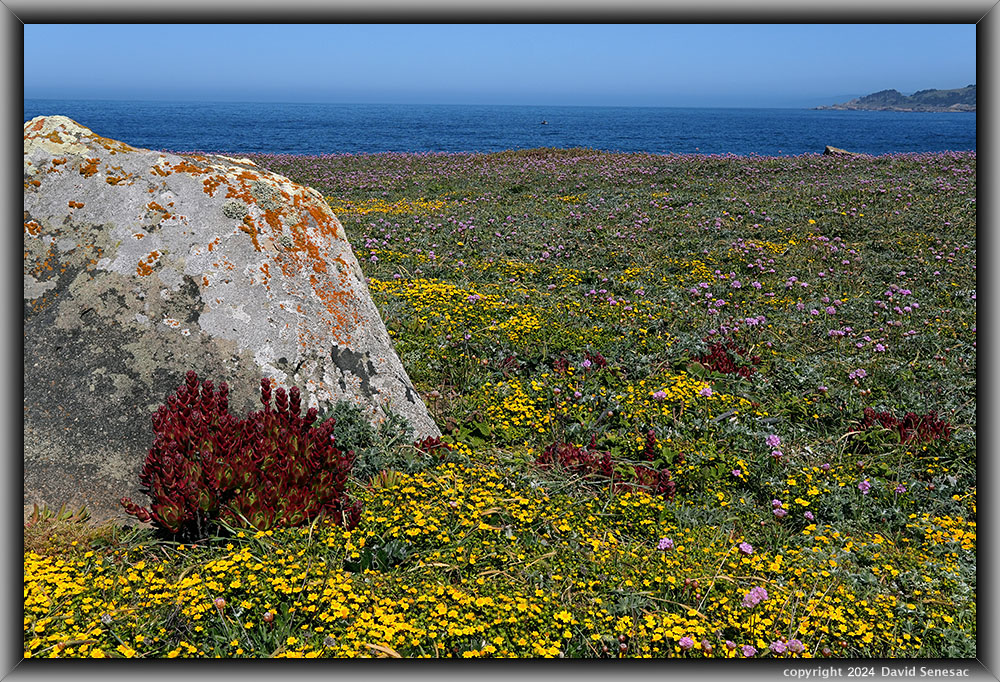
UN09764-80 6150x4100 pixels 1 frame 30 shot focus stack blend a6700 30mm
enlarged vertical slice view image text section
NEXT: Page 6 Salt Point State Park 5/10 2of2
2024 Trip Chronicles: Contents
Sonoma Coast 5/9
Sonoma Coast State Park 5/9
Salt Point State Park 5/10 1of2
There are many beaches along the Pacic Ocean coast with surf-smoothed stone cobbles and pebbles. However, few such stony beaches have multi-colored stones that require uncommon geologies at nearby shore bluff areas they erode out from. I've been occasionally photographing these multi-colored beach stone subjects for nearly 3 decades, so I have a sizeable body of this work. However, few of those images have ever been presented on my public website in part to keep these locations out of the public's awareness. Of course, many beachcombing people might collect such natural beauties that over years would denude these beaches of better stones, much like has happened at Glass Beach in Fort Bragg.
One well-known, very accessible location is on the San Mateo County coast along California Route 1 at Bean Hollow State Beach at Pebble Beach, which has sandstone rock with sedimentary conglomerate bands that erode out embedded stones. Most such locations I've discovered are somewhat obscure, sometimes requiring climbing down steep, unstable sea bluffs. Often, such stony areas on beaches are fully covered in sand that depends on tides and storms to be uncovered. The best time for such wet stone photography, providing the best color saturation, is on sunny mid-days with a higher sun altitude for a translucent glow from inside stones. Thus, cloudy or foggy conditions ought to be avoided. Such wet stone subjects are considerably more aesthetic when freshly wet and glistening in sunlight from surf wave action than when dry or even slightly wet. However, wet stones in sunshine cause bright specular reflections that must then be somewhat neutralized.
Although a photographer could manually wet stones with, say, a spray bottle, such is against my personal choices reflecting the rest of my large body of ethical work and post-processing. I tried that once but decided it would not be part of my natural style. Thus, I only work stone subjects that waves have freshly washed over and never touch or move them. And that also becomes a game of knowing tide tables and keeping an ear and eye towards waves in order to not, while focused down on subjects, become soaked from larger sets of waves rushing up beach sands. Worse, if such waves reach one's camera, the corrosive, salty ion water may destroy it, waterproofing or not. Many times, I've sprung up like a jack-in-the-box on steroids, moments before foamy, sandy, salty waves were about to soak me. Needless to say, waterproof boots have value as one will be walking on wet boulders, stones, and sand.
Since purchasing a Sony a6700 last summer that replaces the a6000 bought in 2014, its focus bracketing function has made capturing such stone close-ups much faster and more productive. Instead of using my Oben CT-2316 carbon fiber tripod with its panoramic head setup, on beaches I use an old Benbo Trekker tripod with a small ballhead that sets up faster and easier for close-to-the-ground subjects. If I need to capture an occasional panoramic landscape, I can still use the grid thirds display method to accomplish that. I also wear knee pads in order to keep the Levi's 505s I often wear from hard stone surfaces and getting knees wet.
Especially on the frequently strong northwesterly wind days, there is much salty water vapor in the air that also may rapidly coat gear. So it is important to continually bother covering lens glass if not actively shooting. I also bring a small cotton cloth in my coat pocket for soaking up any seawater splashing and multiple microfiber lens cloths in my camera day pack. As with the rest of my recent work, I use a small Bluetooth RF wireless shutter release, RM-P1BTA, so my camera, once a shot is set up, is absolutely still and stable, as otherwise, with focus stacking using a high-megapixel camera, misregistration ghosting between shots may result.
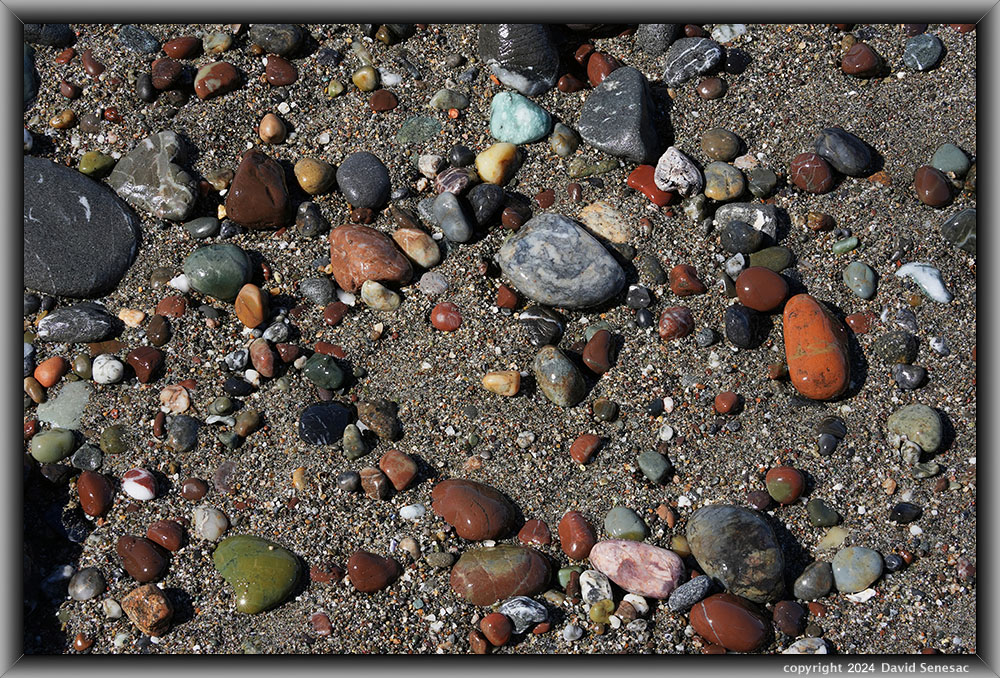
UN07774-02 6200x4100 pixels 1 frame 29 shot focus stack blend a6700 56mm
enlarged vertical slice view
The above image was worked on Thursday May 9, 2024. Subjects with stones isolated by sand offer more element separation to stand out better. Each time a wave washes up on such shore areas, stones and sand move around, changing and refreshing subjects. So working beaches can be more productive on a rising tide. With single-shot camera work for the sake of adequate depth of field, frame elements need to be relatively equidistant or positioned with a lens from a perpendicular position, and one must use a smaller, less sharp lens aperture. However, in doing so, optimal light on stones is usually less than ideal versus focus bracketing from any desired angle. With wet stones, optimal color saturation is rarely from a direct overhead view, so I normally will circle a subject, evaluating the aesthetics of reflected light. With this above subject and most others, the frame bottom edge is closer than the top, with the left and right frame balanced. The a6700 has a camera display leveling tool I always use on any subject.
These subjects won't look impressive in the severely downsized-for-web versions I present herein that lose so much fine detail. That is why I also encourage selecting the enlarged vertical slice view links below each image to better perceive why that is so. The public will otherwise need to wait till I publicly begin exhibiting full images with large 8k displays. And note, such slices are at only 50% full pixels, so actual 100% pixel images are even more impressive.
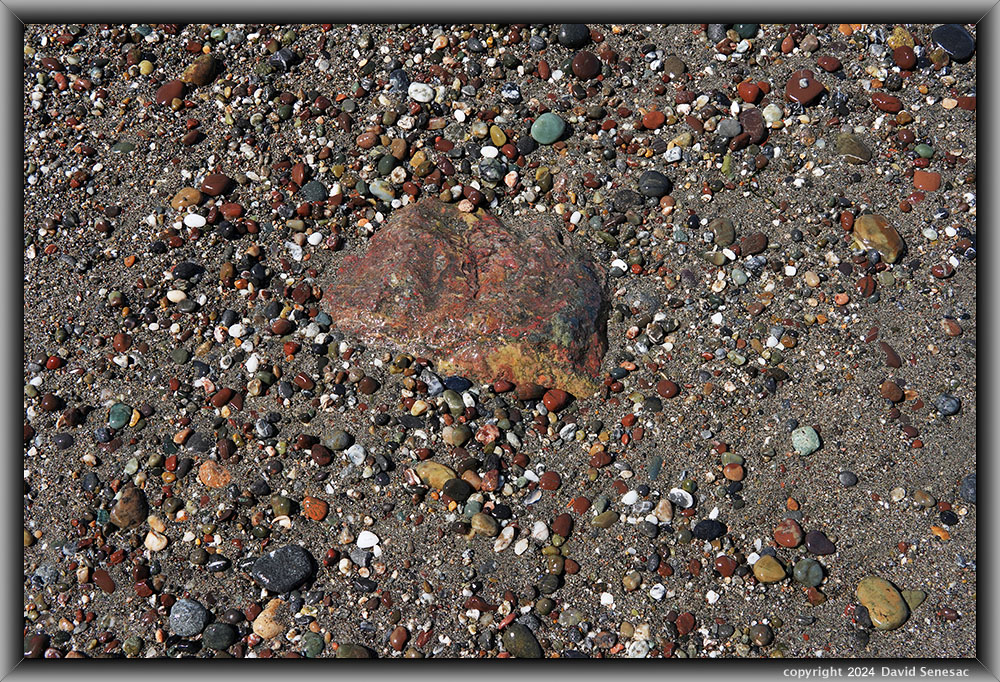
UN07893-07 6150x4100 pixels 1 frame 15 shot focus stack blend a6700 56mm
enlarged vertical slice view
The above subject has a large, colorful siliceous boulder barely uncovered in the sand that reflects the source of why these subjects have so many colorful stones eroded out from adjacent sea bluffs.
In post-processing wet stones, Zerene Stacker must be used in a more tedious and time-consuming manual mode versus the automated Pmax or Dmap modes, because otherwise, every shot in a focus bracket set will have different misregistered, bright, glistening spectral reflections that add into the output, making it unnatural with far more spectral reflections than exist at any one moment. Thus, I immediately totally replace Pmax results and build images at 100% pixels, painting in small areas from shots, window frame by frame, which requires being able to distinguish between slightly different focus detail between shots. A subtle visual skill I have amazingly improved over 10 years.
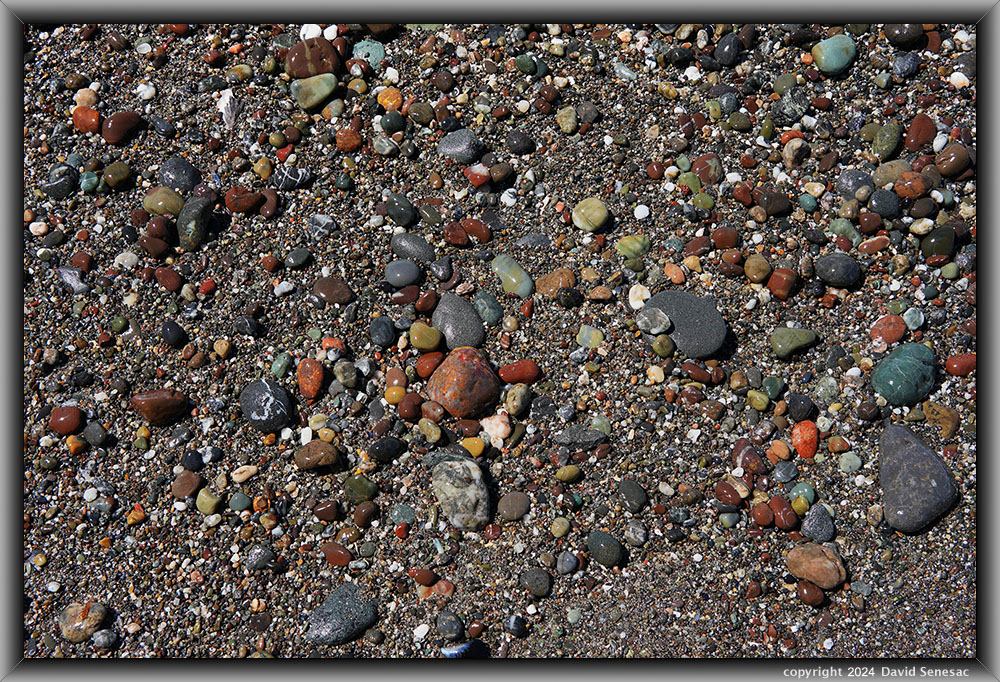
UN08003-19 6150x4100 pixels 1 frame 17 shot focus stack blend a6700 56mm
enlarged vertical slice view
Another subject above with nice sand to stone separation. Of course, I prefer to put the most prominent stones near the frame center, with an eye-catching anchor stone at the frame center.
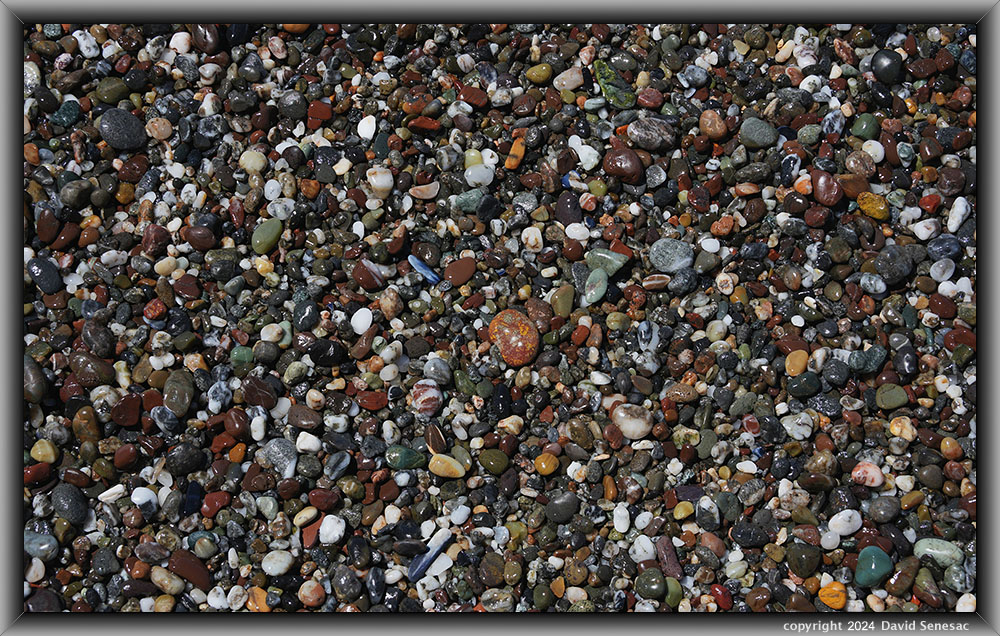
UN08095-12 6150x3800 pixels 1 frame 18 shot focus stack blend a6700 56mm
enlarged vertical slice view
The above subject is a more common situation for all stones without sand.
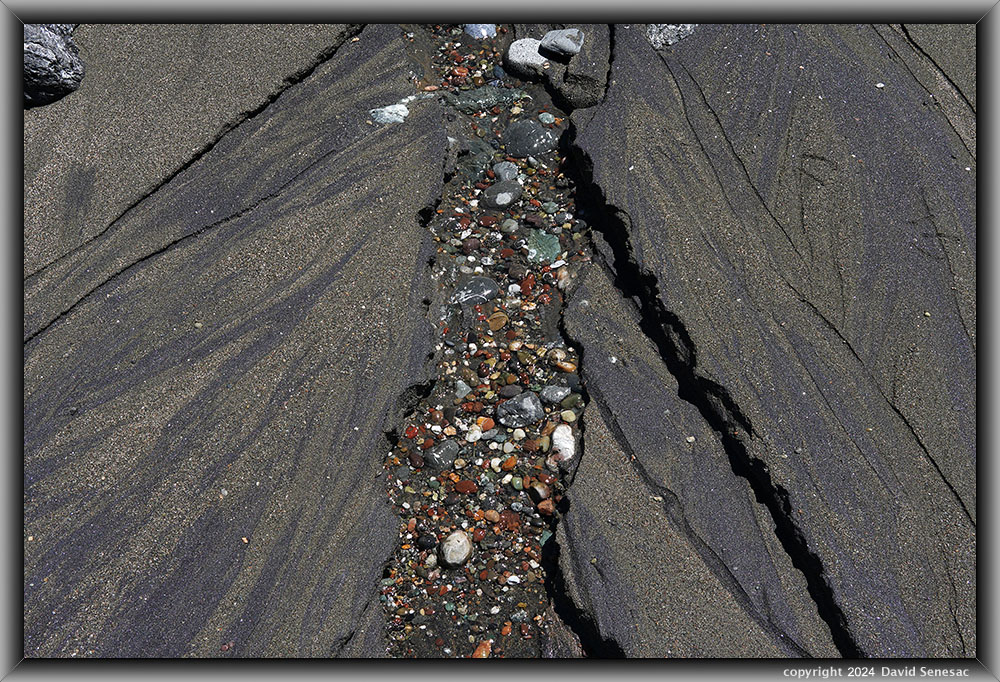
UN08155-64 6150x4100 pixels 1 frame 10 shot focus stack blend a6700 30mm
enlarged vertical slice view
Eroded out from a bluff, fine dark gray sand that a stream off the bluff has eroded a stream path through, revealing buried stones underneath. In the upper right, there are seagull footprints. I often find stones at my favorite stony beaches buried under sand that varying monthly tides are constantly changing.
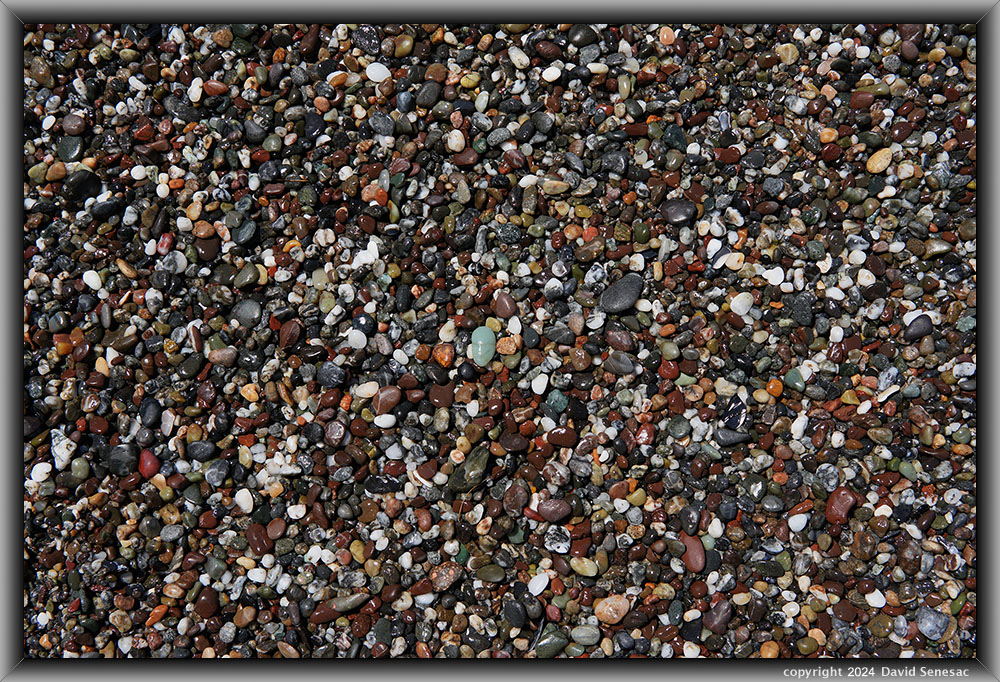
UN08179-88 6150x4100 pixels 1 frame 10 shot focus stack blend a6700 56mm
enlarged vertical slice view
Another all-stones-without-sand subject. Due to wave action, some areas like this tend to mechanically sort stones by size and shape, creating smooth, level areas of similarly sized stones and pebbles.
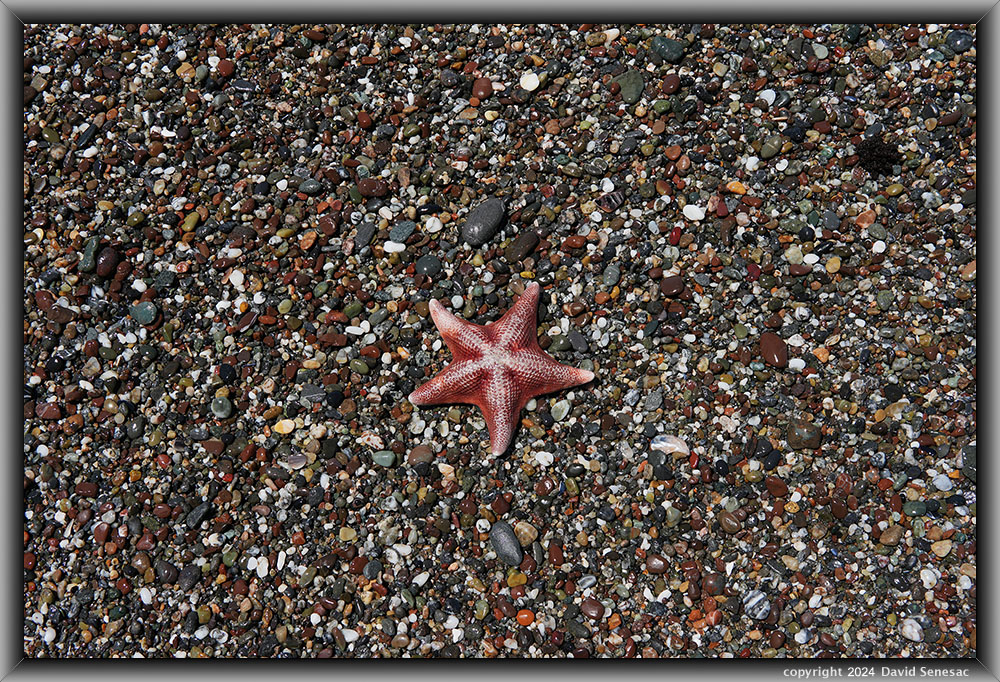
UN08218-34 6150x4100 pixels 1 frame 17 shot focus stack blend a6700 56mm
enlarged vertical slice view
The centerpiece of the above wet shore stones frame is a freshly washed-up starfish that will bake in the sun and then be consumed by other organic life.
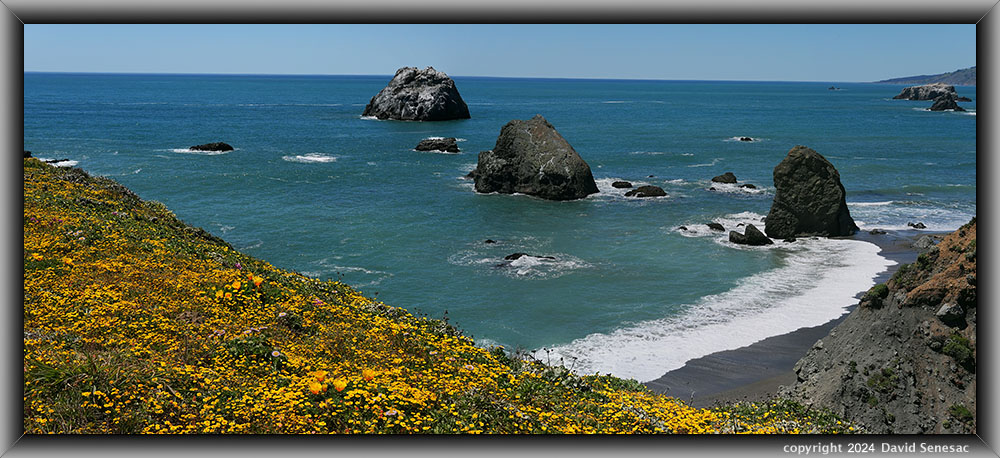
UN08406-08446-2x1h 9400x4050 pixels 2 frame 2 column 1 row 41 shot focus stack stitch blend a6700 30mm
enlarged vertical slice view
Further along the coast at 1:57pm, I had hiked down to a favorite bluff wildflower landscape spot with Gull Rock in the distance at frame center, actually populated by cormorants and 2 other sea stacks closer. Arched Rock is in the distance at frame right. In the foreground, California goldfields, Lasthenia californica, California poppy, Eschscholzia californica, with a few seaside daisies, scarlet pimpernel, Anagallis arvensis, checker mallow, Sidalcea malviflora, and sea thrift, Armeria maritima. A very difficult and time-consuming focus stack image to post-process due to huge parallax artifacts at the near bluff flower edge to distant seawater boundary that I should have added shots at, say F11/F14 to remedy.
Back at my Forester, I drove north to Salt Point State Park where I obtained a campsite in the Lower Forest Loop. Later that breezy afternoon, I surveyed some areas, preparing for work the next morning.
After overnighting at the Salt Point State Park campground, on Friday morning, May 10, 2024 I rose early in order to survey landscapes well before light would be good enough to work them. Note: I have always been able to obtain midweek walk-up campsites at this park that are now $33 for seniors. I ventured out in calm air across its green, wildflower-dense coastal bluffs that have numbers of small sandstone rock outcrop hills. One must be aware of avoiding poison oak on those outcrops.
I was immediately surprised and impressed by a California goldfields bloom on the near bluff edges beyond what I've ever seen in the past, which resulted from the strong rainstorm a week before at an optimal time for the species in early spring. There were other species, such as rose johnny-tuck, cream cups, witches teeth, dwarf brodiae, and others also blooming in unusual numbers. As someone who has experienced several since the term was coined in 2016 for the Death Valley bloom that late winter, this became only the second Northern California location I might ever label as a genuine "superbloom" along with those at Table Mountain near Oroville.
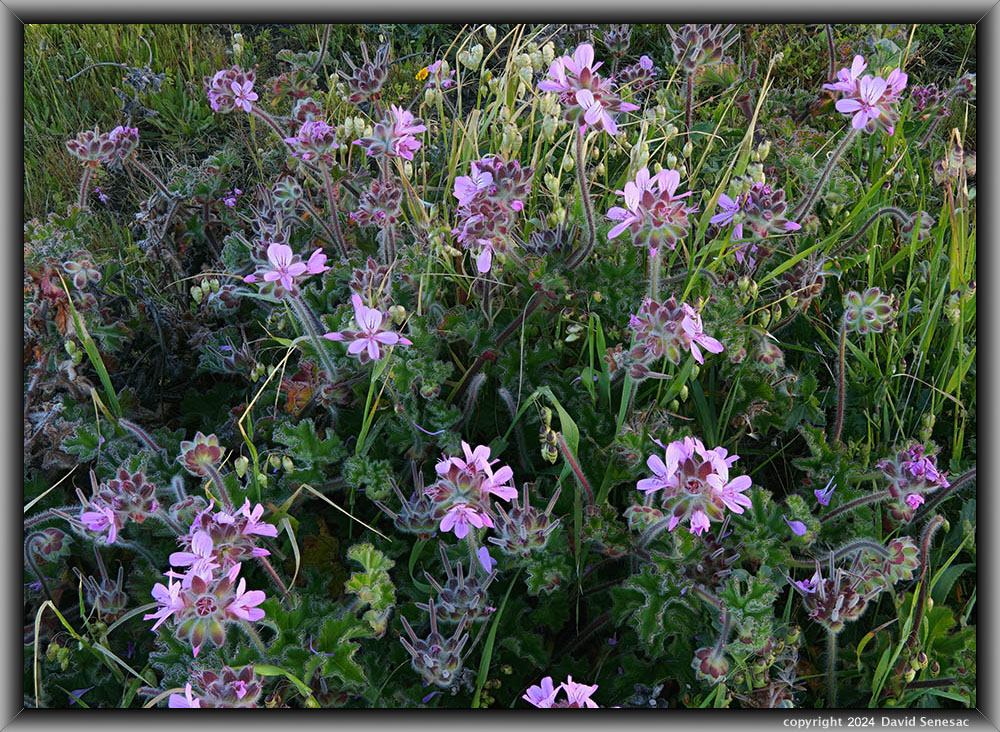
UN08745-78 5700x4100 pixels 1 frame 34 shot focus stack blend a6700 30mm
enlarged vertical slice view
Per the above image, on one hill was this grapeleaf geranium, Pelargonium vitifolium, a southern African native plant, that required several attempts during breeze lulls before capturing a bracket set that stayed dead calm long enough. This type of subject, sharp to the ground frame edge to edge, would be impossible to post-process without in-camera focus bracketing capture due to many elements with significant parallax. Especially impossible to fix is parallax in the back of tiny plant stems and leaf hairs. In Zerene Stacker, manual processing would also be impossible, so I used the automated Pmax output that required several seconds of dead calm while my a6700 cranked through 34 shots. Note the detail of fine hairs and dangling rattlesnake grass (alien) seedheads that, in breezes, shake, making a slight sound like rattlesnake rattles.
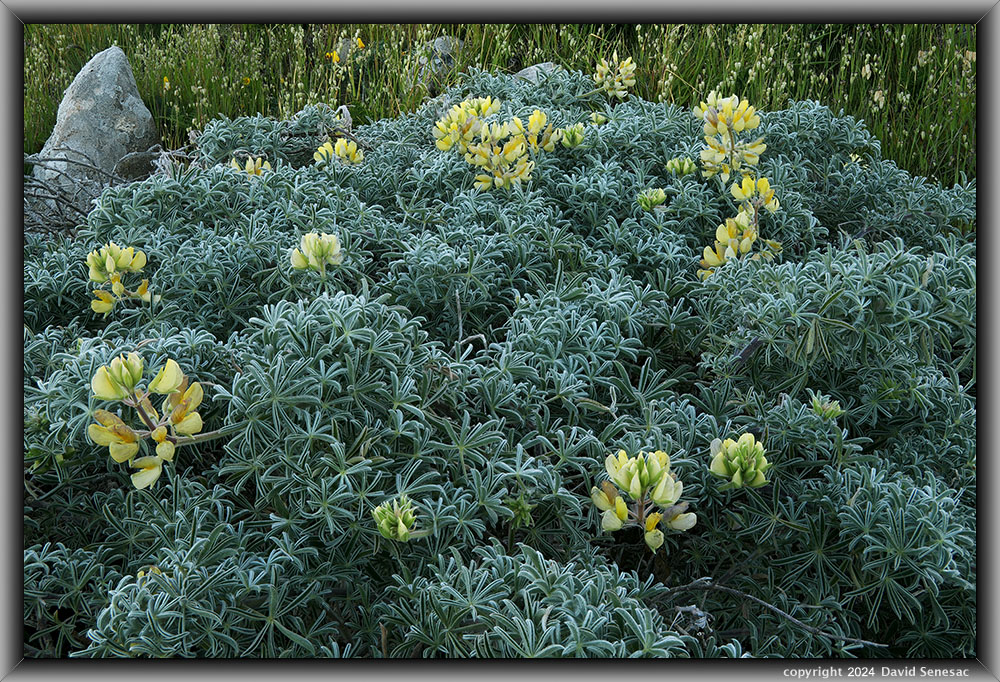
UN08790-39 5700x4100 pixels 1 frame 50 shot focus stack blend a6700 30mm
enlarged vertical slice view
Across the top of fragrant yellow bush lupine, Lupinis arboreaus, with rattlesnake grasses behind. The colorful species was originally only native as far north as San Mateo County but has spread along shores as far north as Oregon. Leaves and stems are covered by tiny white hairs that give the cyan green color a unique white glow.
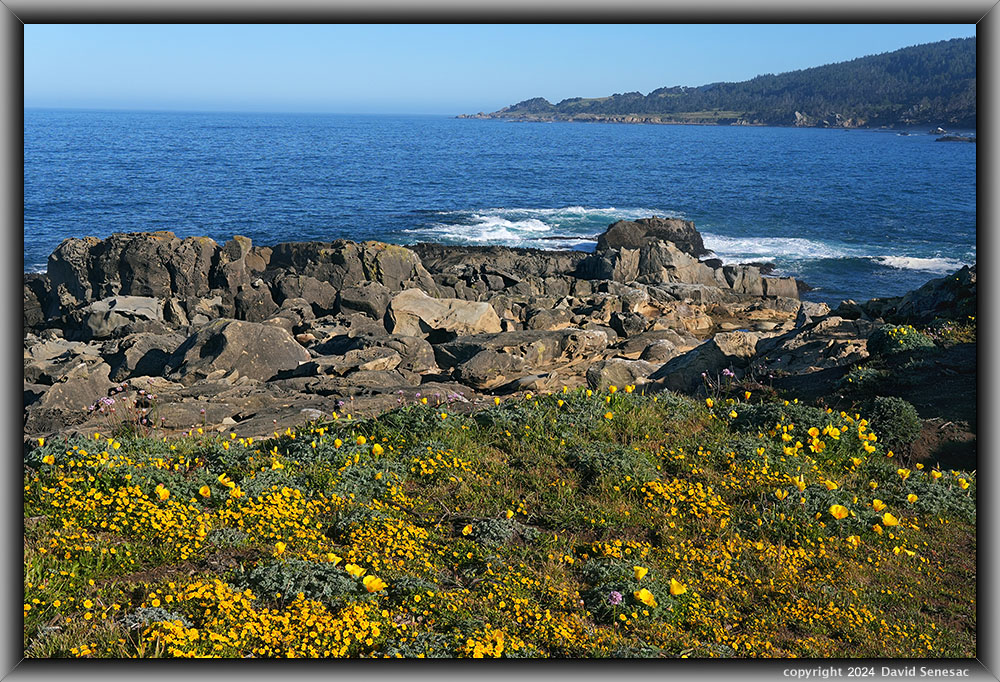
UN08970-84 6150x4100 pixels 1 frame 15 shot focus stack blend a6700 30mm
enlarged vertical slice view
Seascape shot at an early 8:12am PDT with California goldfields, California poppies, and sea thrift, at the bluff edge, and sandstone with tafoni below. Most of these shore wildflower species were just beginning to open up, and the sea itself was quite calm as diurnal winds had not yet developed. Lower shore rocks are increasingly dark from organic life that is also extremely slippery to walk atop.
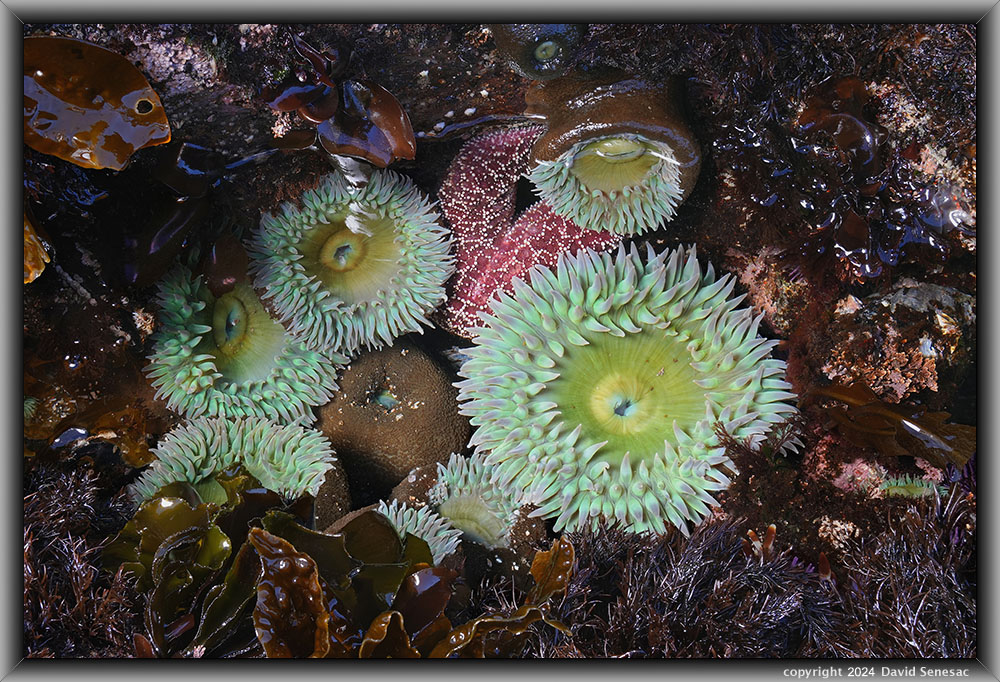
UN09085-22 6150x4100 pixels 1 frame 38 shot focus stack blend a6700 56mm
enlarged vertical slice view
May 10 had a minus 1.0 foot low tide, so I spent some time carefully climbing down within the extremely slippery lower seawater boulders while keeping an eye out for occasional large waves. This subject required an awkward Benbo tripod setup, allowing my lens to peer down between boulders. Giant green anemone, Anthopleura xanthogrammica, ochre sea star, Pisaster ochraceus (starfish), brown seaweed. Also a few purple spines from a hidden sea urchin poking through seaweed. The camera rattled off 35 focus bracket shots at F5.0 to capture this subject. On Internet lens test sites, F4.0 through F5.6 are my Sigma 30mm and 56mm DC DN lens sharpest apertures.
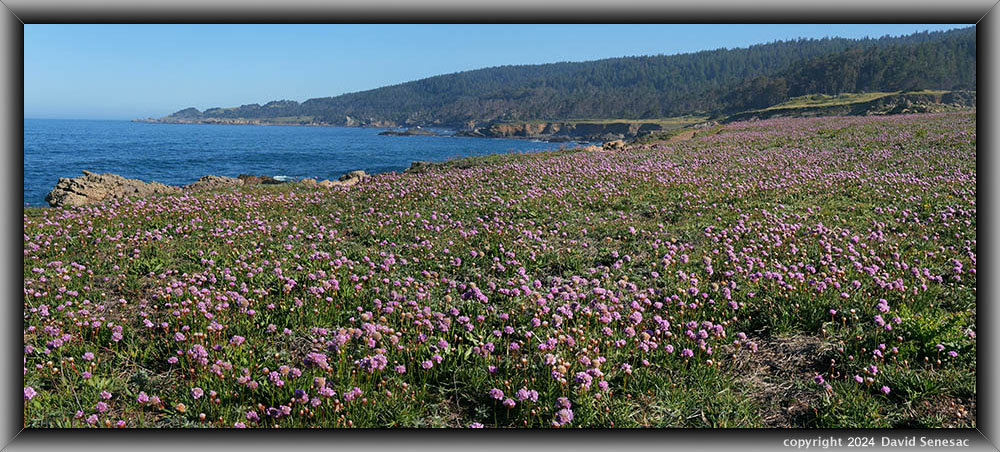
UN09220-09255-2x1h 9400x4000 pixels 2 frame 2 column 1 row 36 shot focus stack stitch blend a6700 0mm
enlarged vertical slice view
At 8:54am, a seascape bluff with an expanse of sea thrift, Armeria maritima, also called sea pink. One of the few species that does not close up at night and colonizes the windiest bluff edge areas.
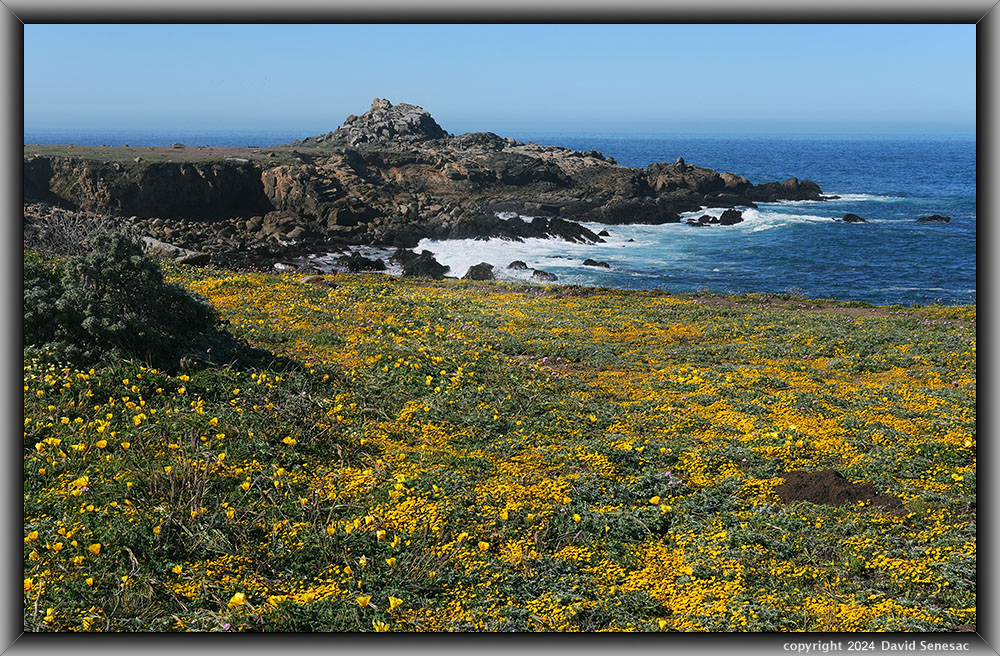
UN09298-30 6100x3900 pixels 1 frame 33 shot focus stack blend a6700 30mm
enlarged vertical slice view
At 9:21am, another bluff terrace seascape with freshly blooming California goldfields, Lasthenia californica, sea thrift, California poppy now more open, cream cups, and a yellow bush lupine at the frame's left edge. The green areas between goldfields are prostrate Lupinis varicolor plants, very few of which bloomed this spring. That rich brown soil patch framing the lower right is from a gopher. Note the heavy, water-vapor-laden marine air off in the distance.
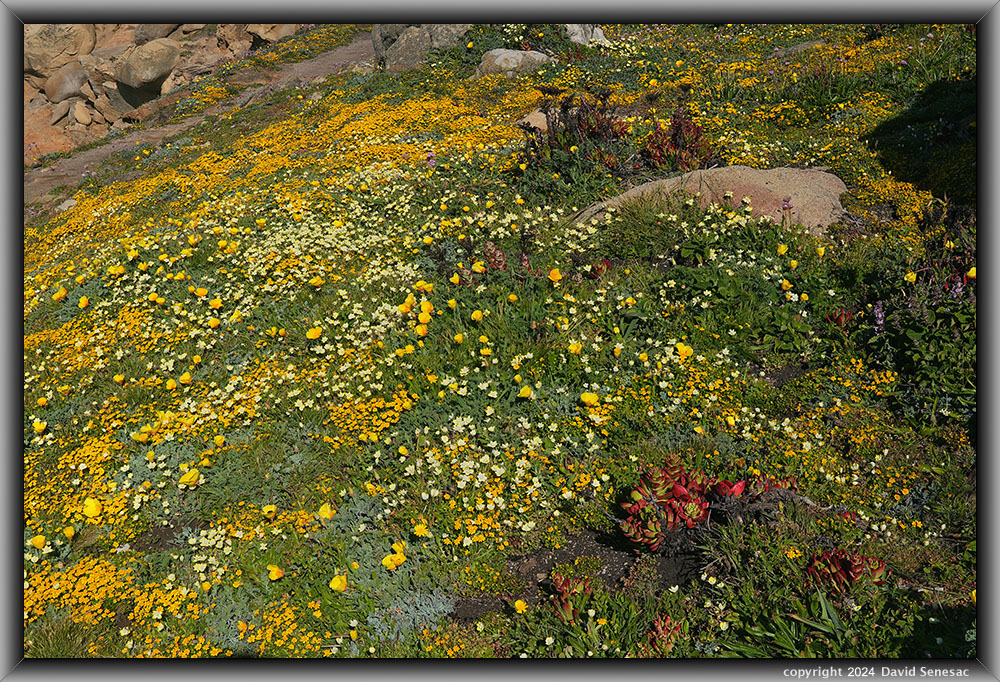
UN09315-30 6150x4100 pixels 1 frame 16 shot focus stack blend a6700 30mm
enlarged vertical slice view
Looking down a slope at California goldfields, sea thrift, California poppy, cream cups, sea lettuce, and a yellow bush lupine, with the use trail along the bluff edge framing the upper left. So indeed, a most delightful location to hike during narrow bloom windows of spring.
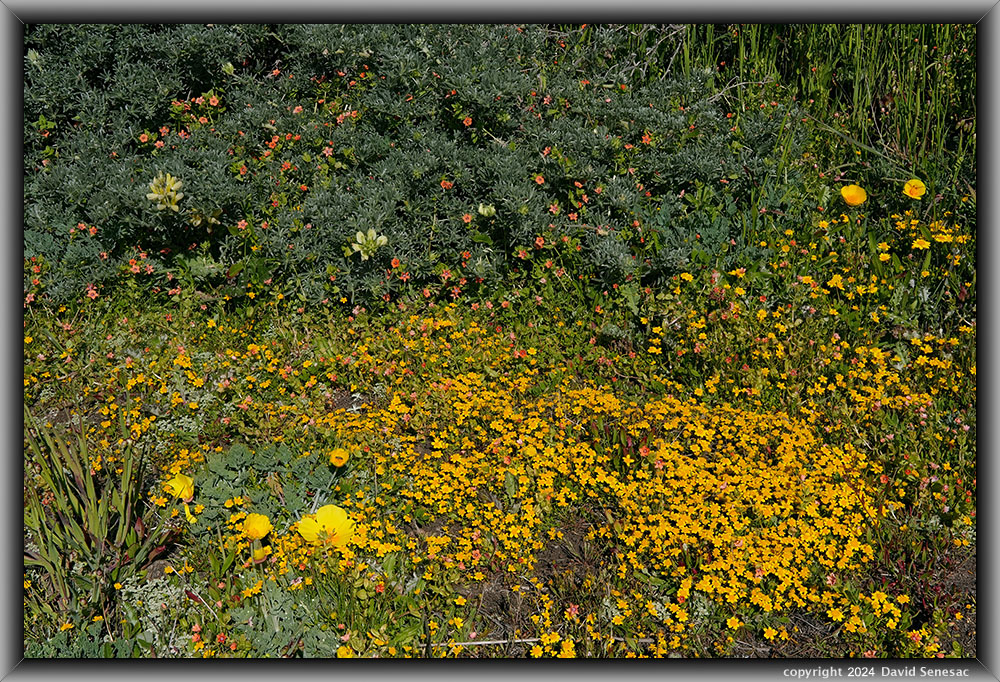
UN09467-96 6150x4100 pixels 1 frame 30 shot focus stack blend a6700 30mm
enlarged vertical slice view
Intimate subject with much fine detail, a bit inland with bluff California goldfields, scarlet pimpernel, California poppy, in front of a yellow bush lupine. Early mornings, one will often see little cottontail rabbits about these coastal bluff gardens.
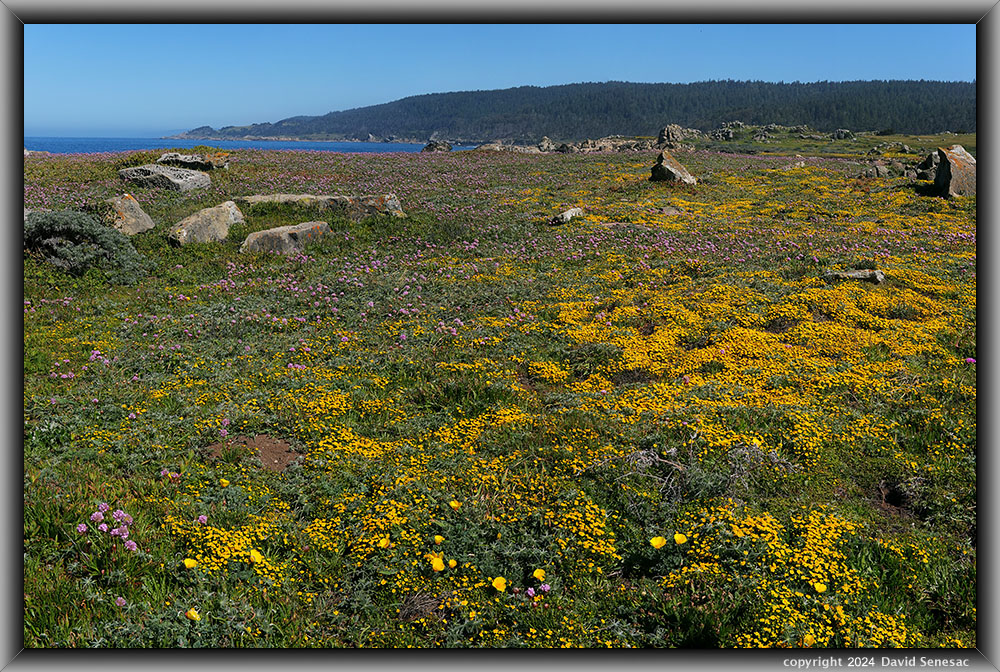
UN09715-09763-3x1v 9300x6100 pixels 1 frame 49 shot focus stack stitch blend a6700 30mm
enlarged vertical slice view
At 10:24am PDT, with an optimal sun altitude for best light and flowers now fully open, a 3-column, 1-row seascape panorama stitch blend expanse of California goldfields, sea thrift, California poppy, tafoni sandstone with lichen.
At page top a seascape with bluff, California goldfields, sea thrift, California poppy, sandstone. Sea lettuce, Dudleya caespitosa, aka sand lettuce, or coast dudleya, is a spectacular native succulent growing along our sea shores. Though flowers bloom during summer, the dramatic red leaves are most impressive. Here up against a sandstone boulder with colorful lichen that thrives in the cool, moist marine air. Note the fisherman in a red kayak who would only gamble on venturing out in such a minimal craft near these dangerous rocky shores during uncommon calm conditions with small wave swells.
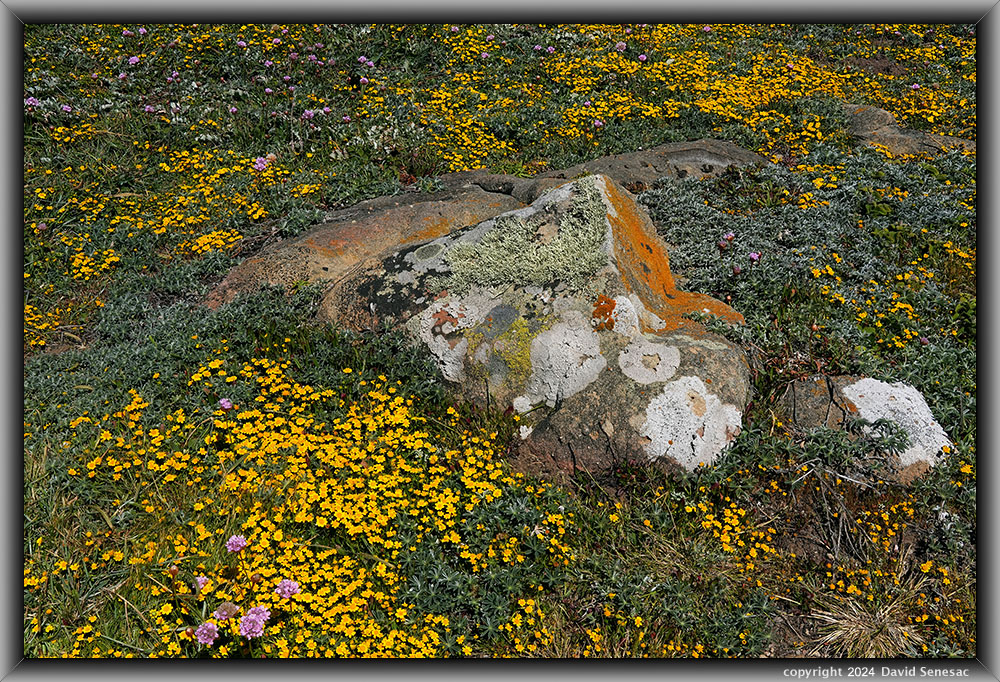
UN09792-09 6150x4100 pixels 1 frame 18 shot focus stack blend a6700 30mm
enlarged vertical slice view
California goldfields and sea thrift surround a sandstone boulder embedded in bluff soils with colorful lichen. What wondrous, beautiful places our rare, DNA life, organic planet Earth offers for those that seek its wonders!
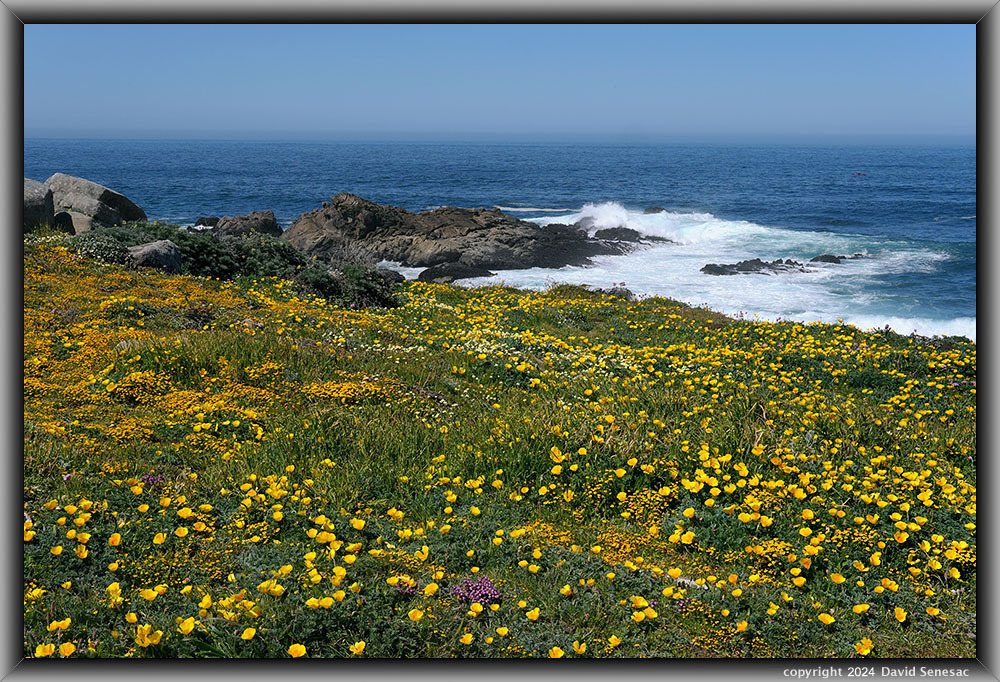
UN09810-19 6150x4100 pixels 1 frame 10 shot focus stack blend a6700 30mm
enlarged vertical slice view
Seascape with freshly blooming California goldfields, California poppy, sea thrift, California poppy, cream cups, rose johnny-tuck, Triphysaria eriantha rosea, yellow bush lupine, and scarlet pimpernel. Note at frame right, another fisherman in a red kayak.
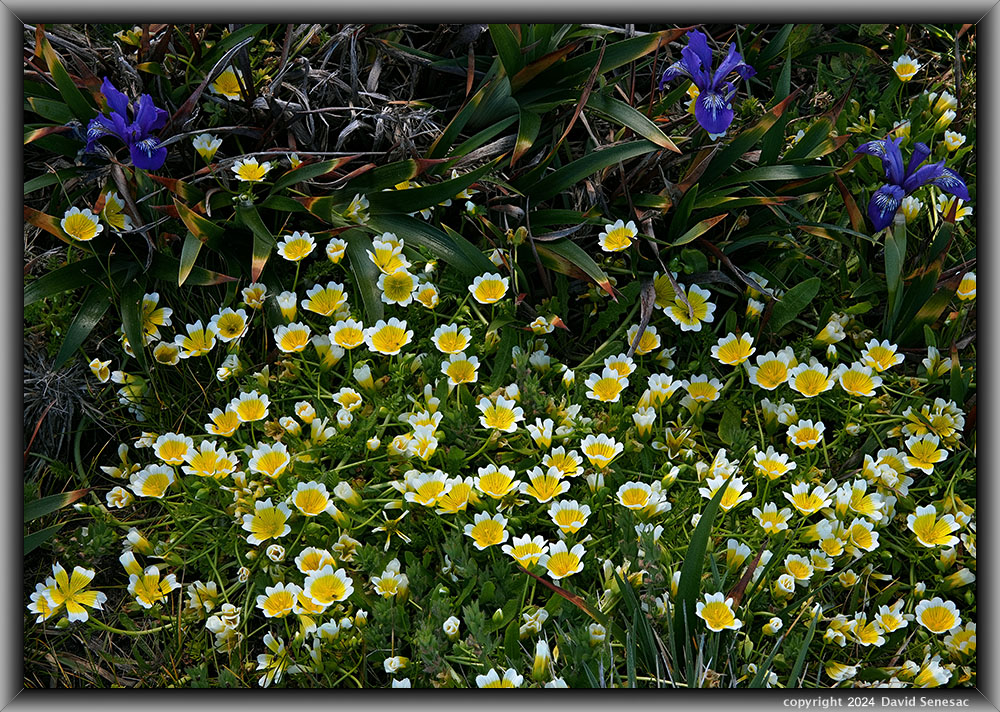
UN09824-42 5300x3700 pixels 1 frame 19 shot focus stack blend a6700 30mm
enlarged vertical slice view
Close-up of coastal tidy tips, Layia platyglossa, and 3 Douglas iris, Iris douglasiana. The large, showy iris densely colonizes in patches at wetter bluff areas.
Note: this road trip continues on Page 6.
NEXT: Page 6 Salt Point State Park 5/10 2of2
2024 Trip Chronicles: Contents




















