
SE00556-00590-2x1v 6200x6000 pixels 2 frame 2 column 1 row 35 image focus stack stitch blend A6000 30mm
enlarged vertical slice view image text section
NEXT: Page 12 North Crane Creek
2018 Trip Chronicles: Contents
Walker River basin 10/10
Walker River basin 10/11
Walker River basin 10/12
Walker River basin 10/13
SR120 Yosemite 10/26
It took 6 days to complete image processing and HTML coding after the North Fork of Bishop Creek road trip to put Page 10 of my 2018 Trip Chronicles up on my site. And most of those days I put in at least 10 hours in front of my computer. Image processing using focus stack blending and stitch blending is considerably more complex and tedious than processing single files in Photoshop. And that is on top of it being more complex out in the field, taking a set of shots for a subject intended to form a composite single image. I only work with JPGs. Thus, I do not use Lightroom or RAW, which those who take single-frame images may use, so that reduces processing overhead. Note: using RAW has little value if one is stitch blending shots that end up much larger than any benefit from increased detail using RAW. Additionally, Photoshop software blends together jpg's with fewer artifacts if shots were all taken with the same camera settings.
Focus stack blending post-processing takes much more effort when an image has element movement between shots. With fall leaf work, even the slightest breezes may cause out-of-registration leaf and branch movement between focus stacked shots. The closer such elements are to a camera, or the greater the zoom factor, the more likely that can be an issue. If trees are far enough away, element movement may not be discernible. The Zerene Stacker program I use allows choosing which shots in a set to select specific sections of by using circular brushes of variable size. Thus, if, say, a single leaf is always moving somewhat in the full image of a tree or vegetation with leaves, one can move through individual shots in a focus stack single-frame set until finding one with the leaf both in focus and not blurred by movement. When that software finds, say, 3 shots all with the particular leaf in reasonable focus but out of registration due to movement within a set of, say, 12 shots, all 3 frames are superimposed in the initial automatically generated composite output that must be worked on to select just those pixels from a single shot.

Beyond just a few such moving elements in an image, the amount of tedious processing work at 100% magnification quickly becomes too much to bother with. At the great detail level of a 24-megapixel camera like the A6000 that has a 6000 by 4000 pixel sensor, even the slightest out-of-registration element may cause misregistration on edges that have a characteristic ugly, very noticeable look. Additionally, there is a list of other issues to possibly deal with beyond misregistration. For example, at large apertures, depth of field is short. If a near element is in front of a significantly more distant element, parallax halo artifacts may occur. Moving clouds in a sky, waves/current on a body of water, animals moving, and leaves floating on a stream are examples of other elements that may move between shots. If downsized for web use, such may not be noticeable. However, at full detail, 100% magnification, such may be quite noticeable on a high-end monitor and will also be on any large print.
When a subject has just a minor amount of movement, say the same tree subject with a few fluttering leaves, I may instead process it with Photoshop, which is better at choosing single shots from a set while warping element movement slightly to come into registration. However, as a less sophisticated process, it also tends to generate artifacts and does so increasingly with more out-of-registration elements that have to be processed out with the Clone Stamp Tool. After focus stack sets have been processed into individual frames, I use Autopano Kolor Pro to stitch blend, and combine the frames into a composite image. All this can be performed hand-holding a camera if just creating small images, but for higher detail images, a stable tripod and head is necessary.
One can again just use Photoshop. However, that often results in artifacts that are impossible to work around. For example, a smooth level ridgeline of a mountain scene might end up with a non-existent abrupt jagged cliff-like section where the software had warped sections between frames so much that it could not combine them correctly. Sometimes the software will simply duplicate nearby sections to fill the space, all of which is very noticeable. One tree on a ridgeline can become two. Worse, there are certain types of colors and textures it tends to choose out-of-focus shots, resulting in mush. Almost all focus stacking information online as of 2018 is for macro work and not landscape images. Also, stitch blending is more oriented towards small web-sized images where artifacts are likely to be so small as to be unnoticeable. If images with depth-of-field requirements, as is the case with many landscape subjects having a foreground, midground, and background, are simply stitch blended using single small apertures, results will be significantly softer due to diffraction degradation versus using a best lens aperture.
During the week before I left, weather forecasts were showing two minor inside slider storms the following Wednesday through Thursday moving down from the Northwest into Nevada that would provide a glancing blow to the Eastern Sierra with clouds and even a dusting of snow above 9000 feet. With a chance for diffuse cloud lighting in aspen grove understories and interesting weather, I decided to return during that period and work areas to the north in Mono County. I had also developed a plantar fasciitis condition on my right foot for the first time that had slowly developed over months of the summer due to all my brutal backpacking carrying extra weight. To help alleviate that while walking, I fashioned up a neoprene insole with a hole cutout where the swollen big ligament attaches to the heel bone.
Thus, mid-morning Wednesday morning, October 10, 2018, I headed east on freeways, crossing the Sierra Nevada on SR108 over Sonora Pass. And indeed skies east of the crest were dominated by clouds, though no showers had developed. Along the way, I took a look at Leavitt Creek gorge and confirmed most creek dogwood were no longer in color, though some shrubs west of the pass were still at peak red. A crop with red dogwood leaves and stems from one image on my return home is above right. Continuing south on US395, I observed that usual aspen groves, including those at Conway Summit at 8.1k, were still surprisingly green without leaf color changes, while areas just a few hundred feet higher were peaking. Continuing south, I went as far as June Lake Loop, where conditions were either still rather green or the color was not as vibrant. The latter was likely due to the unusual 2018 summer weather with a wet May and July between a dry June and August, plus generally above-normal temperatures. I turned around and drove back north to overnight out in a favorite remote dispersed camping spot east of Mono Craters. By late afternoon, snow showers were dusting some crest areas, and winds had increased.
All the hiking had aggravated my right foot plantar fasciitis, making it a bit more sore but not so much that a few days of hiking would set me back much in its slow healing period. I tended to walk on my forefoot without putting strong pressure on the heel, and while moving through terrain, I would make stronger down steps with my good left foot.

SE00512-00555-2x1v 6100x6000 pixels 2 frame 2 column 1 row 44 image focus stack stitch blend A6000 30mm
enlarged vertical slice view
By dawn Thursday, October 11, 2018, clouds only remained in half the sky, with the temperature a chilly 26F degrees and a light breeze. With most lower grove areas surprisingly still green after 12 days, I needed to focus on a bit higher areas than I had expected. Thus, I drove north to Virginia Creek areas within the Walker River Basin and worked the above image at a familiar grove with orange- to red-leaved trees in cold, still air before breezes began to jostle leaves. Nicely, patches of mostly blue sky were above my position while clouds still blocked the sun, still low in altitude to the east.
Wandering through a tangle of clone aspen with reasonably mixed diffuse cloud and sky light, then shot the image at page top with 3 dancing aspen trunks within a canopy of candy cane leaves. The image required some tricky post-processing using a mask to blend in a couple of frames, replacing the otherwise unusable focus stack result, as some dry grasses in the foreground kept moving from a sumping flow near the ground. I quite enjoy the monkeying gymnastic effort of carefully, slowly wandering through such dense tangles of quaking aspen, Populus tremulides, while looking for subjects as long as below is not talus or piles of fallen logs. The translucent yellow, orange, and red leaves filter light, providing delightful warm light with glowing vibrant leaf views against the sky. In order to be able to bushwhack through such, I always wear Levi 505 jeans with their robust denim and a cheap thin nylon shell on top, protecting whatever clothing underneath. This morning, with sub-freezing temperatures, that included several inner layers.
A breeze increasingly developed as I drove north on other back roads of the Walker River basin. By noon, skies had darkened, breezes were impossible for shooting, and showers were moving in over Sierra Crest peaks. I did quite a bit of frustrated stopping and hiking about, looking for subjects to return to. By mid-afternoon, I finally found the goods in one of the drainages, so I set up a dispersed camping spot near a stream, spending the rest of the afternoon exploring that zone. By late afternoon, with temperatures in the low 40Fs, bouts of showers, including a couple with hail, kept me car-bound as I had decided to sleep in the Forester without tenting. During the evening, weather decreased as the circulation moved east of Nevada, with skies clearing by the wee hours, causing temperatures to plummet due to radiation cooling.
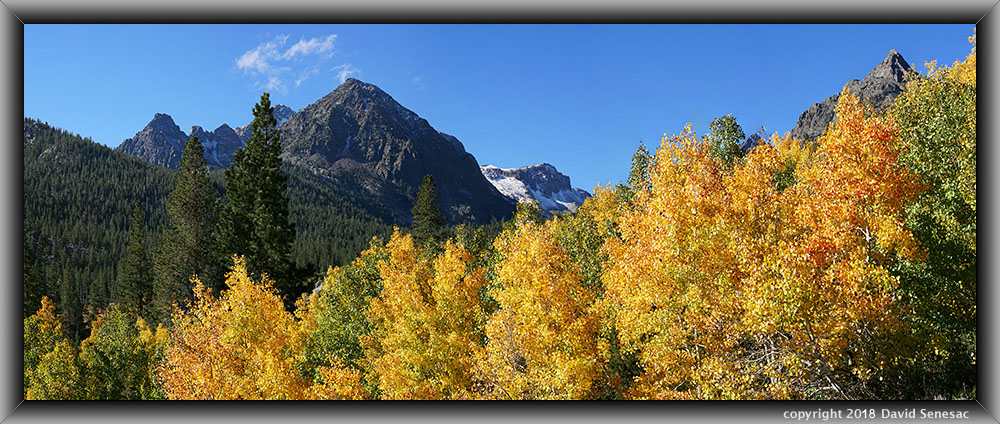
SE00669-00730-5x1v 15200x6000 pixels 5 frame 5 column 1 row 62 image focus stack stitch blend A6000 60mm
enlarged vertical slice view
During the night I had looked at topographic maps of the area and come up with a plan. These were areas I had worked a couple of decades earlier with a large format film view camera and backpacked into several times, so I had a modest knowledge of aspen groves in the area. However, I still needed to do a modest amount of exploring. At dawn Friday, October 12, 2018, I was out of the Subaru wearing lots of warm clothing as the temperature showed 26F degrees while switching around gear. Thus, I drove off to get closer to my area of hiking interest, and as the sun put warm light on crest peaks about 7am, I headed out up a trail on what would be a few-mile morning round-trip effort with considerable awkward off-trail landscapes to travel through. The above vibrant 5-column stitch blend image is the second landscape I worked on during the morning before breezes made further work difficult. Thus, once again I spent most of my morning hiking about, looking for subjects I hoped to return to the following morning. I did locate more excellent landscape subjects than I could hope to capture during the trip, so I would just need decent weather conditions.

SE00842-53 4000x5700 pixels 1 frame 12 image focus stack blend A6000 SEL55-210 @144mm
enlarged vertical slice view
Back at my car with temperatures even late morning in mid 30F's, set up next to the car, an old sleeping bag atop a pad and blue plastic ground sheet, then got some lunch cooking with a pile of adjacent magazines and gear. Thus, I whiled away 3 leisurely hours midday. By mid-afternoon I'd had enough of that, so I set out again to explore some other areas less than a couple of miles distance. Breezes were still too strong to consider serious photography, so I amused myself quite a while just enjoying scenery, often while listening to classic rock music on my tiny SanDisk Sansa MP3 player and earbuds. I did work the above single-frame telephoto subject of leaf colors in the distance, as the moving leaves were too distant to be a factor in element movement. Note: besides aspen, the red areas are creek dogwood and some of the yellow areas are yellow willow. A bit later, I attempted to approach the rock outcrop in that image, but had turned back midway due to unpleasant piles of fallen aspen logs.

With an eye out for small subjects while walking in the shady forest understory, I noticed the above little woody shrub skeleton against the ground that I thought might provide some coloring fun later in Photoshop post-processing. What I'll call The Wood Nymph. After tediously selecting the otherwise white-hued wood with the Lasso Tool, I did a low-opacity gradient fill of pink to purple. The actual manipulated image is 5200 by 3600 pixels.
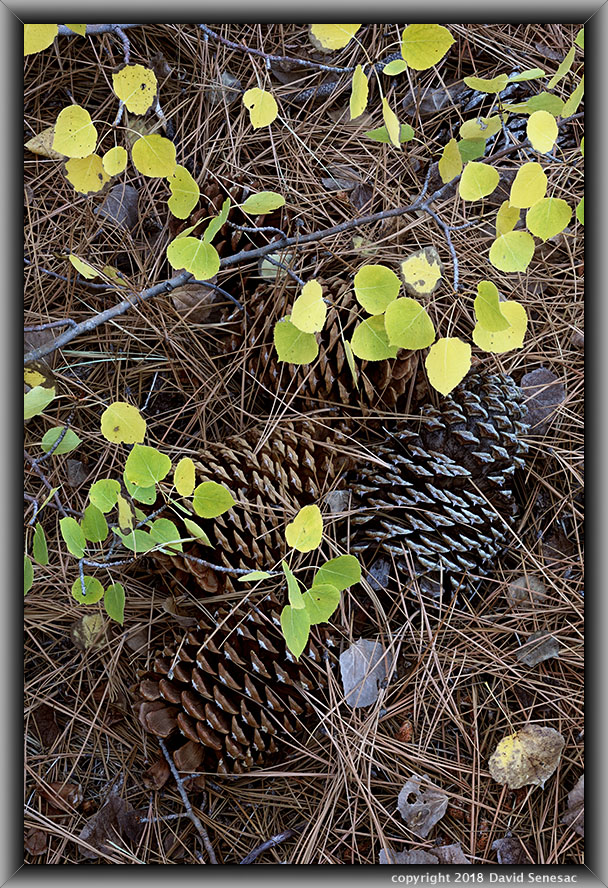
SE00901-14 4000x6000 pixels 1 frame 14 image focus stack blend A6000 60mm
enlarged vertical slice view
Jeffrey pine, Pinus jeffreyi, grow about many aspen groves and below those trees are often thick mats of their long needles as well as their large pine cones. I kept my eye open below such trees for a situation with aspen leaves, so I worked the above modest close-up subject with my Sigma 60mm DN lens I prefer for close-up work. Look at the enlarged vertical slice view to appreciate the fine detail.
By late afternoon I was back at the car, then drove off and parked at a different location to once again disperse camp inside the Forester. Given the tall Sierra Crest blocking peaks to the west, such fall leaf photography trip days tend to end early, well before sunset. Once the sun drops behind a ridgeline, cold fall temperatures keep this person, who rarely makes campfires, inside a warm sleeping bag reading and dealing with gear. Although the 3 first days of the road trip were marginally productive, I hoped Saturday would make the long drive and effort worthwhile, as there were certainly good subjects to work given usable conditions. During the evening, another reason to be glad I was inside my vehicle was the sound of a growling cat less than a couple hundred yards distant that kept at it for about a minute and then repeated such several minutes later as though it might be facing down another cat or critter. Absolutely certain it was a feline species due to its distinctive sound. Suspect it was a bobcat, though it may have been a mountain lion. Bobcats, being smaller and feisty, are more likely to face down other creatures like raccoons or coyotes, while a lion would just scare them.

SE00918-01108-4x3vb 12300x11300 pixels 12 frame 4 column 3 row 191 image focus stack stitch blend A6000 60mm
enlarged vertical slice view
By dawn Saturday October 13, 2018, outside temperatures at my near 8k location had dropped to 21F. Skies were sunny and the air dead still. For fresh air, I will leave Forester windows down about an inch from the top. However, breathing all night did cause a coating of ice on the inside window surfaces, so I needed to run my defrosting heater for several minutes before driving off. I drove to a new roadside location to start this morning's hike and by 8:30am had reached the location of the above landscape, then had to wait about an hour to allow the shadows at frame left midground to recede. That was a dangerous call, as I expected the usual up-canyon breeze to eventually start. But that did allow time to carefully select what would be a single large image to work on using my 60mm lens. The above image is 12300 by 11300 pixels; however, the full image variation is 14000 pixels high, as I cropped off foreground pixels for aesthetic reasons that were mostly brighter sagebrush and small granite boulders and soil. Poking up at the lower left are a few branches of a juniper that is otherwise cropped off.
Beyond the sagebrush are a few Jeffrey pine and Sierra juniper trees. The large orange aspen grove is a clone grove where all trees are the same plant that shares a labyrinth of roots over a wide zone that sprout individual short-lived trunks. Typically in these glacially scoured granite canyons, bedrock lies just a few feet at most below the surface, with tree roots reaching down to that level where water sourced from high above on canyon walls flows underground against capping bedrock. That is why such quaking aspen groves at higher Sierra Nevada canyon elevations tend to colonize right at the U-shaped base of such slopes. That is also where one finds talus that has broken loose from steeper slopes above, then tumbled down to where such slopes level off. Beyond the orange-hued aspen grove is another yellow clone grove.
Notice the strip of talus between the two groves that shows more at frame left, beyond which is a dry blond-hued grassy meadow. Beyond that are individual taller aspen trees mixed with what are mainly lodgepole pine trees against granite domes, and beyond that, dense mixed-species forests dominated by lodgepole pine. Although there was a dusting of snow Wednesday night on the big peaks, most of the snow that shows on north-facing slopes was from a somewhat larger early-season storm a week before. At frame edge left beyond the orange trees is a moraine slope with larger talus colonized with Jeffrey pines and sagebrush.

SE01141-01174-2x1v 6000x5800 pixels 2 frame 2 column 1 row 34 image focus stack stitch blend A6000 30mm
enlarged vertical slice view
With breezes beginning, I put on the wider 30mm lens for this smaller above 2-column image, closer to the base of the aspen grove, with its rather messy foreground.
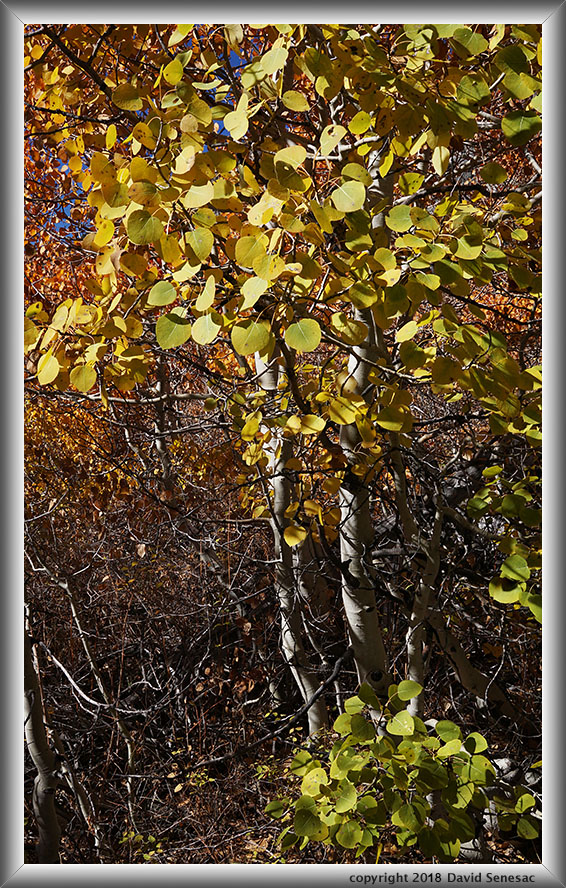
SE01177-81 3700x6000 pixels 1 frame 5 image focus stack blend A6000 30mm
enlarged vertical slice view
Up canyon breezes quickly became unworkable, so I decided to monkey right through tangles in the orange clone grove where I shot the above modest close-up that was somewhat more breeze-protected.

SE01306-16 4000x6000 pixels 1 frame 8 image focus stack blend A6000 30mm
enlarged vertical slice view
On the way back to my car at 12:15pm, I worked on the above single-frame image near a stream where a lush seep ends in a marshy meadow with tall blond grasses and a few yellow willows. Above the willow are dense, mostly leafless, thin aspen trunks that went through leaf color change earlier, as small-diameter aspen trees along streamside areas like this tend to shut down water flows earlier than large, older trees with roots down to wetter depths, due to especially cold night sumping flows down such watercourses.
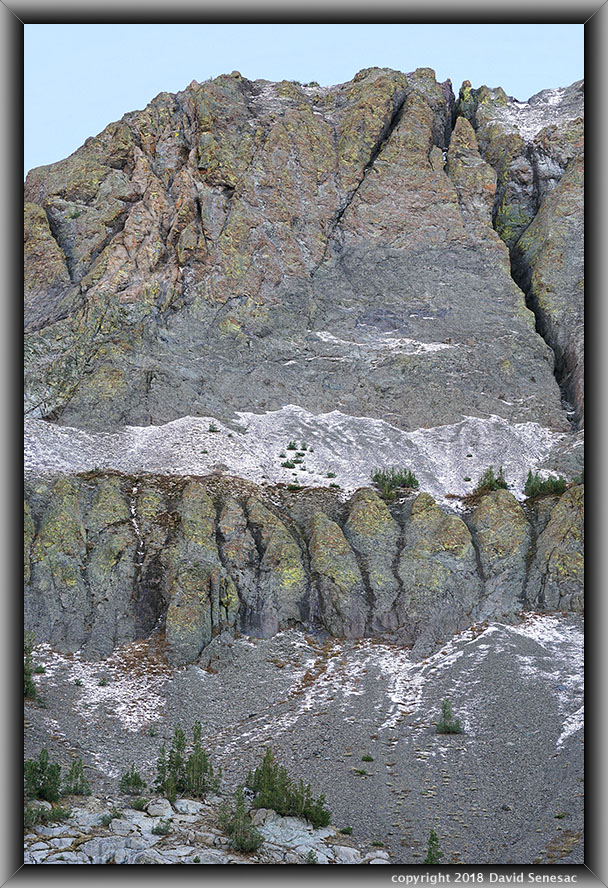
SE01534-44 4000x6000 pixels 1 frame 11 image focus stack blend A6000 60mm
enlarged vertical slice view
Back at my vehicle, I continued north on US395 and then west on SR108 while stopping a few times. On the west side of Sonora Pass near the mouth of Deadman Canyon, I stopped at 5:30pm for the above image taken in the sunlight of the volcanic Mehrten Formation slope with colorful lichens and residual snow.

SE01569-79 6000x4000 pixels 1 frame 11 image focus stack blend A6000 60mm
enlarged vertical slice view
For my final modest image of the road trip taken at 6pm Saturday, I caught the last warm light as the sun was dipping below the ridgeline on creek dogwood, aka red osier dogwood, Cornus occidentalis, and below whitethorn, Ceanothus cordulatus. The creek dogwood has wonderful shiny red stems, and in fall its leaves also turn a rich red. The species tends to grow along rocky, all-summer streams and seeps where I try to find it, color-complementing aspen and willows. The cyan-hued whitethorn is a thorny Ceanothus species, especially common at mid-forest elevations of western Sierra Nevada slopes where it presents an unpleasant, dense ground cover up to head height that I always try to avoid. I do like the red and cyan combination, but this subject, due to somewhat direct sunlight, is more contrasty than optimal. So in the future, I am going to make a point of finding a better subject for a close-up when I also have better diffuse lighting conditions.
By the end of the trip, my plantar fasciitis pain in my right foot was worse. However, after 3 days, sitting in front of my computer was about the same as it was the day the road trip started, which was what I hoped to get by with. My right knee has also had a loose cartilage problem over the last few years that has intermittently swollen up and did so during this same trip. I have been hoping it gradually dissolves versus having to have expensive arthroscopic knee surgery. I have been doing these fall leaf trips for many years and already have considerable numbers of strong images, especially with large format 4x5 film, so it is rather difficult to improve with strong enough material that is better than what I have already captured. Overall, the trip was less productive than my earlier Bishop Creek trip and IMO my least productive eastern Sierra fall trip ever. In any case, I much enjoy simply being out in the field experiencing these inspiring natural places with brilliant fall leaf color. Photography, even when not particularly successful, serves as a valuable vehicle in which to visually experience these places at deeper levels as one seeks the most beautiful.
Twelve days later, I was on the road again east on SR120, where I spent the night dispersed camping, sleeping in my Forester. Weather forecasts showed a one-day window of light breezes with sunny skies. On the morning of Friday, October 26, 2018, I was checking on roadside areas of SR120 in Yosemite. Early morning was not productive. However, by 10:30am PDT, the sun's altitude was high enough to shine down over the trees beside Siesta Lake, which was the main objective of this short road trip.
The small shallow lake at 7955 feet is the first lake visitors driving east on State Route 120 will see in the national park. And many first-time drivers indeed stop at the paved pullout with its plaque describing this natural feature. Most of summer, its green world is a pleasant though unremarkable sight. There are many such shallow mid-forest ponds in the Sierra Nevada with water grasses growing along edges and floating leaves of lily plants on their surfaces. However, most are nameless, not given much interest when compared with our beautiful alpine timberline waters that often have backgrounds of impressive peaks. In early summer, June, one will see many white flowers of Labrador tea shrubs that grow along many of its marshy shore edges. Many who walk about its well-pounded shore use trail will take a few photos, and even Ansel Adams has a well-known black-and-white image of the lake. But my interest was for a different reason than one may understand by searching for the lake on Google or Yahoo, then opening their Image tabs. There, one will see a few images with bright red and yellow shore vegetation.

SF01580-01603-2x1v 6800x6000 pixels 2 frame 2 column 1 row 24 image focus stack stitch blend A6000 60mm
enlarged vertical slice view
By mid-fall, the green water grasses turn a fine mix of yellow and bog blueberry, Vaccinium uliginosum, and shrubs turn a bright red. The blueberry is common along shores and small streams and is widespread across our northern hemisphere. By early September, one might also eat its small sweet blueberries. In the past, I'd drive by in the fall after working eastern Sierra aspen groves, but the waters would always be wavy due to breezes. But this day, the considerably improved weather forecasts of this technological era proved accurate, so I was able to work 3 subjects, with the first above, a modest view across the lake from the highway side showing the red and yellow stripes of vegetation on its opposite shoreline. Trees at the shoreline edge are lodgepole pines, while a few other species like red and white firs stick up beyond.

SF01604-21 6000x4000 pixels 1 frame 18 image focus stack blend A6000 60mm
enlarged vertical slice view
Next I rambled along the tortured use path to get close to the most colorful shore. It is difficult to get close to the edge due to the marshy edge, and water grasses tend to grow out from the edge, blocking open water for a reflection. However, there was a flatish boulder just breaking the surface close enough that I could reach with a jump. Otherwise, one might wade into the lake. However, having done so at other such ponds, one can expect to sink deeply into mud, and keeping so still as to not cause little waves is nearly impossible. A key reason to work the subject late morning is that the sun was above left, over trees of the far shore from this position, providing backlighting to the translucent vegetation leaves, resulting in much more vibrant color. Mixed in with the top of the blueberry band are darker green leaves of Labrador tea. In the shallow, rich waters are large numbers of invertebrates and microorganisms that, during early summer, include mosquitoes, a good reason to wait till fall to enjoy this intimate environment.

SF01622-38 4000x6000 pixels 1 frame 17 image focus stack blend A6000 30mm
enlarged vertical slice view
I then worked on this third image above, emphasizing the water grasses, where a lone blueberry bush provided a nice red foreground.

SF01671-85 5800x4000 pixels 1 frame 15 image focus stack blend A6000 30mm
enlarged vertical slice view
During midday hours, my camera remained in the bag while I explored some granite dome landscapes. By 2:30pm the low-altitude sun at this time of fall was dipping behind tall trees over many road areas, so I drove to the South Fork of the Tuolumne River crossing at 6800 feet, where there is a bridge with a popular paved highway pullout and, during earlier summer, cascades over steep granite bedrock. By fall, the river is just a small trickling flow through bedrock and large boulders in the river channel. If one bothers to climb down below the bridge, one will find numbers of fine intimate fall leaf subjects, especially red-hued creek dogwood aka red osier dogwood, Cornus sericea, mixed with yellow-hued willow. I waited till sun shine through the dense pine forest was muted, leaving blue skylight illumination to work the above subject against darkly lichen-covered bedrock granite, providing a good background for the colorful leaves. There are 30 species of willow in our state, and identifying an exact Salix species is best left to experts.

SF01718-01757-4x1v 11500x5900 pixels 4 frame 4 column 1 row 40 image focus stack stitch blend A6000 60mm
enlarged vertical slice view
With breezes very light and intermittent, I gambled on using my 60mm lens for a similar subject: a large, 4-column panoramic image that was successful above. Note the long, dried brown Jeffrey pine needles that easily become trapped in vegetation branches. Besides lichen, dark moss also grew on these granite faces.

SF01763-76 6000x4000 pixels 1 frame 14 image focus stack blend A6000 60mm
enlarged vertical slice view
Next, I climbed down the riverbed some to a large patch of creek dogwood, where at 4pm I shot the above close-up of leaves above a river-bleached log. After their leaves change to a deep red, they slowly lose the red, transitioning through orange to yellow before dropping.
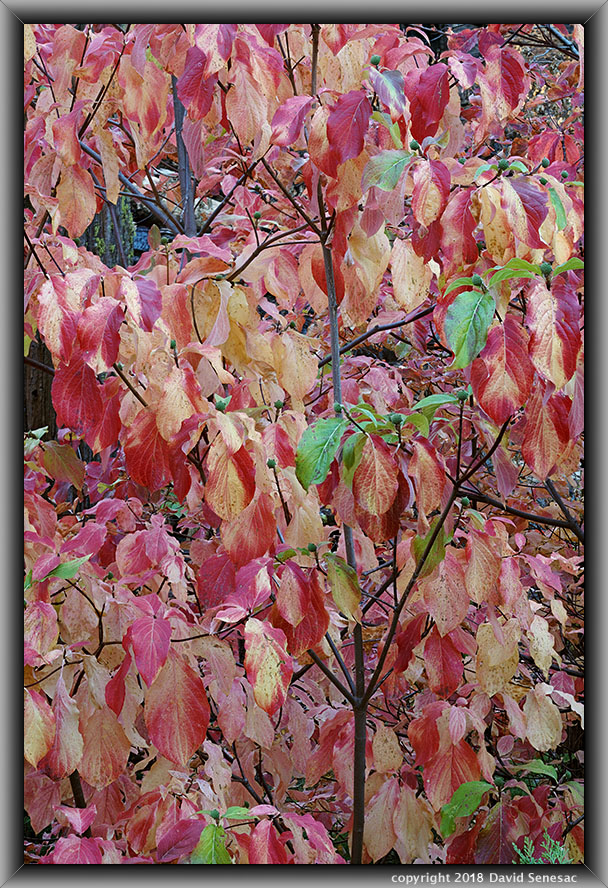
SF01800-13 4000x6000 pixels 1 frame 14 image focus stack blend A6000 60mm
enlarged vertical slice view
Although there was much more for me to explore in the stream bed both above and below the highway, I will leave doing so for my following road trip. Instead, I drove further west to the Hazel Green Creek drainage at 5500 feet, where at 5:15pm worked the above Pacific dogwood, Cornus nuttallii, right from the highway roadside. Fall leaf color of this dogwood species, with larger leaves than C. sericea, has a wide range of intense color, often more purplish, that glow like Christmas tree ornaments in shadowed understories. Although the best illumination is with diffuse midday thin cloud lighting, such weather is infrequently offered, and instead the wise strategy is to be in these forests at early and late hours for blue sky lighting on days when breezes are minimal. Otherwise, mixed sunlight is rather impossibly contrasty. On the enlarged vertical slice view, one will see the dogwood fruit of small green berries. This mottled leaf subject interestingly had a few still very green leaves where berries grew.
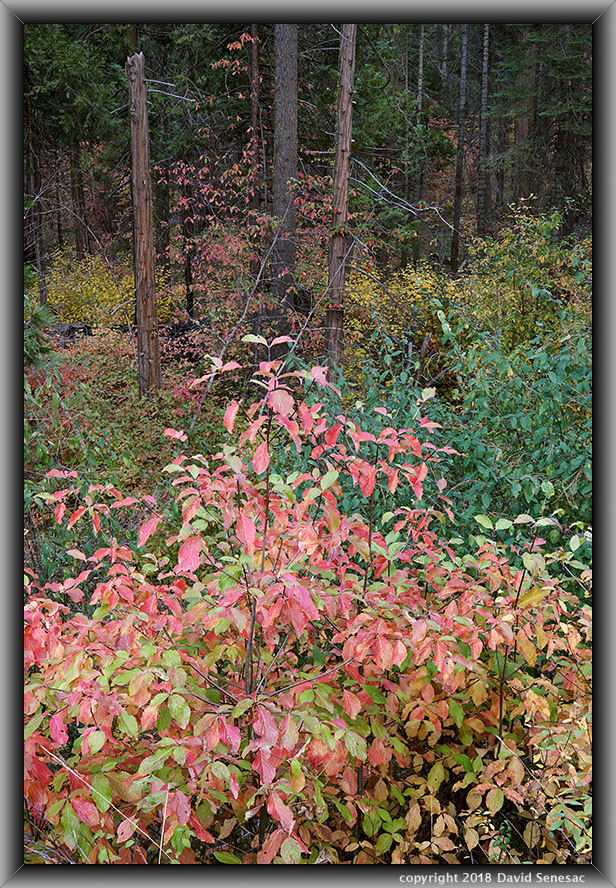
SF01848-65 4000x5900 pixels 1 frame 18 image focus stack blend A6000 30mm
enlarged vertical slice view
My last subject at 5:45pm was the above modest image showing the wide range of colorful leaves that make wandering through Pacific dogwood forests such a wonder. I tried working a couple of other subjects, but the slight breeze resulted in impossible to post-process movement. Instead, I expect to return in a few days in early November given a calm enough day.
NEXT: Page 12 North Crane Creek
2018 Trip Chronicles: Contents


