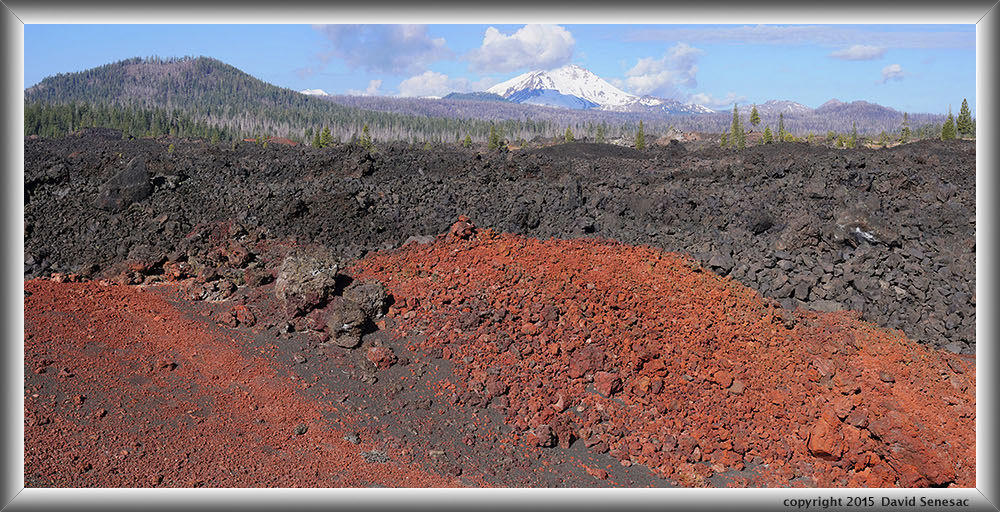
OG03412-03440-3x2h 13200x6450 pixels 6 frame 3 column 2 row 29 image focus stack stitch blend A6000 60mm
enlarged vertical slice view
NEXT: Page 8 Redwood NP ; Northern Coast
2015 Trip Chronicles: Contents
Lassen Volcanic National Park 5/23
Lassen Volcanic National Park 5/24
Trinity River 5/25
Over winter I had done considerable planning for a May 2015 2-week road trip to Utah plateau country. A trip that had also been in the works the previous 3 years, but in each case drier-than-normal conditions aborted the notion. A friend I was to meet up with, and I had last worked that region in 2005. Then this winter, with normal early winter storms, it appeared more likely until the January and March dry periods. Accordingly, by late April I dropped plans for that trip and, with the rest of California suffering from record drought conditions, instead settled on yet another trip up to our Northern California redwood coast parks. However, this time I would first spend the first 3 days, which were the Memorial Day holiday weekend, at Lassen Volcanic National Park, which I had not been to in decades, and it would be just 9 days, Saturday through Sunday. Despite an otherwise record droughty winter across California, May became cooler and wetter than average. Thunderstorms were forecast in mountain areas over the holiday weekend and cloudy, foggy weather along the coast during the following week.
Friday late afternoon, May 22 ended my work week. I drove off north, and after 6 hours of driving, reached state route 89 south of the Lassen area late evening as rains were still falling. Continuing a bit north on SR89 through dense, tall conifer forests above 6k feet, turned west on a gravel road I'd surveyed on the topo and Google Earth. I then took a short spur road off where I could overnight inside my 2007 Forester in peace, where no one else would happen by. An excellent on-the-road example of the value of owning a vehicle one can readily set up for sleeping in overnight instead of hassling with setting up a tent outside during dark, wet, rainy conditions. With the right rear seat in the Forester folded down flat, my short 66-inch frame easily fits in the rear bed.
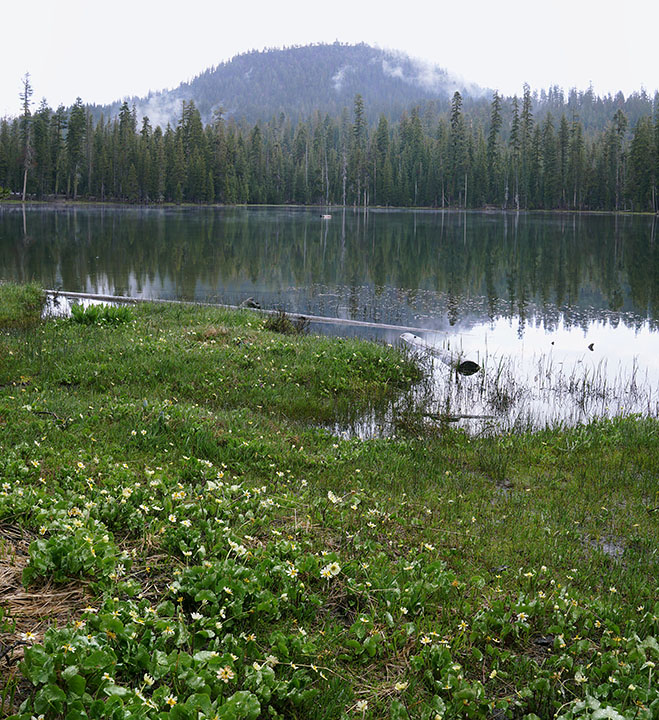
As dawn on Saturday, May 23, 2015 rose, light rain was still falling, which led to an expectation of probably having to adjust my elaborate photography hiking plans. I would not see any other vehicles for over an hour as I entered the park northward on SR89. The skies were 100% dim clouds, and the landscape was wet without the usual snow patches. Some slopes showed arrowhead balsamroot plants with only about 5% in bloom, while many mule ears were just short ears. It looked like a return in about 4 weeks would show more wildflowers. I stopped briefly at the noisy, foul-smelling Sulfur Works and then continued up to higher elevations closer to the peak, which by 7k were mostly snow-covered and by 8k, about Helen Lake, depths were over 3 feet deep everywhere roadside. Rounding the peak high point, I continued down to lower areas and stopped at Summit Lake in the image above, where I grabbed my camera gear for the first shots of the trip. Light sprinkles were falling, so I waited out for brief lulls in order to take a few modest images with my Sigma 30mm F2.8 DN. Although I brought my 4x5 view camera film gear along on the trip, all my work below was with the 24-megapixel Sony A6000 APS-C body. The lakeshore had areas of marsh marigolds. I also noticed a few shooting stars, California buttercup, dog violet, and California violet. I was hoping for better light, so I lingered an hour before leaving.
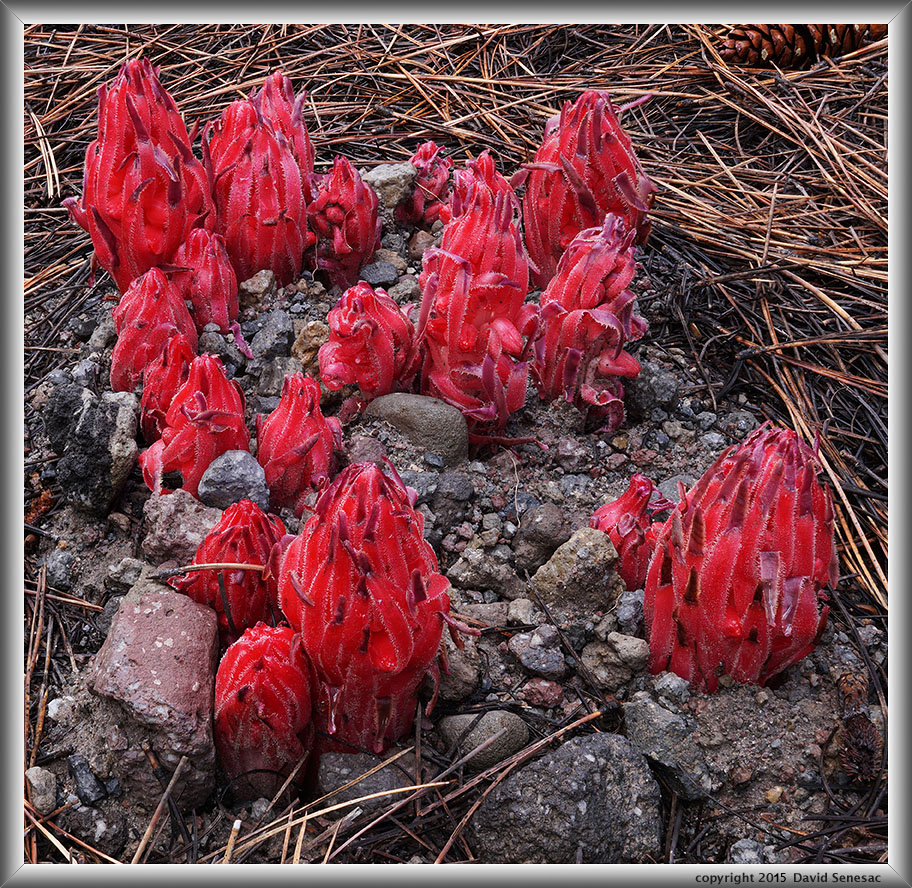
OG02494-2b 3600x3500 pixels 1 frame 9 image focus stack blend A6000 30mm
enlarged vertical slice view
Three more of my planned hikes were just down the road. Clouds obscured Lassen Peak, so I scratched two of the ideas and instead just hiked up on the shoulder of Ragged Peak that wasn't productive. Then continued driving north a short ways to where emerging snow plant, Sarcodes sanguinea, were amazingly abundant in the Jeffrey pine forest. In fact, one area had more of these striking red plants than any place I'd ever seen, and I've seen a lot of them over decades. So spent the next couple of hours rambling about roadsides and taking close-up images, including the image above.
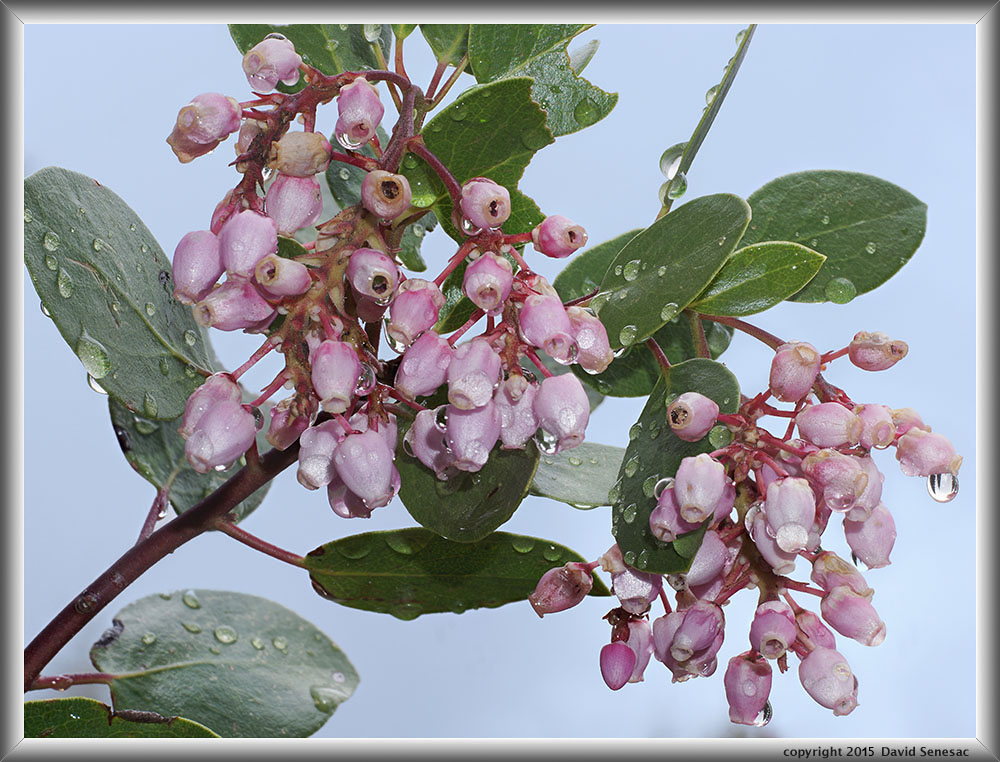
OG02547-2 5000x3750 pixels 1 frame 6 image focus stack blend A6000 60mm
enlarged vertical slice view
By late morning, showers had stopped, and sun began to poke through holes in clouds. Further north, blooming manzanita along the road offered an opportunity to put still wet flowers up against the sky. Note the dark inverted reflection of two fir trees in the water drop at frame right. Also notice how the concave shape of water drops magnifies the areas they lie on. This is more readily noticeable by selecting the enlarged vertical slice view.
By noon I reached the most popular area of the park at Manzanita Lake where the parking lot had filled with early holiday visitors. I went into the visitor center for a walk-through, picking up some handouts and a new Wilderness Press park topo that replaced my ragged 1984 version. I decided to move along into my afternoon plans, so I drove out of the park and, for the next few hours, drove and explored some roads. Later in the afternoon, I made a 4-mile hike out to one of my planned areas, though the mostly cloudy skies rather limited photography. The landscapes were as good as expected, so I would be spending the next couple of days there with more hope for shootable weather during mornings before forecast cumulus clouds built up. At day's end, I was outside the park in Lassen National Forest, dispersed camping along a remote dirt road.
As the morning rose on Sunday May 24, 2015, I was already out on a trail. In some areas of the park are multi-hued volcanic cinders and shards of mudflow strata. Thus, over my 3 days at the park, I took several close-up images. For the images below, I used my Sigma 60mm F2.8 DN in sunlight, which tends to bring out better rock color versus diffuse light conditions because light penetrates deeper into the translucent colored surface boundary of rock before reflecting back out. Additionally, throughout my time at Lassen, soils and rocks were still damp from rains, which tends to darken color saturation because light is not as scattered by microscopic surface features that otherwise reflect out as washed-out white light, so more light passes into a rock surface and then reflects out with colors within a rock. The fragments below sort of look like some dry dog foods.
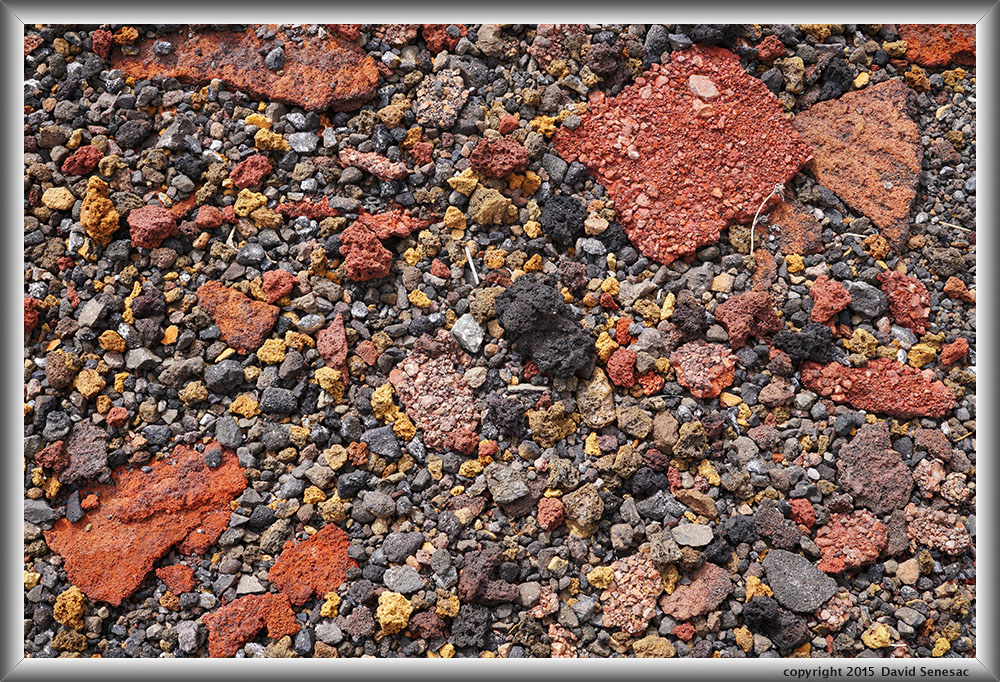
OG02612-8 6000x4000 pixels 1 frame 7 image focus stack blend A6000 30mm
enlarged vertical slice view
Of particular interest were colorful lapilli cinders with various shades of reds, oranges, greys, blacks, yellows, and pinks. Lapilli form from explosively airborne ejected volcanic vents and fissures. After deposition, water and heat may enhance chemical bonding, gluing surface layers into thin, level plates. In some areas, lapilli were all of similar color while others were mixed. Individual plates will have a similar color across their surface. Notice how the darker rock plates below, resting atop consistently rose-red lapilli, have a rustier surface layer where water has leached out iron oxides.
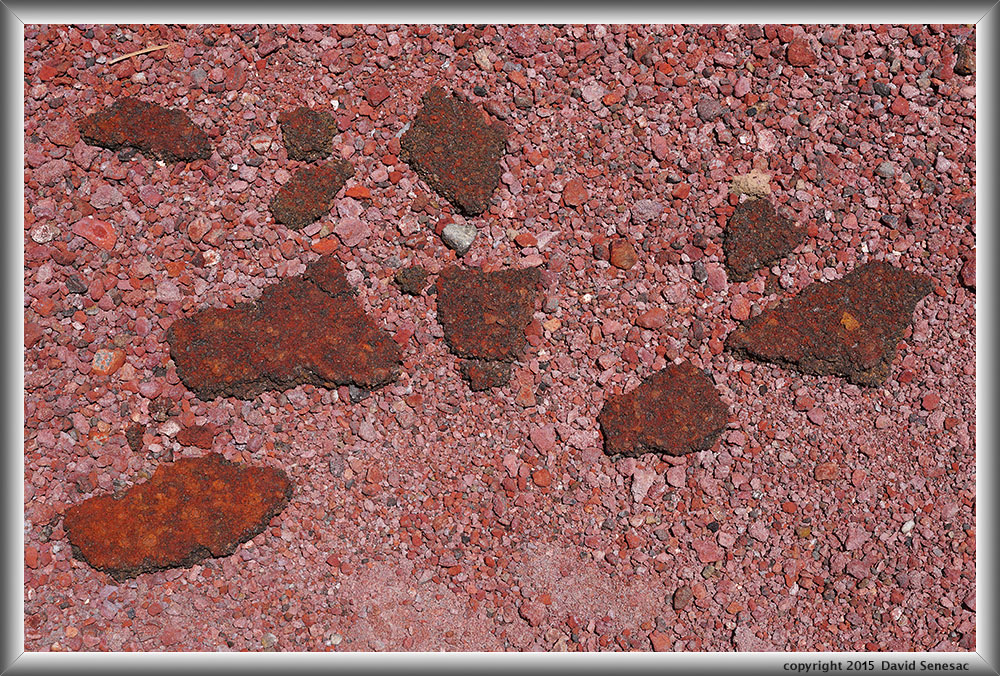
OG03113-9 5900x3900 pixels 1 frame 7 image focus stack blend A6000 60mm
enlarged vertical slice view
Another of the early season wildflowers that were blooming in areas of black lapilli cinders were pussy paws, Calyptridium umbellatum, that contrasted strongly against the black rock, increasing the aesthetic. Areas of dark black lava rock dominated Lassen landscapes. Not zones to roam sunny middays during mid-summer when such rock would absorb and then radiate out infrared heat. Sigma 60mm F2.8 DN with extension tube and my 32-inch diameter Impact diffuser. Unlike rock, most plants photograph better in diffuse light.
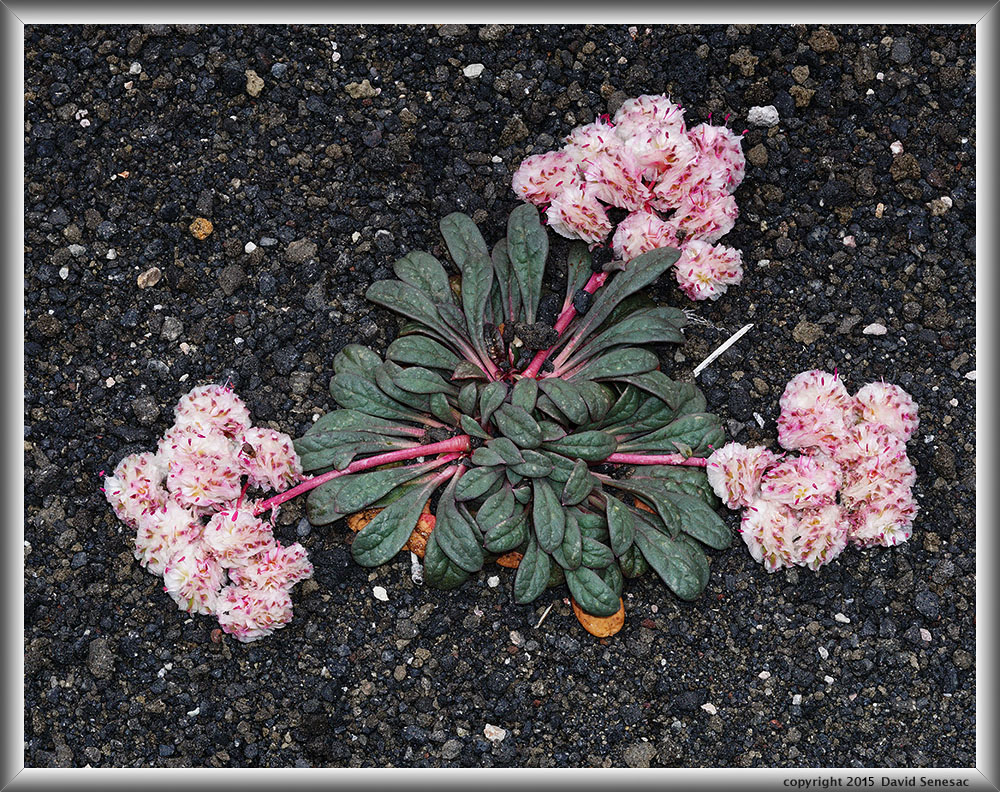
OG02701-7 4600x3600 pixels 1 frame 7 image focus stack blend A6000 60mm extension tube
enlarged vertical slice view
And yes, I did frame a few colorful landscapes, one of which is at the top showing a lava flow foreground with Lassen Peak in the background, a 3x2 panel stitch from 29 shots. It's a worthwhile image to view the enlarged vertical slice view link that brings out the fascinating structure and detail of the lava field. Other subjects I shot with stronger aesthetics I've chosen not to make public at this time, lest other photographers take notice and disturb pristine areas near Lassen Peak I'll first work in the future. I was glad to see that much of the park has apparently seen few tripods beyond roadsides and trailsides, which is reflected in just a few strong images on Google Images or Yahoo Images. One reason is that terrain like the lava fields is a rather dangerous place to climb about on due to sharp, irregularly shaped volcanic glass boulders with all manner of glass sharp surfaces, little affected by millennia of weathering.
On Memorial Day Monday, May 25, 2015, after a productive morning, a powerful thunderstorm chased me off exposed landscapes and out of the Lassen region. At noon, along SR44, I took a little side dirt road along a small stream where dispersed camping would be nice and enjoyed a submerging, refreshing dip and a chance to reorganize gear. I continued west down SR44 into Redding, where temperatures were near 100F degrees, and then west along the Trinity River on SR299, where I paid a lot of attention to roadside flora, which is a habit of mine while driving about unfamiliar areas.
Near sunset, my eyes noticed an interesting magenta color, so I did a U-turn back to a pullout and wandered along the road busy with holiday traffic to find the uncommon clarkia species red ribbons, Clarkia concinna, one of California's most beautiful wildflower species. These flowers have a considerable 3-dimensional shape, so I bothered to take more focus stack blending shots than normal. Also, some shots required manual focus lens adjustments of barely visible petal parts too small for spot autofocus deep within the labyrinth. Notice the red sepals of flowers yet in bud that, in opened flowers, curl backwards and have a light magenta inner surface with a dark stripe down the center. Looking at the enlarged vertical slice view link, notice how the sticky female stigma has a bluish purple hue atop a dark magenta-hued round tube termed style that disappears into a small hole where it eventually ends up at the unseen ovary, while the several male anthers are curled red-and-white striped elements atop purple-hued flat filaments. Behind the flowers are buds covered with red sepals.

OG03594-3 6000x4000 pixels 1 frame 10 image focus stack blend A6000 60mm
enlarged vertical slice view
Getting the shot for the group of flowers required an awkward tripod placement up on a vertical bank using my incredibly flexible Benbo Trekker while cars whizzed by at high speed a few feet away. With each chain of cars, the flowers would shake from the concussion of the wind, and then I would have a brief interlude before the next group of cars came to complete all my focus stack shots with fill flash. An intermittent breeze complicated matters, so I used my 32-inch-diameter collapsible Litedisc to help block that. Eventually that was successful. Then noticed another uncommon, amazing-looking species, the intensely red firecracker plant, Dichelostemma ida-maia. And yet again endured another lengthy effort using my 60mm lens with an extension tube and fill flash, along the highway during increasing dusk darkness. Notice how the green ends of bud sepals peel back when flowers open exposing a less green inner side with off-white flowers that then hang down with lengthened pedicels.

OG03605-7 3000x4500 pixels 1 frame 3 image focus stack blend A6000 60mm extension tube
enlarged vertical slice view
By mid-evening, I reached Arcata, filled up on gas, visited a supermarket to supply what would be a rather remote few following days, and enjoyed some fast food. Then drove north on the US101 freeway all the way to the small community of Orick near the mouth of Redwood Creek, where I pulled into a secret legal spot on public land to spend the night outside the park.
NEXT: Page 8 Redwood NP ; Northern Coast
2015 Trip Chronicles: Contents


